
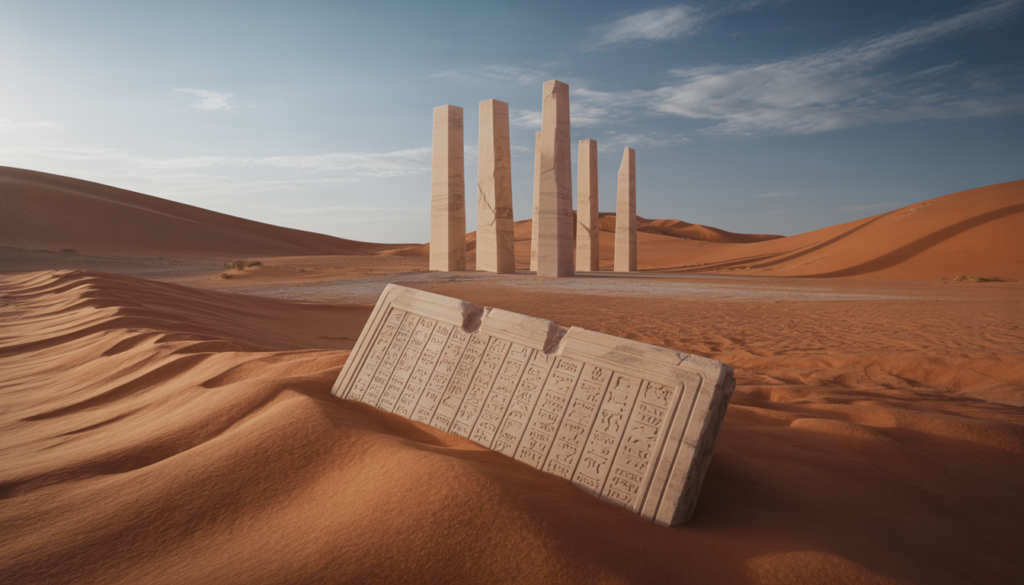
Ancient Civilizations in the Quran: 7 Profound Archeological Realities
At Truth Clearly, we are dedicated to investigating the intersection of historical archeology and scriptural revelation. This research paper examines the accounts of the lost civilizations of ‘Ad and Thamud, comparing 7th-century Quranic descriptions with 21st-century satellite imagery and excavation data.
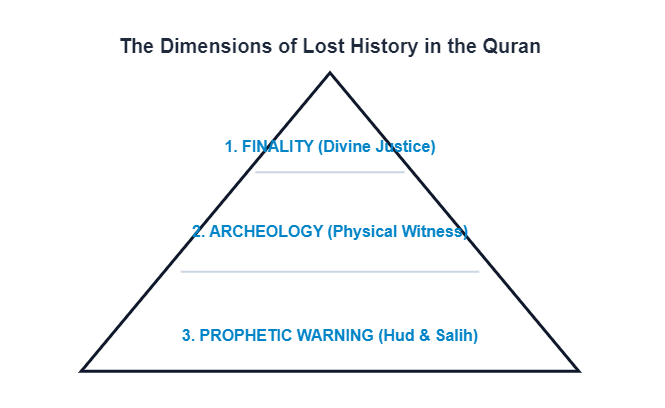
For centuries, the stories of ancient, powerful nations destroyed by natural cataclysms were viewed by skeptical Western readers as folklore or regional myths of the Arabian Peninsula. Figures such as the people of ‘Ad and their “City of Pillars,” or the people of Thamud and their rock-carved dwellings, remained hidden beneath the shifting sands of the Empty Quarter and the mountains of Al-Hijr. However, a rigorous logical and archaeological inquiry into Ancient Civilizations in the Quran has transformed these narratives into staggering historical realities. Through the use of modern technology, including radar-imaging satellites, science has begun to uncover what the Quran described with absolute precision fourteen centuries ago.
In the Islamic worldview, we recognize Allah as the unique Creator who is High above His Heavens and established over His Throne. He is the Sovereign Master of history who witnessed the arrogance of these ancient empires. Ancient Civilizations in the Quran are not presented as mere historical trivia, but as “Signs” (Ayat) of divine justice and the consequences of rejecting Objective Morality. This article explores seven profound archaeological realities that demonstrate how the Quranic account of these lost nations aligns perfectly with modern discoveries.
Table of Contents
1. The Mystery of Iram: The Logic of the “City of Pillars”
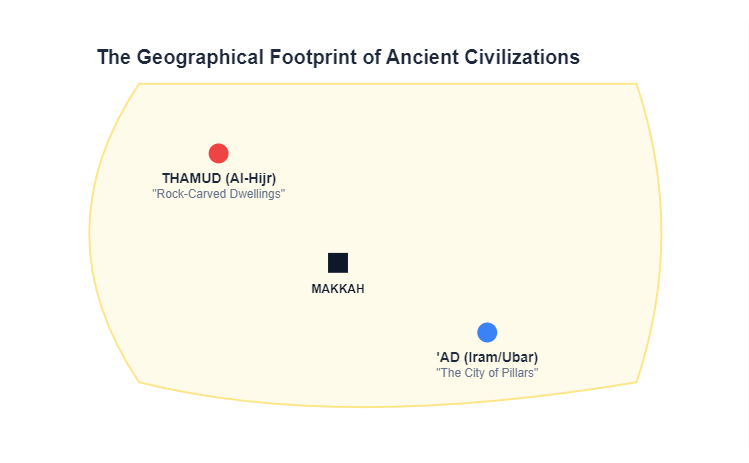
The primary logical pillar of Ancient Civilizations in the Quran is the identification of Iram. The Quran describes the people of ‘Ad and their capital: “Iram, [the city] of lofty pillars, the like of which was never created in any land” (Quran 89:7-8). For nearly 1,400 years, critics claimed that this “City of Pillars” was a myth, as no such city was mentioned in the historical records of Rome or Greece.
Logically, if the Quran were a human fabrication, it would be a massive risk to invent a city of such grandeur that left no trace. However, in 1992, using satellite data from NASA, researchers discovered the lost city of Ubar in the remote desert of Oman. Excavations revealed a fortress with distinct, massive octagonal pillars and walls. This “Atlantis of the Sands” perfectly matches the Quranic description of Iram. This discovery serves as a material credential for the Authenticity of the Quran, proving that the unlettered Prophet Muhammad provided geographical information that was physically buried under the sand for millennia.
2. The Logic of Architecture: Rock-Carved Dwellings of Thamud
Another profound reality in the study of Ancient Civilizations in the Quran involves the people of Thamud. The Quran describes them as a nation that achieved supreme engineering feats: “…and you carve out of the mountains, houses, with great skill” (Quran 26:149).
Logically, this description identifies a specific architectural tradition. Modern archaeology at Madain Saleh (Al-Hijr) in Saudi Arabia—the first UNESCO World Heritage site in the country—has verified the existence of hundreds of sophisticated rock-carved facades and homes. Unlike the later Nabataeans (who built Petra), the Quran accurately attributes the origins of this technology to the earlier civilization of Thamud. This descriptive precision regarding Sharia Law in Islam and social structure proves that the Quranic account is rooted in a Knowledge that transcends the human observation of late antiquity.
3. Meteorological Precision: The Logic of the Sandstorm
The destruction of the people of ‘Ad is described in the Quran as being caused by a “furious, roaring wind” that Allah unleashed for seven nights and eight days. Logically, this describes a specific meteorological event: a catastrophic, multi-day sandstorm.
Modern paleoclimatologists, as documented in Britannica’s review of Arabian geography, have found evidence that the region around Ubar underwent a drastic climate shift, where massive sandstorms and the depletion of underground aquifers led to the sudden collapse of the civilization. The Quranic description of the wind “uprooting men as if they were trunks of hollow palm trees” matches the physical impact of high-velocity desert winds. This alignment with the Scientific Miracles of the Quran suggests a source that understands the Origins of the Universe and the atmospheric mechanisms that govern it.
4. The Logic of the “Voice”: Sound Frequency and Destruction
A unique reality in the Ancient Civilizations in the Quran is the cause of death for the people of Thamud. While ‘Ad was destroyed by wind, Thamud was destroyed by a “Shaykhah” (a Saihah or a single blast/shout).
From a logical physical perspective, this can be understood as a high-intensity acoustic event or a sonic shockwave, perhaps triggered by an earthquake or a volcanic eruption. Modern research into “Infrasound” and its effects on human biology shows that specific sound frequencies can cause internal organ failure and immediate death. For a 7th-century text to distinguish between different “modes of destruction” for different nations—rather than a generic “fire and brimstone”—is a sign of a Creator who manages the Fine-Tuning of the Universe and knows the precise physical properties of sound.
5. Historical Continuity: The “Common Thread” of Revelation
The study of Ancient Civilizations in the Quran reveals a logical consistency in the prophetic message. Prophets like Hud (sent to ‘Ad) and Salih (sent to Thamud) called for the same Tawhid (Absolute Monotheism) that we see in the lives of Jesus in Islam and Muhammad.
Logically, if Islam were a new, disconnected religion, it would not place its roots in the deep history of the Arabian desert. By claiming these ancient nations as part of the Prophetic Sincerity narrative, Islam provides a unified theory of human history. The ruins of these civilizations serve as empirical evidence for the Logic of Free Will; these nations were given the power, the wealth, and the warning, but they chose a path that was logically and spiritually unsustainable.
6. The Logic of the “Signs”: Preserved Ruins as Guidance
The Quran makes a bold logical claim: Allah preserved the ruins of these civilizations as a sign for future generations. “And ‘Ad and Thamud… it has become clear to you from their [ruined] dwellings” (Quran 29:38).
Logically, for a sign to be effective, it must remain visible. Madain Saleh and the recently uncovered Ubar are literal, physical witnesses to this claim. In an age of digital skepticism, the fact that we can still touch the rock-carved homes of Thamud and see the pillars of ‘Ad via satellite is a modern credential for the Preservation of the Bible and Quran dialogue. It proves that the “Truth Clearly” is etched into the very stones of the earth. By aligning the Purpose of Life with the lessons of the past, Islam invites the Human Logic to see the patterns of divine intervention.
7. The Archaeological Correction of “Sabean” History
Finally, the study of Ancient Civilizations in the Quran provides a corrective to historical gaps. Many 19th-century historians assumed that pre-Islamic Arabia was a cultural void. The Quranic mention of these sophisticated empires challenged this view long before the discovery of the Sabean and Himyaritic inscriptions.
Logically, the Quran provides the “Missing Links” of Middle Eastern history. It explains the migration patterns and the shifts in power that led to the environment in which Muhammad as a Leader arose. By accurately identifying the social and economic habits of ‘Ad and Thamud—such as their obsession with building monuments in high places—the Quran proves its source is the One who is High above His Heavens and saw the pride of the ancient kings.
Conclusion: The Witness of the Sands
The scholarly investigation into Ancient Civilizations in the Quran leads to a profound rational verdict: the text possesses a degree of archaeological and geological accuracy that was impossible for a human author in the 7th century to achieve. From the pillars of Iram to the rock-houses of Al-Hijr, the Quran matches modern discovery with unshakeable precision.
For the skeptical mind, these realities are invitations to recognize the “Truth Clearly.” These lost civilizations were not destroyed by accident; they were the subjects of a divinely mandated “System Reset” when they abandoned the path of justice and worship. By recognizing the harmony between Bible and Quran preservation and the physical ruins of the desert, the seeker finds the Why Islam answer: a religion that preserves the history of the world to guide the destiny of the soul back to the worship of the One True God, the All-Wise, the Most High.