Quran and Modern Science: 7 Stunning Miracles for the Rational Mind
This research paper is part of Truth Clearly’s commitment to providing an authentic Islamic perspective on theology and history. We adhere to rigorous academic standards, relying exclusively on the Quran, authentic Prophetic traditions, and verified historical sources to provide clarity for the rational seeker.
In the contemporary era, the relationship between religion and science is often portrayed as an irreconcilable conflict. For the skeptical Western reader, the common narrative suggests that faith requires a suspension of the intellect, while science demands its full engagement. However, when we examine the profound relationship between the Quran and Modern Science, a different, more harmonious picture emerges. The Quran is not a science textbook; it is the literal and uncreated Speech of Allah (Kalamullah), who spoke it with Letter and Voice, revealed to the Prophet Muhammad.
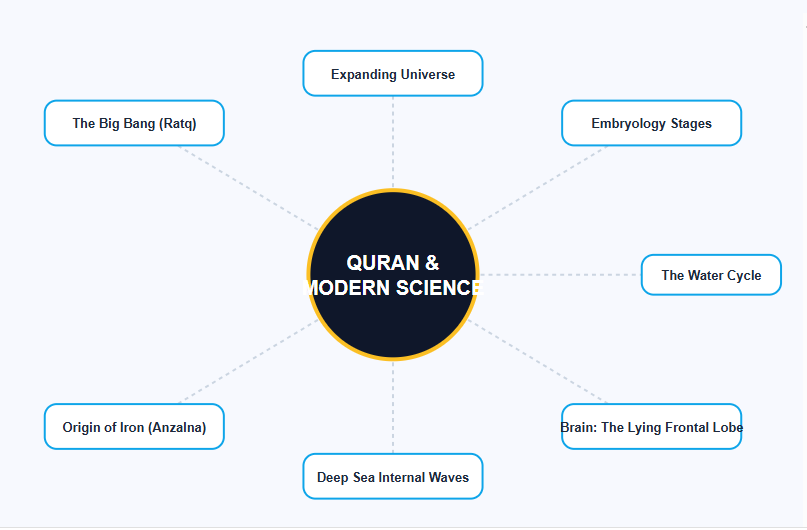
Allah, the Most High, who is established over His Throne and distinct from His creation, possesses absolute Knowledge (Ilm) and Wisdom (Hikmah). It is therefore logical that His Speech would contain descriptions of the physical world that are staggering in their precision. Unlike ancient myths, the Quran speaks of the universe in a way that aligns remarkably with 21st-century discoveries. This article invites you to a logical investigation into the Quran and Modern Science, exploring eight phenomena that suggest the text could only have originated from the Creator of the Heavens and the Earth.
Table of Contents
1. The Islamic Philosophy of Inquiry
To understand the connection between the Quran and Modern Science, one must recognize that Islam views the study of the natural world as a means to recognize the greatness of the Creator. The Quran repeatedly urges humanity to “reflect,” “observe,” and “think.” This is not an invitation to philosophical guesswork, but a call to witness the signs (Ayat) that Allah has placed in His creation.
In Islamic theology, the “Signs in the Horizons” and the “Signs within the Self” are consistent with the “Signs in the Revelation.” Because Allah is the Truth (Al-Haqq), His created work (the universe) can never contradict His spoken word (the Quran). This intellectual framework laid the foundation for the Islamic Golden Age, where Muslim scientists made revolutionary contributions to optics, mathematics, and medicine, driven by the Quranic mandate to seek knowledge.
2. Cosmology: The Origin of the Universe (Ratq and Fataq)
One of the most profound intersections of the Quran and Modern Science lies in the origins of the universe. Modern cosmology, specifically the Big Bang Theory, posits that the universe began as a single, highly dense point before a massive expansion.
The Quran described this “singular” origin 1,400 years ago:
“Have those who disbelieved not considered that the heavens and the earth were a joined entity (Ratq), and We separated them (Fataq)…?” (Quran 21:30).
The Arabic word Ratq refers to something sewn together or a unified mass, while Fataq refers to the process of breaking apart or separating. Furthermore, modern science describes the early universe as being in a state of hot, opaque gas. The Quran uses a strikingly accurate word for this:
“Then He directed Himself to the heaven while it was smoke (Dukhan)…” (Quran 41:11).
To a skeptical mind, the word “smoke” (Dukhan) is more scientifically precise than “gas,” as it implies a hot, opaque, and dense substance—exactly the state of the universe in its early formative stages according to current astrophysics.
3. The Expanding Universe: Beyond Hubble’s Law
Until the early 20th century, the scientific consensus was that the universe was static and eternal. It wasn’t until 1929 that Edwin Hubble provided the observational evidence that galaxies are moving away from us, a discovery documented by NASA’s Hubble Site regarding the expanding universe.
However, the Quran and Modern Science converged on this point centuries earlier. The Quran states:
“And the heaven We constructed with strength, and indeed, We are [its] expander.” (Quran 51:47).
The Arabic term Musi’un is a present participle indicating a continuous and ongoing action of expansion. This aligns perfectly with modern astrophysics, which confirms that the universe is not only expanding but is doing so at an accelerating rate. This verse remains a primary pillar in the study of the Authenticity of the Quran.
4. Embryology: The Precision of Human Development
The field of embryology provides perhaps the most detailed evidence for the Quran and Modern Science dialogue. The Quran describes the development of the human embryo in stages that were invisible to the naked eye, centuries before the invention of the microscope.
The Quranic stages include:
- Nutfah: The drop of fluid.
- Alaqah: A leech-like substance that clings.
- Mudghah: A chewed-like substance.
Dr. Keith Moore, a world-renowned anatomist, noted that the term Alaqah is a perfect description of the early embryo (around 7-24 days), as it physically resembles a leech and “clings” to the uterine wall for nourishment. He stated that this level of detail, mentioned in the Quran and Modern Science, could not have been known through human means in the 7th century. This aligns with human development studies that verify these distinct morphological changes.
5. Mountains as Pegs: The Concept of Isostasy
In the field of geophysics, the theory of isostasy explains how mountains are not just surface features but have deep “roots” embedded in the earth’s crust. These roots act as stabilizers for the lithosphere.
The Quran states:
“Have We not made the earth a resting place? And the mountains as pegs (Awtad)?” (Quran 78:6-7).
The use of the word Awtad (pegs) is a precise scientific description. Just as a peg holds a tent and has most of its length buried underground, mountains provide stability to the earth’s crust through their deep roots. This knowledge, essential to the Quran and Modern Science, was only understood after the development of plate tectonics and modern geology.
6. The Extra-Terrestrial Origin of Iron
A fascinating geological fact mentioned in the Quran is the origin of iron. Modern science confirms that iron was not formed on Earth but was “sent down” from space via supernovae explosions that occurred billions of years ago. Earth’s core did not have the energy required to produce iron atoms.
The Quran uses a very specific verb when referring to iron:
“…And We sent down (Anzalna) iron, in which is great military might and benefits for the people…” (Quran 57:25).
The verb Anzalna in Arabic means “to send down” from above. While ancient people might have thought iron was just another rock from the earth, the Quran and Modern Science both confirm that iron is an element that literally fell from the stars. This reflects the perfect Knowledge of Allah, the Creator of the Heavens and the Earth.

7. The Deep Sea: Internal Waves and Darkness
Until the development of modern oceanography and submarines, humans knew very little about the environment of the deep ocean. The Quran, however, describes the deep sea with remarkable accuracy:
“Or [it is] like darknesses within a deep sea which is covered by waves, upon which are waves, over which are clouds…” (Quran 24:40).
This verse mentions “waves upon waves,” referring to “internal waves.” Oceanographers have discovered that waves do not only occur on the surface but also exist deep within the ocean at the interface of different densities. Furthermore, the description of “darkness upon darkness” aligns with the fact that light is absorbed by the ocean in stages, eventually leading to total darkness at great depths. A desert-dwelling man in the 7th century could not have known about internal waves or the light spectrum of the deep sea, making this a cornerstone of the Quran and Modern Science.
8. Neuroscience: The Frontal Lobe and Moral Choices
In a verse describing a rebellious and lying individual, the Quran says:
“No! If he does not desist, We will surely drag him by the naseyah (forehead)—A lying, sinful naseyah.” (Quran 96:15-16).
Why does the Quran attribute “lying” and “sinning” to the forehead (Naseyah) rather than the person as a whole? Modern neuroscience has discovered that the prefrontal cortex—the part of the brain located directly behind the forehead—is responsible for executive functions, decision-making, and the act of lying. Research using functional MRI (fMRI) shows that when a person lies, the prefrontal cortex becomes highly active. The Quran and Modern Science thus agree on the biological center of moral decision-making.
Conclusion: The Sign of the Creator
The evidence found in the Quran and Modern Science suggests that the text contains a depth of knowledge that transcends its historical context. These verses were not meant to be a science manual, but a series of “signs” (Ayat) intended to prompt the human mind to recognize the Wisdom and Power of Allah, the Most High, who is established over His Throne.
For the skeptical reader, the harmony between 1,400-year-old scripture and 21st-century science is a powerful invitation to reflection. Whether it is the Sincerity of Prophet Muhammad or the Prophecies of Muhammad in the Bible, Islam presents a unified worldview where faith and reason are two sides of the same coin. By exploring the Quran and Modern Science, we move away from the myth of conflict and toward a future where the pursuit of scientific truth is seen as a way to observe the magnificent design of the Creator.