The Linguistic Miracle of the Quran: 7 Profound Realities of Divine Eloquence
At Truth Clearly, we are committed to investigating the foundational credentials of the Islamic revelation through the lens of logic and historical evidence. This research paper examines the linguistic structure of the Quran, comparing its unique literary genre with the highest standards of Semitic eloquence. Our analysis is rooted in the authentic Islamic perspective, which recognizes the Quran as the literal and uncreated Speech of Allah, provided to humanity as an eternal sign of divine truth.
In the history of world literature, most masterpieces are recognized for their creative genius, emotional depth, or social impact. However, the Quran presents a claim that is entirely unique: it asserts that its very linguistic structure is a miracle that cannot be replicated by any human or collective effort. For the skeptical Western reader, the linguist, or the student of history, the Linguistic Miracle of the Quran (known as I’jaz) presents a staggering intellectual challenge. How could a text revealed over 23 years, in various contexts of war and peace, maintain a level of eloquence and structural perfection that silenced the masters of Arabic poetry?
In the Sunni Athari worldview, we recognize that the Quran is the literal Speech of Allah, which He spoke in a way that suits His Majesty, consisting of actual letters and voice. Allah, the Most High, who is established over His Throne and is distinct from His creation, chose to reveal His final message in a language that reached its peak of sophistication in 7th-century Arabia. The Linguistic Miracle of the Quran was not a random choice; it was a targeted proof intended to overcome the specific expertise of the people to whom it was first revealed. This article explores seven profound logical realities of this miracle, demonstrating why the Quran remains the ultimate literary anomaly in human history.
Table of Contents
1. The Logic of the Challenge (The Tahaddi)
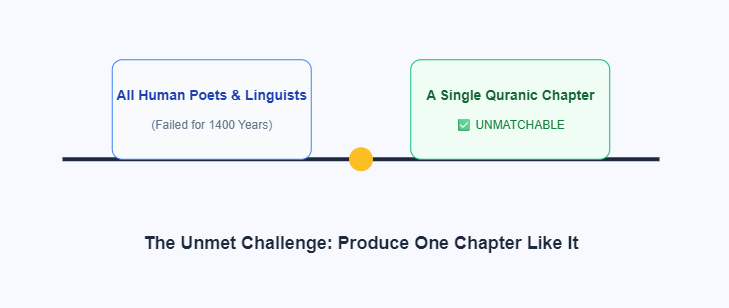
The primary logical pillar of the Linguistic Miracle of the Quran is the “Standing Challenge” issued within the text itself. Unlike other sacred books that ask for blind faith, the Quran offers a testable proposition. It challenged the most eloquent poets of Arabia—who lived for language—to produce just one chapter (Surah) that matches its quality.
Logically, if the Quran were a human production, then other humans, especially those who were masters of the same language, would have been able to produce something similar. The challenge was issued in stages: first to produce a book like it, then ten chapters, and finally a single chapter. The smallest chapter in the Quran is only three lines long. Yet, for 1,400 years, this challenge has remained unmet. This failure of human experts constitutes an empirical proof of the Authenticity of the Quran. For the rational mind, the inability of an entire civilization to replicate a three-line structure is a definitive sign of a non-human source.
2. A Unique Literary Genre: Neither Poetry nor Prose
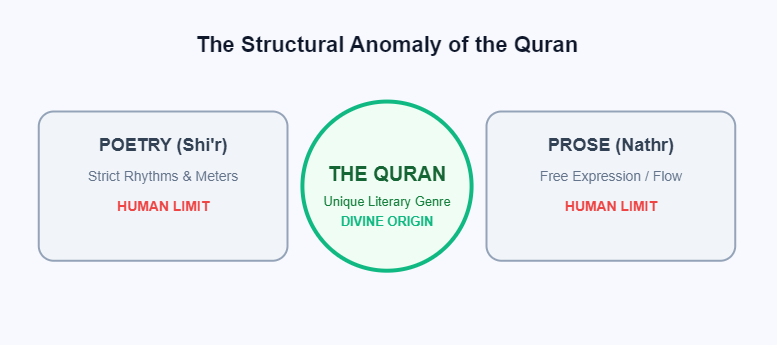
A profound reality of the Linguistic Miracle of the Quran is its defiance of established literary categories. In the 7th century, Arabic literature was divided into two strict forms: Saj’ (rhymed prose used by soothsayers) and Shi’r (poetry governed by sixteen complex meters called Al-Buhur).
Logically, any human speaker must follow the rules of their language’s genres. However, the Quran introduced a third, completely new genre. It possesses the rhythm and impact of poetry without being restricted by its meters, and it has the clarity of prose without being mundane. When the elites of Mecca heard the Quran, they were logically trapped; they could not call it poetry, nor could they call it prose. As documented by Britannica’s analysis of Quranic style, the text creates a unique symphonic effect that is mathematically impossible to sustain over 600 pages for a human author. This structural singularity is a hallmark of the Islam and Human Logic dialogue.
3. The Perfection of Word Choice: Precise Logic in Every Particle
In the study of the Linguistic Miracle of the Quran, scholars have noted that the replacement of a single word with its closest synonym often breaks the logical or rhythmic flow of a verse. Every word is placed with absolute “Measured Decree” (Qadar).
For example, when the Quran describes the Origins of the Universe, it uses verbs like Ratq (joined) and Fataq (separated) which carry specific physical implications. Logically, a human author—especially an Unlettered Prophet—would inevitably make linguistic choices influenced by their mood, environment, or limited vocabulary. The Quran, however, maintains a level of precision where every particle and letter serves a grammatical, theological, and scientific purpose. This reflects the Knowledge of Allah, who is established over the Throne and knows the weight of every atom.
4. Spontaneous Perfection: Revelation without Revision
Every great human literary work requires multiple drafts, edits, and revisions. Logically, the more complex the work, the more time it takes to refine. The Linguistic Miracle of the Quran is unique because it was revealed “spontaneously” over 23 years in response to real-time events.
Whether the Prophet was in the heat of battle, in a state of deep grief, or addressing a legal dispute, the verses he recited were immediately perfect. There was no “editing phase,” yet the end result is a book that maintains a unified theme and flawless grammar from start to finish. Logically, for a man to speak off-the-cuff in a way that matches the highest literary standards for two decades is a psychological and linguistic impossibility. This reality provides a powerful proof for the Sincerity of Prophet Muhammad, as he acted merely as a vessel for the literal Speech of Allah.
5. Structural Symmetry: The Logic of Ring Composition
Modern literary analysis has discovered that many Quranic chapters are built using “Ring Composition” or “Chiasmus”—a complex symmetrical structure where the beginning of the text mirrors the end, and the most important message is located exactly in the center.
Logically, creating a ring composition requires a “Bird’s Eye View” of the entire text before it is even written. Since the Quran was revealed in pieces over 23 years, a human author could not have known how to place a verse in the year 610 CE so that it perfectly matches a verse revealed in 632 CE. This structural symmetry is the “Macro-Miracle” of the Linguistic Miracle of the Quran. It proves that the Architect of the text is the One who manages the Fine-Tuning of the Universe, seeing the end from the beginning from His position Above the Throne.
6. The Logic of Universal Impact: Moving Hearts through Sound
The Linguistic Miracle of the Quran extends beyond the meaning of the words to their very sound. Even those who do not understand Arabic often report a profound sense of peace or “Sakinah” when hearing the recitation.
As we discussed in Islamic Psychology, the Thinking Heart is the organ of spiritual perception. The Quranic phonetics—the way the letters interact with the breath and the tongue—are designed to resonate with the Fitrah (innate nature). Logically, a purely human text might be intellectually stimulating, but it rarely possesses the power to transform the psychological state of millions across diverse cultures and languages. This emotive power is a primary credential for the Worship in Islam, showing that the Speech of Allah addresses the human being as a whole.
7. Preservation of the Tongue: The Logic of a Living Miracle
Finally, the Linguistic Miracle of the Quran is linked to the preservation of the Arabic language itself. Unlike the languages of the Preservation of the Bible—such as Aramaic or Ancient Greek—the Arabic of the Quran remains a living, accessible tongue.
Logically, for a “Final Revelation” to be effective, it must be understandable to every generation. By preserving the Quran, Allah preserved the language. A 21st-century child in Makkah or London can understand the same words spoken by the Prophet in the 7th century. This linguistic continuity is a historical anomaly. It ensures that the Why Islam answer is never lost in translation. The Quran remains the only book in history that acts as its own dictionary, its own grammar guide, and its own proof of authenticity.
Conclusion: The Finality of the Divine Word
The scholarly inquiry into the Linguistic Miracle of the Quran leads to an inescapable rational verdict: the Quran is not a human invention. Its unique genre, its spontaneous perfection, its structural symmetry, and its unmet challenge all point toward a single, Transcendent Source.
For the skeptical seeker, the linguistic precision of the Quran is an invitation to listen. If the Quran is accurate about the hidden Scientific Miracles and the deep history of the People of Lot, it is only logical to conclude that its beauty is the signature of the One who spoke it. The “Truth Clearly” is that Allah, the Most High, who created the tongue and the mind, has provided a message that satisfies both, leading humanity back to the worship of the One True God.