

The Logic of Monotheism in Islam: 7 Profound Realities of a Designed Universe
At Truth Clearly, we are dedicated to investigating the foundational principles of reality through a synthesis of scriptural revelation and rational inquiry. This research paper explores the core concept of Tawhid, or absolute monotheism, as a logical and scientific necessity. Our analysis is rooted in the authentic Islamic perspective, which recognizes that the unity of the laws of nature serves the Logic of Monotheism in Islam. We invite readers to reflect on how a unified cosmos demands a unified Source.
In the long history of human thought, the quest for a “Unified Theory” has been the holy grail of both science and philosophy. From the pre-Socratic thinkers to modern quantum physicists, humanity has intuitively sensed that the vast complexity of the cosmos must be anchored in a singular, coherent principle. For the skeptical Western reader, the agnostic academic, or the student of logic, The Logic of Monotheism in Islam (known as Tawhid) presents a compelling answer to this quest. Islam does not present the oneness of God as a mere dogma to be accepted without evidence; rather, it presents it as the only intellectually consistent conclusion that accounts for the order, harmony, and fine-tuning of existence.
In the Islamic worldview, we recognize Allah as the unique and supreme Creator who is High above His Heavens and established over His Throne. He is distinct from His creation, and His Knowledge and Will encompass every particle in the universe. The Logic of Monotheism in Islam asserts that the “Book of Nature” and the “Literal Speech of Allah” speak with one voice. This article explores seven profound logical realities that demonstrate why absolute monotheism is the most rational framework for understanding our universe and our place within it.
Table of Contents
1. The Logic of Unified Command: The Conflict Resolution Argument
The first logical pillar of The Logic of Monotheism in Islam is the necessity of a single sovereign will. In classical logic and systems theory, a complex, high-functioning system cannot operate efficiently with multiple, independent, and equal commanders. If there were two or more “Gods” with absolute power, the cosmic order would inevitably collapse due to conflicting wills.
Logically, if “God A” willed a star to ignite and “God B” willed it to remain dark, either both wills would be frustrated (meaning neither is truly God), or one would prevail (meaning the other is deficient). The Quran articulates this logic with surgical precision: “Had there been within the heavens and earth gods besides Allah, they both would have been ruined” (Quran 21:22). The remarkable stability of the physical laws we discussed in the Origins of the Universe points to a singular, unified source of command. A plurality of creators would necessitate a plurality of conflicting physics, leading to cosmic chaos rather than the Fine-Tuning of the Universe we observe.
2. Mathematical Intelligibility: One Language, One Author
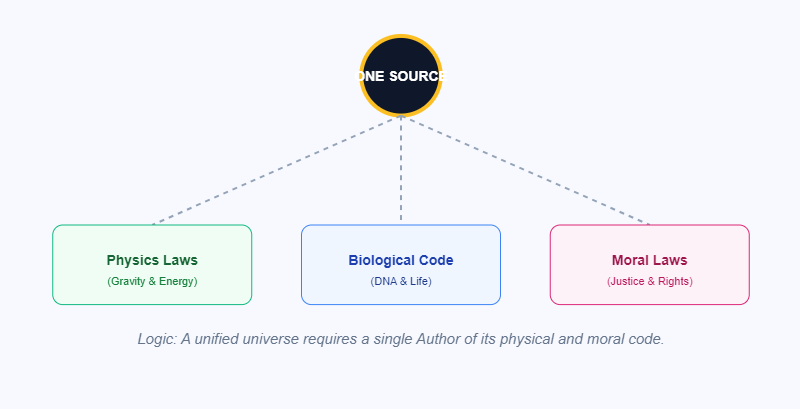
A profound reality that supports The Logic of Monotheism in Islam is the mathematical consistency of the universe. From the subatomic level to the largest galactic clusters, the same fundamental equations of gravity, electromagnetism, and thermodynamics apply.
Logically, if the universe were a product of multiple independent forces or blind chance, we would expect a fragmented reality with different “dialects” of physics in different regions. Instead, we see a universal mathematical language. As documented in Britannica’s analysis of the laws of physics, the cosmos is a “coherent whole.” In Islamic logic, this consistency is the physical signature of Tawhid al-Rububiyyah (The Oneness of Lordship). It proves that the Author of the Scientific Miracles of the Quran is the same Designer who wrote the laws of the stars.
3. The Biological Signature: DNA and the Unified Code
Modern biology has revealed that all life on Earth—from the simplest bacteria to the most complex human being—is written in the same genetic language: DNA. The study of The Logic of Monotheism in Islam identifies this as an empirical proof of a single Originator.
Logically, the complexity of information found in our cells—as we explored in Embryology in the Quran—cannot arise from unguided material processes. Information requires an intellectual source. The fact that the entire biosphere shares a unified “Software” suggests a single “Programmer.” Islam rejects the polytheistic or pantheistic view that different aspects of nature have different “spirits.” Instead, it asserts that the Reality of the Soul and the material body are both designed by the One who is High above all. This biological unity is a primary evidence for Why Islam offers the most consistent explanation for life.
4. The Logic of Absolute Transcendence: Rejection of Incarnation
A critical reality of The Logic of Monotheism in Islam is the unbridgeable ontological gap between the Creator and the created. Islam maintains that the attributes of the Divine (Eternal, Self-Sufficient, All-Powerful) and the attributes of the human (Temporal, Dependent, Limited) are mutually exclusive.
Logically, a being cannot be both the Infinite Creator and a finite human simultaneously. This is where Islam provides a corrective to other traditions, such as the Messiah Identity Crisis. By affirming that Jesus in Islam was a noble prophet and not a god, Islam protects the human intellect from the logical paradoxes of incarnation and the Trinity. Absolute monotheism requires that the object of worship remains High above the deficiencies of the material world. This preserves the Concept of God in Islam as a Being of absolute perfection.
5. The Moral Argument: Objective Truth vs. Moral Chaos
Without The Logic of Monotheism in Islam, morality becomes a matter of human opinion, cultural trend, or biological survival. In a polytheistic or atheistic worldview, there is no ultimate, objective standard for “Good” and “Evil.”
Islamic logic anchors ethics in the character and command of the One True God. Because Allah is Al-Adl (The All-Just) and He is established over His Throne witnessing all affairs, morality is an objective reality. This provides the stable foundation for Islam and Objective Morality and the protection of Islam and Human Rights. If there were multiple gods with different moral standards, humanity would be trapped in an eternal state of ethical confusion. The oneness of the Lawgiver ensures a unified moral compass for all of humanity.
6. The Fitrah: The Internal Reflection of Monotheism
A profound internal evidence for The Logic of Monotheism in Islam is the Fitrah—the innate human nature. Every human being is born with an intuitive recognition that there is a single Source to existence. This is why, in moments of extreme crisis, even the most committed skeptics instinctively call upon a single “Higher Power.”
Logically, an internal drive for a single Creator—as analyzed in the Neurobiology of Faith—is a sign that the “Software of the Soul” matches the “Hardware of the Universe.” This internal witness is the strongest psychological proof for Islam and Human Logic. It proves that Worship in Islam is not the adoption of a foreign concept, but a return to the soul’s original and most rational state.
7. The Final Accountability: Politics and the One God
Finally, The Logic of Monotheism in Islam has massive implications for social and political life. By acknowledging only one supreme authority—Allah, the Most High—Islam dismantles all forms of human tyranny and the deification of political leaders.
Logically, if there is only one Master, then all humans are equal servants. This was the revolutionary reality of Muhammad as a Leader, who established a society where the ruler was as accountable to the law as the commoner. In the Islam and Secularism dialogue, we see that monotheism provides a check on power that purely human-made ideologies cannot. Absolute accountability before the One who knows the Signs of the Day of Judgment is the ultimate deterrent against injustice.
Conclusion: The Rational Triumph of Tawhid
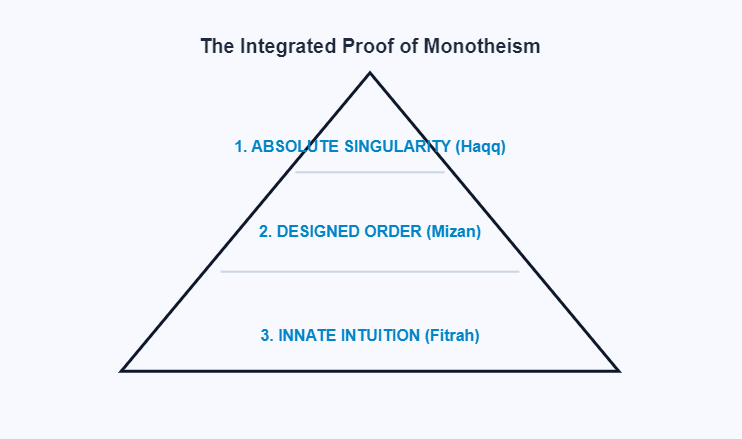
The scholarly investigation into The Logic of Monotheism in Islam leads to an inescapable rational verdict: the unity of the universe, the precision of biological code, the objectivity of morals, and the intuition of the soul all point toward a single, Magnificent Designer. Monotheism is not just a “belief”; it is the most consistent logical explanation for the totality of human experience.
For the skeptical mind, the Islamic concept of Tawhid is an invitation to intellectual coherence. It offers a worldview where science, history, and spirituality are unified under the sovereignty of the One who said “Be,” and the universe was. By recognizing the Authenticity of the Quran as the final guide, the seeker finds the “Truth Clearly”—that in a world of infinite complexity, the Source is profoundly One.