
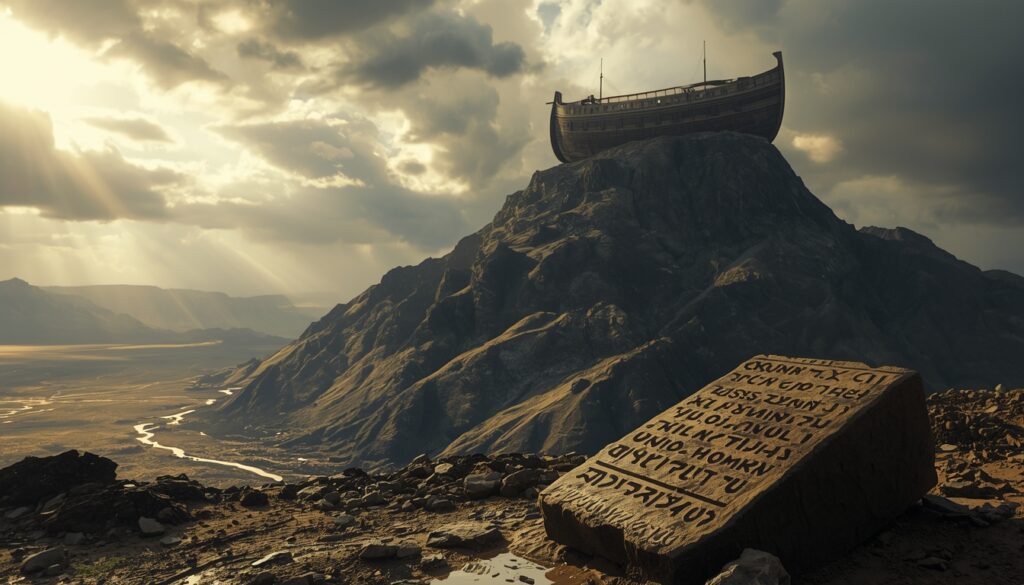
7 Profound Realities: The Great Flood in the Quran and Modern Science
Editorial Note: At Truth Clearly, our mission is to examine historical and religious narratives through the rigorous lens of logic and empirical data. This research paper explores the account of the Deluge, comparing ancient scriptural descriptions with modern geological and archaeological findings. We adhere to the authentic Islamic perspective, which emphasizes that revelation and reason are two harmonious paths toward understanding the actions of the All-Wise Creator.
The story of a massive flood that wiped out an entire civilization is a universal memory, found in the records of the Sumerians, Babylonians, Greeks, and even indigenous tribes in the Americas. For the skeptical Western reader, the geologist, or the student of history, the narrative of the Deluge is often dismissed as a cross-cultural myth or a biological impossibility. However, a logical inquiry into The Great Flood in the Quran reveals a narrative that is strikingly different from other ancient versions—one that avoids scientific pitfalls and aligns with the nuances of regional archaeology.
In the Islamic worldview, we recognize the Quran as the literal and uncreated Speech of Allah. Allah, the unique Creator who is High above His Heavens and established over His Throne, is the Sovereign Master of history. He sent the Flood not as a random natural disaster, but as a calculated divine intervention. The Great Flood in the Quran serves as a “Sign” (Ayah) of ultimate accountability. This article explores seven profound realities that demonstrate how the Quranic account provides a logically superior and scientifically plausible framework for this ancient event.
Table of Contents
1. Regional vs. Global: The Logic of Targetted Justice
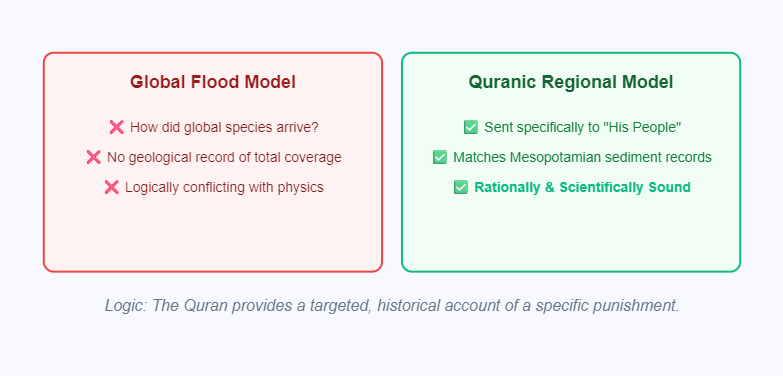
A primary point of skepticism regarding the Deluge is the “Global Flood” model found in many traditions, which claims the entire planet was covered in water. Logically, this presents massive biological and geological challenges: How did animals from every continent reach the Ark? Where did the water go?
The narrative of The Great Flood in the Quran provides a more precise logical framework. The Quran states that Noah was sent specifically to “his people” (qawmihi), and the punishment was for those who rejected the message. Logically, Islamic theology does not necessitate that the entire globe was submerged, but rather that the civilization of Noah was destroyed. This “Regional Flood” model is consistent with archaeological evidence of massive, catastrophic flooding in the Mesopotamian basin. By focusing on the destruction of a specific people, Islam maintains the Logic of Divine Justice without contradicting the physical laws of the planet.
2. The Mount Judi Connection: An Archaeological Mystery
One of the most specific realities of The Great Flood in the Quran is the identification of the Ark’s resting place. While the Bible mentions the “Mountains of Ararat,” the Quran specifies a single location:
“And it was said, ‘O earth, swallow your water, and O sky, withhold [your rain].’ And the water subsided, and the matter was accomplished, and the ship came to rest upon [Mount] Judi.” (Quran 11:44).
Logically, Mount Judi (located in modern-day Turkey near the Syrian border) is a much more plausible landing site than the steep, volcanic peaks of Ararat. Interestingly, early Christian and Jewish traditions prior to the medieval period also identified Judi as the landing site. This precision in The Great Flood in the Quran serves as a credential for the Authenticity of the Quran, as the unlettered Prophet Muhammad corrected a geographical detail that had been shifted by later human traditions.
3. The Logic of the Ark’s Construction: “Planks and Nails”
The Quranic description of the Ark itself is remarkably grounded and devoid of mythological exaggeration. It describes the vessel as being made of “planks and nails” (Quran 54:13).
Logically, this emphasizes the “Causality” of the event. Even though the rescue was a miracle, Allah commanded Noah to use the laws of physics and engineering to build a seaworthy vessel. This aligns with the Islamic Philosophy of Science, where divine intervention operates through created means. The Ark was not a magical floating palace, but a functional ship designed to endure the Logic of Suffering and Trial that Noah’s community faced.
4. Textual Correction: Resolving the Sumerian Parallel
Skeptics often claim that the Quranic account is simply a retelling of the older Sumerian Epic of Gilgamesh. However, a logical comparison—as we do in Comparative Religion—reveals that the Quran removes all the irrational elements found in the Sumerian myths.
In the Sumerian version, the gods are depicted as being terrified of the flood and cowering like dogs. Logically, such a portrayal contradicts the very Concept of God in Islam as the All-Powerful and All-Wise. The Quran restores the narrative to a dignified, monotheistic framework where the Flood is an orderly execution of divine decree. The The Great Flood in the Quran is thus a “Rescue Mission” for the truth, stripping away the human-made myths to reveal the underlying historical reality.
5. The “Tannur” Miracle: The Logic of Geothermal Activity
A fascinating and often misunderstood detail in The Great Flood in the Quran is the mention of the Tannur (oven). The Quran states: “Until when Our command came and the oven (Tannur) gushed forth…” (Quran 11:40).
From a logical geological perspective, this could be interpreted as a description of geothermal or volcanic activity. Many modern geologists hypothesize that a regional Deluge could have been triggered by tectonic shifts and the gushing of pressurized underground aquifers. The use of the word “oven”—implying heat and an eruptive force—matches the physical requirements for a catastrophic flood of that scale. This level of descriptive detail is another sign of the Scientific Miracles of the Quran, pointing to a source that understands the Plate Tectonics of the earth.
6. Sincerity and Prophetic Evidence: The “Long Call”
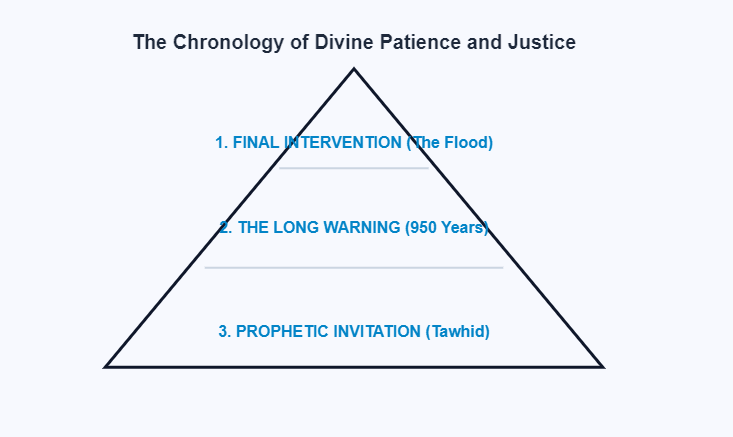
The The Great Flood in the Quran dialogue emphasizes the extreme patience of Noah, who called his people for 950 years. Logically, this duration serves as a proof of his Sincerity. A fraudster seeking power or wealth would never persist for centuries in the face of mockery and rejection.
This “Long Call” also establishes the logic of “Fair Warning.” Allah, the Most Merciful, did not punish Noah’s people until every possible opportunity for Worship in Islam and repentance was exhausted. This ethical framework ensures that Islam and Human Rights are respected; no one is destroyed without a clear message and a rational choice, reinforcing the Logic of Free Will.
7. The Ark as a Perpetual Sign for Humanity
Finally, the Quran makes a bold claim that the Ark was preserved as a sign for later generations: “And We left it as a sign, so is there any who will remember?” (Quran 54:15).
Logically, this invites the modern world to investigate. Whether it is the physical remains of a large vessel on Mount Judi or the “cultural DNA” of the flood story in every corner of the world, the Preservation of the Bible and Quran ensures that this warning remains fresh. For the skeptical mind, the universality of the story combined with the Quranic precision suggests that the Flood is the ultimate historical anchor for the Why Islam inquiry—a reminder that the laws of nature and the laws of morality are both overseen by the One who is High above His Throne.
Conclusion: The Rationality of Revelation
The scholarly investigation into The Great Flood in the Quran leads to a profound rational verdict: the Quranic account is the only version of the Deluge that harmonizes historical tradition, ethical logic, and geological possibility. By removing the irrationality of a global submersion and the anthropomorphism of the polytheistic gods, Islam restores the Deluge to its rightful place as a monumental historical fact.
For the skeptical seeker, the story of Noah is an invitation to recognize that the Creator communicates through history. If the Quran is accurate about the resting place of the Ark and the regional nature of the punishment, it is only logical to trust its guidance regarding the Purpose of Life. The “Truth Clearly” revealed in the waters of the Flood is a mercy for those who reflect—a call to return to the worship of the One True God before the final and greatest Hour.