

This research paper is part of Truth Clearly’s commitment to providing an authentic Islamic perspective on theology and history. We adhere to rigorous academic standards, relying exclusively on the Quran, authentic Prophetic traditions, and verified historical sources to provide clarity for the rational seeker.
For the skeptical Western reader or the student of comparative religion, the word “worship” often evokes images of isolated, repetitive rituals—chanting in a cathedral, kneeling in a temple, or performing silent meditation in a remote cave. In many secular worldviews, worship is perceived as a private, compartmentalized act that exists only on the fringes of “real life.” However, a rigorous logical inquiry into the concept of Worship in Islam (known as Ibadah) reveals a paradigm that is far more comprehensive, rational, and integrated than traditional definitions suggest.
In the Sunni Athari worldview, we recognize Allah as the unique Creator who is High above His Heavens and established over His Throne (Istawa) in a manner that suits His Majesty, distinct from His creation. He spoke the Quran as His literal and uncreated Speech, and in this revelation, He defined worship not merely as a set of physical motions, but as the very core of human existence.
Worship in Islam is a holistic system where every purposeful action, guided by divine wisdom and a sincere intent to please the Creator, becomes an act of devotion. This article explores seven profound logical realities of worship, demonstrating why rituals alone are never sufficient to fulfill the Islamic mandate for a purposeful life.
Table of Contents
1. The Divine Definition: Worship as Rational Submission
The primary logical pillar of Worship in Islam is its expansive definition. In Islamic theology, Ibadah is an all-encompassing term that includes every internal belief, spoken word, and physical action that Allah loves and is pleased with. Logically, if Allah is the Sovereign Creator of all that exists—as we explored in the Origins of the Universe—then His authority and guidance must logically extend to every facet of existence, not just the moments spent within a house of prayer.
Worship is the intellectual act of recognizing the cosmic hierarchy. Allah, the Most High, is the Self-Sufficient (As-Samad), while humanity is inherently dependent. When a person aligns their will with the commands of the Creator, they are engaging in the most rational act possible: acknowledging reality. This is why the 5 Pillars of Islamic Faith are not the totality of worship, but rather the essential rhythmic foundation upon which a life of total devotion is constructed.
2. The Logic of Intention: Turning Habit into Devotion
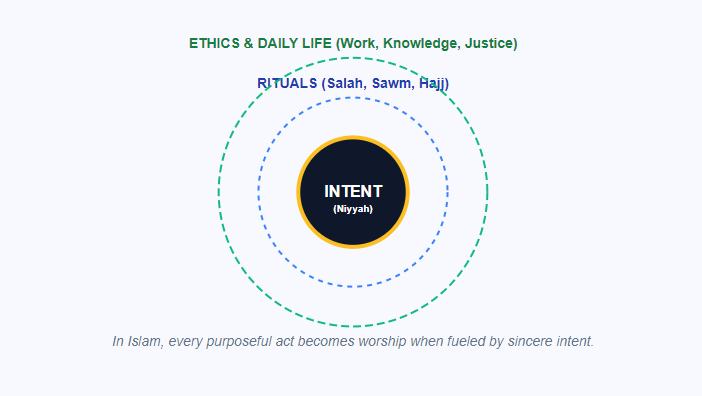
One of the most profound realities of Worship in Islam is the transformative role of Niyyah (intention). In many religious systems, an act is only considered “holy” if it occurs within a specific sacred space. In Islam, however, the intention of the heart acts as a “spiritual catalyst” that can transform a mundane habit into a high act of worship.
Logically, this provides a powerful and continuous psychological motivation for the believer. When a person eats to maintain their health, works diligently to provide for their family, or seeks knowledge—and does so with the intention of pleasing Allah—these acts are recorded as Ibadah. This ensures that the individual remains in a state of connection with the One who is established over the Throne, even while navigating the complexities of the modern world. The Sincerity of Prophet Muhammad serves as the ultimate historical exemplar of this, as his every breath was directed toward the service of the Creator.
3. Beyond Ritualism: The Ethical and Social Dimension
A frequent skeptical critique of religion is that it focuses on “empty rituals” while ignoring practical social justice. The Worship in Islam framework rebuts this by making ethical conduct a mandatory component of spiritual success. Prophet Muhammad (peace be upon him) taught in numerous authentic reports that a person who prays but fails to abandon lying or cheating has misunderstood the very nature of worship.
Logically, rituals like Salah (prayer) are intended to be spiritual training grounds that produce moral fruit. If the ritual does not improve the character, the ritual is functionally incomplete. True worship must manifest as integrity in trade, the implementation of Islam and Human Rights, and the protection of the vulnerable. By linking spiritual practice to Islam and Objective Morality, Islam ensures that religion remains a potent force for social good rather than a self-serving escape.
4. The Intellectual Mandate: Seeking Knowledge as Ibadah
While some traditions have historically experienced tension between “faith” and “reason,” the Worship in Islam paradigm views intellectual growth as a divine obligation. The Prophet Muhammad (peace be upon him) explicitly stated that “Seeking knowledge is a mandate upon every Muslim.”
Logically, if the universe is a “Book of Signs” created by Allah, then studying those signs is a primary way of appreciating the Creator’s Wisdom. This is why the Islamic Civilization’s Contributions to Science were so vast; early scholars viewed their laboratories as places of worship. As emphasized by UNESCO regarding the value of knowledge, the pursuit of truth through education is a global public good—a concept that Islam mandated 1,400 years ago as a form of devotion to the All-Knowing Creator. Whether one is analyzing the Scientific Miracles of the Quran or the laws of physics, the act of learning is a profound form of Ibadah that honors the human intellect.
5. Psychological Stability: The Balance of Hope and Fear
Islamic logic suggests that a healthy relationship with the Creator requires a dynamic balance of two core emotions: Khawf (Awe/Fear) and Raja (Hope). Worshiping out of fear alone leads to spiritual despair; worshiping out of hope alone can lead to moral complacency.
The Worship in Islam framework provides a “middle path” that creates immense psychological resilience. By acknowledging the absolute Justice of Allah—who will settle every account—and the infinite Mercy of Allah—who forgives all sins—the believer maintains a state of focused accountability. This balance is crucial for navigating the Logic of Suffering and Trial, allowing the individual to remain steadfast during hardship and humble during prosperity, knowing that both states are part of a divinely decreed test.
6. The Logic of Direct Connection: The Rejection of Intermediaries
A unique and liberating aspect of Worship in Islam is the absolute rejection of a priestly caste or spiritual intermediaries. In Islamic logic, every human being has a direct “hotline” to the Creator who is High above His Heavens. There is no requirement for a saint or a priest to “broker” the relationship between the servant and the Lord.
This directness is a fundamental requirement of Tawhid (Absolute Monotheism), as explored in our inquiry into the Concept of God in Islam. It empowers the individual, granting them an inherent dignity that cannot be controlled by any religious institution. When a Muslim stands in prayer or engages in Supplication, they are standing directly before the Lord of the Worlds. This unmediated connection is why the Authenticity of Hadith is so vital; it provides the verified methodology for this direct interaction.
7. The Ultimate Goal: Reaching the State of Ihsan (Excellence)
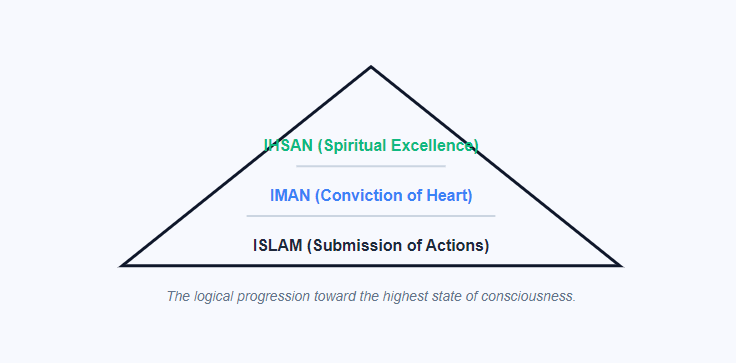
The ultimate peak of Worship in Islam is a state called Ihsan. The Prophet defined this state as: “To worship Allah as if you see Him; and if you do not see Him, know that He sees you.”
Logically, this represents the highest form of self-regulation and psychological integrity. A person who strives for Ihsan does not require a policeman to act ethically. They act with excellence because they are constantly aware of the Presence and Knowledge of Allah, who sees all from His position Above the Throne. This internal “moral compass” is the logical conclusion of a life built on truth. It aligns with The Purpose of Life as a continuous journey of spiritual refinement toward an inevitable meeting with the Creator. This perspective is what makes Why Islam such a compelling choice for the modern seeker.
Conclusion: A Symphony of Purpose
The scholarly study of Worship in Islam reveals that it is not a burden to be borne, but a symphony of purpose to be lived. By integrating rituals with ethics, daily habits with divine intention, and faith with reason, Islam provides a comprehensive and logical map for human flourishing.
For the skeptical mind exploring the history and meaning of worship, the Islamic model of Ibadah offers a life that is never fragmented between the “sacred” and the “secular.” It invites humanity to recognize that true peace is found only when the heart, the mind, and the hands are all working in harmony to serve the One True God, the Most High, who created all things in perfect proportion. Worship, in its truest sense, is the rational and beautiful response of the creature to the magnificence of the Creator.










Leave a Reply