
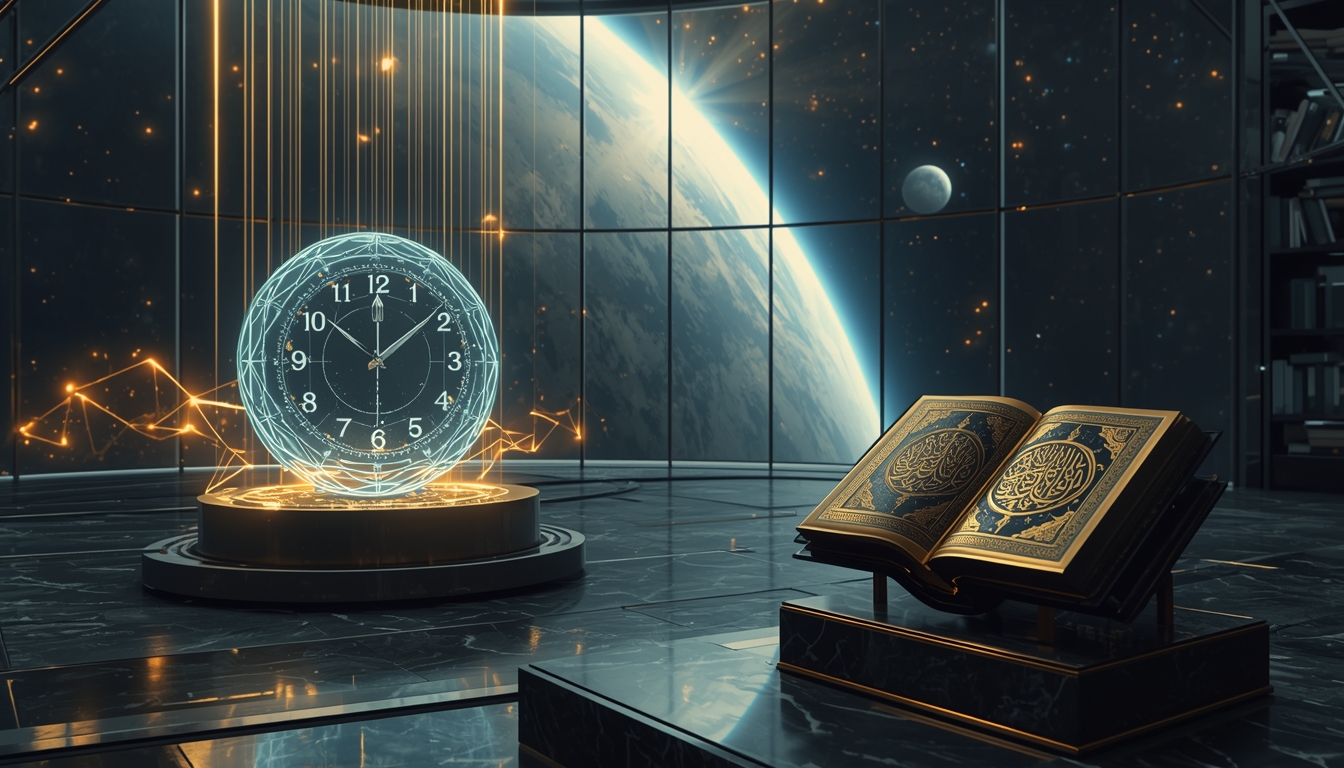
At Truth Clearly, we are dedicated to exploring the profound intersections of 7th-century revelation and modern scientific inquiry. Our research team ensures that every theological analysis is rooted in the authentic Islamic perspective, specifically the Sunni Athari tradition, while validating scientific claims against peer-reviewed physics and cosmology. This article invites readers to examine the logical harmony between the Creator’s literal Speech and the discovered laws of the space-time continuum.
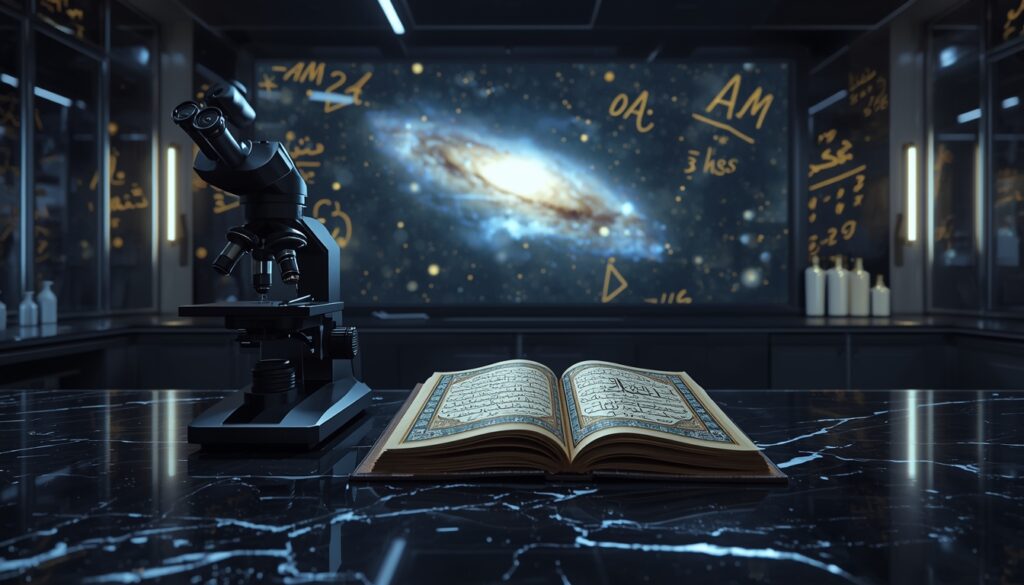
In the early 20th century, Albert Einstein transformed our understanding of the universe with his General and Special Theories of Relativity. He famously dismantled the Newtonian concept of “Absolute Time,” proving that time is not a fixed background but a flexible, created dimension that changes based on velocity and gravity. For the skeptical Western reader, the physicist, or the student of philosophy, this discovery was an ontological revolution. However, a rigorous logical inquiry into the nature of Time in the Quran reveals that the core principles of “Temporal Relativity”—the fact that time flows differently for different observers—were articulated with startling precision fourteen centuries before modern physics.
In the Islamic worldview, we recognize Allah as the unique Creator who is High above His Heavens and established over His Throne. He is the Architect of the space-time fabric, yet He is not subject to its constraints. Time is a created entity, and the One who brought it into existence is necessarily distinct from it. The discourse on Time in the Quran is not an attempt to force science into religion; it is an observation of “Signs” (Ayat) that point toward an Omniscient Source. This article explores seven profound logical realities that bridge the gap between relativistic physics and divine revelation through the lens of Time in the Quran.
Table of Contents
1. The Logical Construction of Time in the Quran
The primary logical pillar in the study of Time in the Quran is the understanding that time is a created construct. For centuries, materialist philosophies assumed a “Static Universe” with an infinite past, suggesting time was an uncaused, eternal backdrop. Einstein’s field equations, followed by the Big Bang model, proved that time is a dimension that emerged along with space and matter.
Logically, if time is a created thing, it must have an uncreated Creator. As we explored in the Origins of the Universe, Islam asserts that Allah is the First before whom there was nothing. By identifying Time in the Quran as a subservient element of the created order, the text provides a rational framework that aligns with modern cosmology. Allah, the Most High, exists in a state that transcends the “ticking clock” of the material world. Recognizing Time in the Quran as a finite, designed system is the first step in understanding the Concept of God in Islam.
2. The Logic of Time Dilation: A Profound Reality
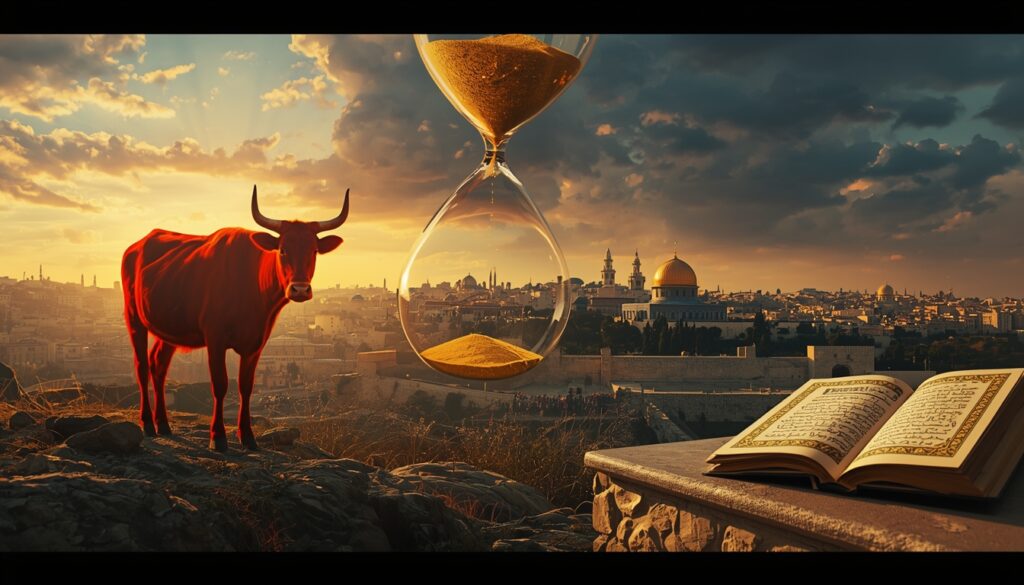
The most famous intersection of Einsteinian physics and Time in the Quran is the phenomenon of “Time Dilation.” Relativity proves that time slows down for an observer as they move faster or enter a stronger gravitational field. A day on one celestial body can be equivalent to years on another.
The concept of Time in the Quran mentions this relative nature in a specific, measurable context:
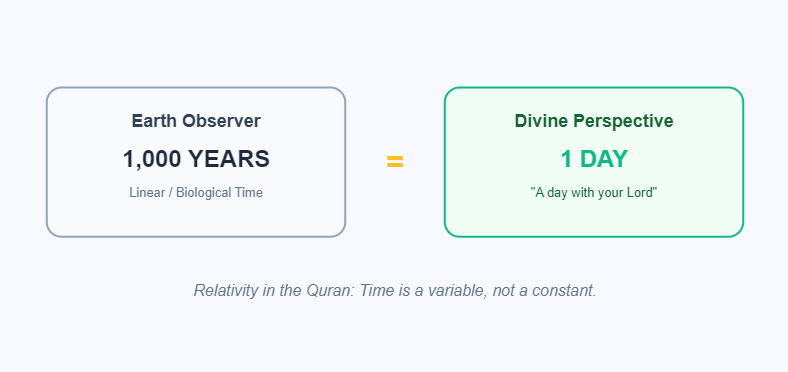
“And indeed, a day with your Lord is like a thousand years of those which you count.” (Quran 22:47).
From a logical scientific perspective, for a 7th-century text to state that a single “Day” in one dimension is equivalent to “a thousand years” in another is an incredible credential of truth. It identifies Time in the Quran as a subjective experience rather than a universal constant. This descriptive accuracy is a primary proof for the Authenticity of the Quran, as it provides information that was physically impossible to verify through human observation in late antiquity. As documented by Britannica regarding the nature of time, modern physics confirms the fluidity that the Quran asserted 1,400 years ago.
3. Cosmic Velocity and Time in the Quran: The 50,000-Year Scale
The study of Time in the Quran reaches an even higher level of precision in Surah Al-Ma’arij. The text describes the movement of angels and the Spirit through the dimensions of space and the varying speeds of time:
“The angels and the Spirit ascend to Him in a Day the measure of which is fifty thousand years.” (Quran 70:4).
Logically, this describes a “Scaling Factor.” Modern relativity confirms that the faster a being travels (the “ascension”), the more pronounced the time dilation becomes. The jump from a 1:1,000 ratio to a 1:50,000 ratio in different contexts of Time in the Quran suggests that time is a variable depending on the state of the observer and the velocity of travel. This is the very definition of relativistic physics. This level of precision is a hallmark of the Scientific Miracles of the Quran, showing that the One who spoke the words is the One who established the Fine-Tuning of the Universe.
4. Space-Time Curvature: The Logic of “Al-Hubuk”
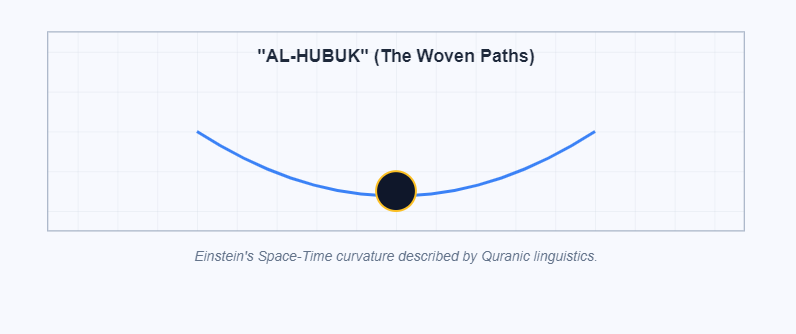
One of Einstein’s greatest achievements was proving that space and time are not empty, but form a “Fabric” that can be warped. A profound reality in the discourse of Time in the Quran is the specific Arabic terminology used to describe the structure of the heavens.
The Quran mentions: “By the sky which has woven paths (Al-Hubuk).” (Quran 51:7). Linguistically, Al-Hubuk refers to the weaving of a cloth or the intertwining of paths. Logically, until the 20th century, the “heavens” were thought to be a void. Einstein proved that the universe is a “Space-Time Fabric” that curves around mass. For Time in the Quran to be associated with a “woven” sky is in perfect harmony with General Relativity. This scientific foresight is a testament to the divine source of the message, which addresses the hidden structure of the space-time continuum.
5. The People of the Cave: The Biological Relativity of Time
The story of the “People of the Cave” (Ashab al-Kahf) provides a fascinating case study in the perception of Time in the Quran. These individuals were placed in a deep sleep for 309 years. Upon waking, their logical deduction was that they had only been asleep for “a day or part of a day” (Quran 18:19).
From a neurological and physical perspective, this narrative addresses the “Relativity of Perception.” While the “external” world moved through three centuries of history, their “internal” clock remained stationary. This highlights that Time in the Quran is treated as a measurement of change. Without change or consciousness of the material world, the flow of time as we know it loses its meaning. This reinforces the Reality of the Soul, showing that consciousness can exist in a state where the body’s temporal biological clock is suspended by the command of Allah.
6. The “Block Universe” and the Logic of Divine Decree (Qadar)
In modern physics, the “Block Universe” theory suggests that the past, present, and future all exist simultaneously in a four-dimensional block. Logically, if we could step outside of time, we would see the entire “movie” of history at once. This scientific concept provides a powerful bridge to the Logic of Free Will in Islam.
The concept of Time in the Quran is inseparable from Qadar (Divine Decree). Since Allah is the Creator of the space-time fabric and exists Above His Throne, He is not bound by the “linear” flow of time. Logically, He sees our future choices just as clearly as our past actions. His Knowledge does not “compel” us to act, but it “encompasses” our acts from a transcendent perspective. This reconciles human agency with divine sovereignty, a theme we explored in Sincerity of Prophet Muhammad, whose mission was based on absolute trust in the divine plan that exists beyond the linear experience of Time in the Quran.
7. The End of Entropy: The Termination of Time in the Quran
The study of Time in the Quran concludes with the inevitable end of the temporal dimension. The Second Law of Thermodynamics states that the universe is moving toward “Heat Death” or a state of total entropy. Logically, time as a measure of change must have a final stop.
The Quran describes the Day of Judgment as a time when the sun is folded and the stars fall. This indicates a “Phase Transition” of the space-time fabric itself. The framework of Time in the Quran provides the Purpose of Life as a preparation for this transition. When the “temporary” time of this world ends, the “Base Reality” of the Life After Death begins. For a rational seeker, the scientific reality that the universe is “winding down” is the ultimate proof that we are moving toward a final meeting with the Creator, a concept further validated by Why Islam is the most rational choice.
Conclusion: The Finality of Time in the Quran
The scholarly investigation into Time in the Quran leads to an inescapable rational verdict: the descriptions of temporal relativity and the woven structure of the heavens are not the result of 7th-century imagination. They are the “Logical Signatures” of the One who designed the dimensions of the universe.
By recognizing that time is a created, relative, and purposeful fabric, the individual finds the “Truth Clearly”—that we are part of a grand narrative governed by an All-Knowing Master. For those asking the Concept of Prophethood question, the logic of Time in the Quran is a powerful invitation: if the Quran is accurate about the complex physics of time that Einstein only decoded recently, it is only logical to trust its guidance for the soul that travels through that time. The same God who governs the expansion of the galaxies governs the beat of the human heart, and to Him is the ultimate return.






Leave a Reply