

This research paper is part of Truth Clearly’s commitment to providing an authentic Islamic perspective on theology and history. We adhere to rigorous academic standards, relying exclusively on the Quran, authentic Prophetic traditions, and verified historical sources to provide clarity for the rational seeker.
In the modern age of advanced satellite imagery, meteorology, and global hydrology, the mechanism of rain, cloud formation, and the continuous circulation of water on Earth is considered elementary science. However, for the vast majority of human history, even the most advanced civilizations—including the Greeks, Romans, and Persians—held deeply flawed and often superstitious views regarding these phenomena. For the skeptical seeker, the modern scientist, or the agnostic researcher, the specific and systematic descriptions of The Water Cycle in the Quran present a startling intellectual challenge. How could a text revealed in a 7th-century desert environment provide an account of a global atmospheric process that would not be fully understood by science until the 18th century?
In the Sunni Athari worldview, we affirm that the Quran is the literal and uncreated Speech of Allah, who is High above His Heavens and established over His Throne (Istawa) in a manner that suits His Majesty. He is the Creator of every water molecule and the absolute Legislator of every physical law. The Water Cycle in the Quran is not presented as a theoretical lecture; rather, it is offered as a series of “Signs” (Ayat) intended to prompt the human mind to recognize the Wisdom and Power of the Creator. This article explores five profound scientific realities of hydrology as detailed in the Quran, providing a logical and scriptural inquiry into their divine origin.
Table of Contents
1. The Biological Necessity: Every Living Thing from Water
The most fundamental scientific reality in the study of The Water Cycle in the Quran is the origin of life itself. Centuries before the discovery of the microscope, cytoplasm, or the molecular basis of cellular biology, the Quran made a definitive and universal biological declaration:
“…and We made from water every living thing? Then will they not believe?” (Quran 21:30).
Logically, this is an extraordinary statement for a man in the 7th-century Arabian desert to make. Modern biochemistry, as documented by Nature’s research on the molecular properties of water, confirms that water is the essential solvent of life. Every biological function, from DNA replication to protein synthesis, requires an aqueous environment. The Origins of the Universe and the subsequent emergence of life are described in the Quran as a unified act of creation. This alignment between the literal Speech of Allah and the physical reality of our cells is a powerful logical proof of the Authenticity of the Quran.
2. The Logic of “Fertilizing Winds” and Cloud Formation
The second reality of The Water Cycle in the Quran involves the complex process of cloud formation and the specific role of the wind. Until the late Renaissance, many prominent thinkers believed that clouds were simply “exhalations” from the earth or magical mists that appeared without a physical cause. The Quran, however, provided a specific atmospheric mechanism.
The Quran states: “And We have sent the fertilizing winds (Lawaqih) and sent down water from the sky and given you drink from it…” (Quran 15:22). Modern meteorology and studies by the USGS (United States Geological Survey) confirm that winds perform two distinct “fertilizing” roles:
- Evaporative Transport: Winds carry water vapor from the oceans to the higher layers of the atmosphere.
- Condensation Nuclei: Winds transport aerosols, salt particles, and dust, which act as “seeds” or nuclei around which water droplets condense to form clouds.
The use of the word Lawaqih (fertilizing) to describe the wind’s role in rain production is a profound linguistic and scientific sign, perfectly consistent with Islam and Human Logic.
3. The Three Stages of Rain: Accumulation, Layering, and Discharge
For a skeptical researcher, the Quranic description of how clouds produce rain is perhaps the most detailed evidence for The Water Cycle in the Quran. In Surah An-Nur, the text describes a sequence of events that mirrors modern cloud physics:
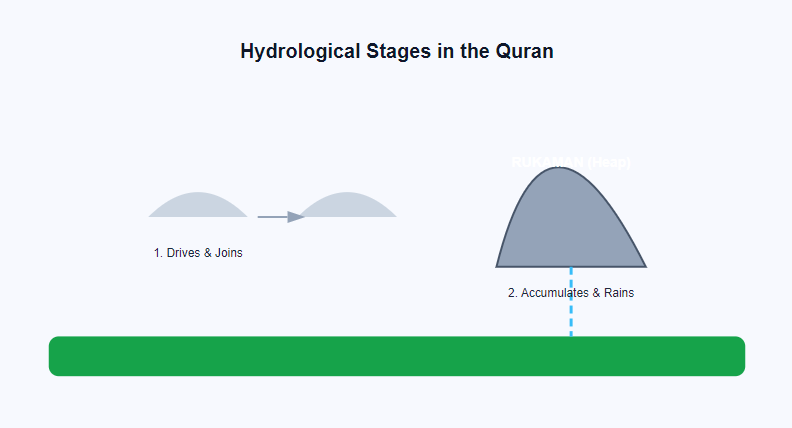
“Do you not see that Allah drives clouds? Then He joins them together, then He makes them into a heap (Rukaman), and then you see the rain emerge from within them…” (Quran 24:43).
Hydrologists and meteorologists today use remarkably similar terminology to describe the formation of cumulonimbus clouds. First, clouds are “driven” by wind currents. Second, small cloud cells “join” to form larger masses. Third, there is vertical accumulation—the “heaping”—where the cloud grows tall. It is only after this vertical development (the Rukaman) that rain is discharged from the interior of the cloud. Logically, a desert dweller in late antiquity could not have observed the internal “layering” or “heaping” mechanism of a storm cloud from the ground. This descriptive accuracy is a hallmark of the Sincerity of Prophet Muhammad who delivered these words exactly as spoken by Allah, the Most High.
4. The Logic of Proportions: The Balanced Rain (Qadar)
A fascinating scientific reality mentioned in The Water Cycle in the Quran is the concept of “Measured Proportion.” The Quran states: “And who sends down rain from the sky in measured measure (Qadar)…” (Quran 43:11).
Logically, if the amount of rain falling on Earth were random or chaotic, the planet would face permanent global flooding or total dehydration. Modern hydrology confirms that the total amount of water on Earth remains constant; the amount that evaporates is precisely balanced by the amount that falls back as precipitation. This global equilibrium is essential for the Islamic Environmental Ethics that mandate the preservation of the earth’s balance (Mizan). Allah, the All-Knowing Creator who is established over the Throne, has designed the water cycle with a mathematical precision that ensures the survival of all species.
5. The Barrier Between the Two Seas: Logic of Salinity and Density
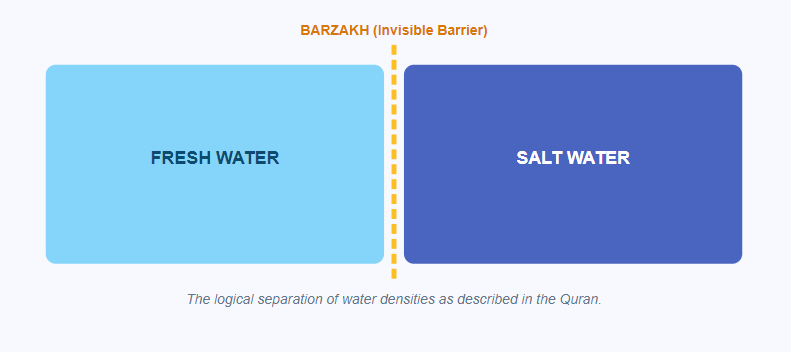
While not strictly about rain, the Quran’s description of the meeting of different bodies of water is a crucial reality in the study of The Water Cycle in the Quran. It describes a “barrier” between fresh and salt water: “He released the two seas, meeting [side by side]; Between them is a barrier [Barzakh] so neither of them transgresses.” (Quran 55:19-20).
Modern oceanography, as documented in Britannica’s analysis of ocean currents, has discovered “haloclines”—invisible barriers created by differences in salinity and density that prevent the immediate mixing of river water and sea water. This keeps the Concept of God in Islam as a Being who manages the deep oceans just as He manages the high heavens. For a 7th-century text to describe an invisible underwater physical barrier is a sign of a Creator whose Knowledge encompasses every depth.
6. The Logic of Preservation: Underground Storage
A common misconception in ancient times was that rain simply vanished or was “consumed” by the earth. The Quran, however, mentions the logical preservation of water in underground aquifers:
“…And We send down from the sky water in measure and settle it in the earth. And indeed, We are Able to take it away.” (Quran 23:18).
Logically, this points to the infiltration of rain into the groundwater system. This scientific reality is what allows for the existence of springs and wells in arid regions. By describing water as “settled” (Askannahu) in the earth, the Quran identifies the logic of the hydrological storage system that sustains Prophetic Medicine and human agriculture. This reinforces the Purpose of Life as a journey of gratitude toward a Sustainer who provides for our most basic needs.
7. The Metaphor of Resurrection: Logic from Observation
Finally, The Water Cycle in the Quran is used as a logical bridge to explain the possibility of resurrection. The Quran often compares the revival of dead, parched land after rain to the resurrection of the dead on the Day of Judgment.
Logically, if Allah can initiate the first creation of life from water, and He can revive a dead landscape into a lush garden, He has the absolute power to reconstruct the human body. This logical consistency connects the physical world to the Life After Death worldview. For the skeptical mind, the water cycle is a living, annual proof of the Creator’s ability to bring life out of non-life.
Conclusion: The Sign of the All-Wise Creator
The scholarly investigation into The Water Cycle in the Quran leads to an inescapable rational verdict: the descriptions found in the text are not the product of human observation or 7th-century guesswork. They are the literal and uncreated Speech of the One who designed the laws of thermodynamics, gravity, and chemistry. From the origin of life in water to the precise vertical heaping of clouds, the Quran remains in perfect harmony with 21st-century scientific discovery.
For the skeptical mind, these profound realities are an invitation to reflect on the Source. If the Quran is accurate about the water that sustains your physical heart, it is only logical to trust its guidance for the spiritual heart. By recognizing the Scientific Miracles of the Quran, one discovers that the “Truth Clearly” is not hidden; it is as visible as the rain falling from the sky—a mercy from the Lord of the Worlds, the Most High, who is established over His Throne.













Leave a Reply