
This research paper is part of Truth Clearly’s commitment to providing an authentic Islamic perspective on theology and history. We adhere to rigorous academic standards, relying exclusively on the Quran, authentic Prophetic traditions, and verified historical sources to provide clarity for the rational seeker.
In the complex intersection of modern biological science and ancient theological traditions, few narratives are as provocative as the fatherless conception of the Messiah. For the skeptical Western reader, the medical professional, or the student of genetics, The Virgin Birth of Jesus is often relegated to the realm of poetic myth or an impossible violation of the laws of nature. However, a rigorous logical and scriptural inquiry into the Islamic account of this event reveals a framework that is not only profoundly spiritual but also intellectually consistent with the nature of a Creator who governs the laws of physics and biology.
In the Islamic worldview, we recognize the Quran as the literal Speech of Allah—the unique Creator who is distinct from His creation and possesses absolute Knowledge. The Virgin Birth of Jesus (known as Prophet Isa, peace be upon him) is presented not as a proof of his divinity, but as a “Sign” (Ayah) to humanity. It serves as a physical demonstration that the biological habits of reproduction are subservient to the Will of the Lawgiver. This article explores five profound logical realities of the miracle, demonstrating why this event is a rational necessity in the Abrahamic narrative.
Table of Contents
Understanding the Virgin Birth of Jesus in the Quranic Context
To grasp the logic behind The Virgin Birth of Jesus, one must first position him within the literary and theological landscape of the Quran. Unlike the biographical accounts found in later centuries, the Quran identifies Jesus as a “Word from Allah” and a “Spirit from Him.” This terminology is crucial for the scientific mind to decode.
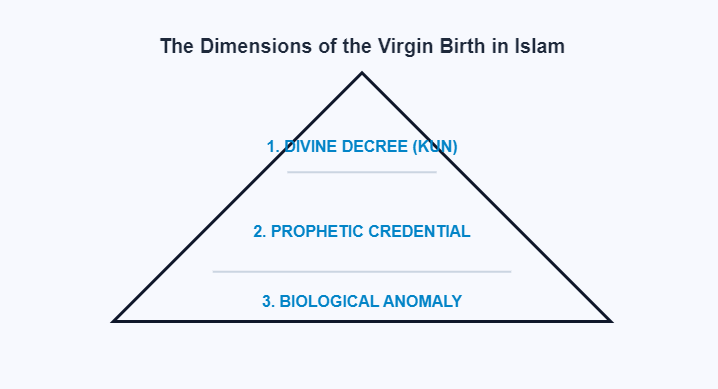
Logically, calling Jesus a “Word” (Kalimah) signifies that he came into existence through a direct creative command—”Be” (Kun)—rather than through standard biological fertilization. This bypasses the need for paternal DNA while maintaining his full human status. As discussed in our analysis of the Concept of Prophethood, Allah has used various means throughout history to communicate with humanity. The creation of Jesus was a communicative act, a message in human form that confirms the power of the Creator who initiated the Origins of the Universe.
1. The Logic of the First Cause and the Virgin Birth of Jesus
The primary logical pillar of The Virgin Birth of Jesus begins with the origin of the human species itself. Skeptics often find it difficult to accept a birth without a father, yet they accept the existence of a “First Human” or the initial emergence of life from inert matter.
The Quran utilizes a powerful “A Fortiori” logic to address this skepticism:
“Indeed, the example of Jesus to Allah is like that of Adam. He created Him from dust; then He said to him, ‘Be,’ and he was.” (Quran 3:59).
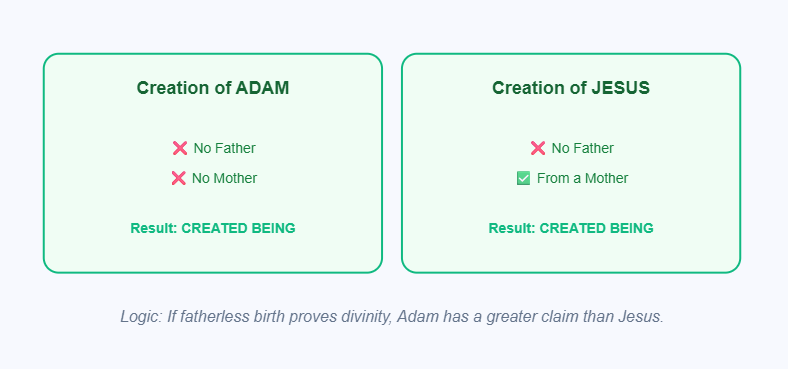
Logically, if the Creator possesses the power to create the first human (Adam) without either a father or a mother, then The Virgin Birth of Jesus without a father is equally possible. If we accept the Concept of God in Islam as the Sovereign Director of all matter, then this miracle is simply a variation of the creative process. This reasoning forces the intellect to acknowledge that biological “laws” are actually “habits” established by the Creator, which can be suspended to manifest a specific purpose.
2. Biological Possibility: Science and the Virgin Birth of Jesus
While The Virgin Birth of Jesus is a unique divine miracle, modern science has observed phenomena that provide a logical “possibility-model” for such events. In the natural world, “Parthenogenesis”—the development of an embryo from an unfertilized egg—occurs in several species, including reptiles, sharks, and birds.
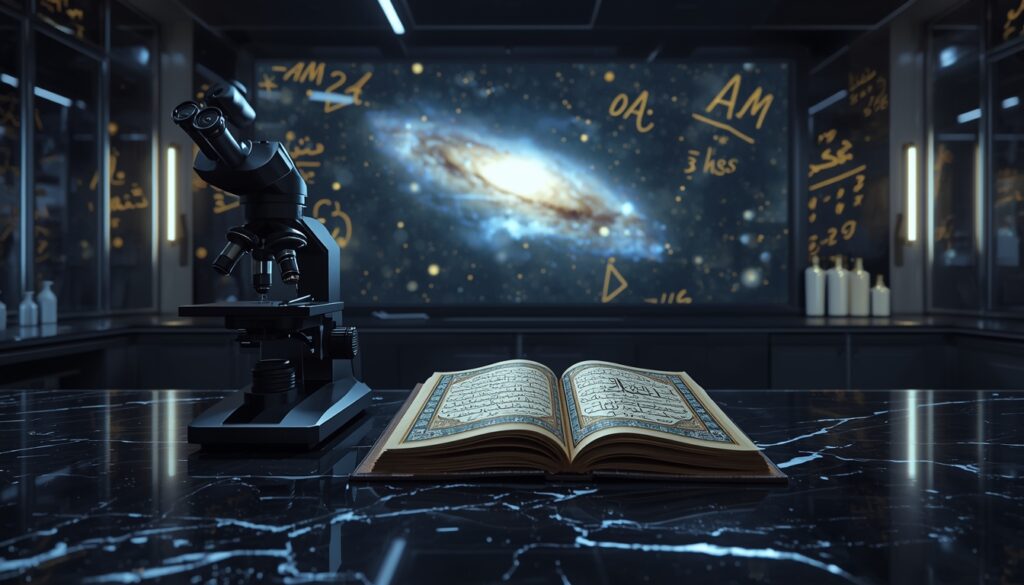
Logically, while this is not the habitual way for human beings to reproduce, its existence in nature proves that the biological “machinery” for fatherless birth exists within the potential of the Creator’s design. In Islamic theology, a miracle is often a “Habitual Impossibility” rather than a “Rational Impossibility.” For the scientific mind, recognizing that the Quran and Modern Science are in harmony means acknowledging that the One who designed the Human Genome has the absolute data-control to initiate an embryonic process without external male input. Thus, The Virgin Birth of Jesus is a sign of supreme biological authority.
3. The Status of Prophet Isa: Logic of the Virgin Birth of Jesus vs. Divinity
A major point of divergence between the Islamic perspective and traditional Western theology is the interpretation of The Virgin Birth of Jesus. While many use this miracle as proof that Jesus is the “Son of God” in a literal, ontological sense, the Islamic framework offers a more consistent logic: a miraculous birth does not necessitate a change in essence.
Logically, if being born without a father makes one divine, then Adam would have a greater claim to divinity than Jesus. Islam restores the logic of Tawhid (Absolute Monotheism) by affirming that Jesus was a “Created Servant” (Abd). The miracle was a credential for his Prophetic Sincerity, intended to show the Children of Israel that he was supported by the Lord of the Heavens. By maintaining this ontological gap, Islam protects Human Logic from the traps of deifying a mortal man who experienced human limitations despite the extraordinary nature of The Virgin Birth of Jesus.
4. The Honor of Mary: A Logical Requirement for the Virgin Birth of Jesus
The narrative of The Virgin Birth of Jesus is inextricably linked to the character of his mother, Mary (Maryam). The Quran elevates Mary above all women in the world, dedicating an entire chapter to her name. She is described as the woman who preserved her chastity and was a “Sign” for the worlds.
Logically, for such a monumental miracle as The Virgin Birth of Jesus to be verified, the vessel had to be a person of documented, absolute integrity. As explored in the study of Mary in Islam, her dedication to the sanctuary and her spiritual discipline provided the trustworthiness required for the community to accept the miracle. Her life is a proof of Islam and Objective Morality, where the purity of the individual is the foundation for receiving divine grace. The miracle was both a reward and a test for her unshakeable faith.
5. Prophecies and the Logical Purpose of the Virgin Birth of Jesus
The Virgin Birth of Jesus serves a specific eschatological and prophetic purpose. By entering the world through a direct creative command, Jesus was established as a unique bridge between the Law of Moses and the finality of Muhammad. His miraculous nature was a sign that the “Israelite branch” of prophecy was reaching its climax.
As we analyzed in Muhammad in the Bible prophecies, Jesus used his status to prepare the world for the arrival of the “Paraclete” or the “Spirit of Truth.” Logically, if the beginning of his life was a miracle of “Speech” (the Word), it is only consistent that he would prophesy a messenger whose primary miracle is also “Speech” (the Quran). This continuity proves that the Preservation of the Bible and Quran was part of a unified divine plan to lead humanity toward the Why Islam answer.
The Social and Historical Impact of the Virgin Birth of Jesus
To a skeptical researcher, The Virgin Birth of Jesus must also be understood through its immediate social consequences. When Mary returned to her people with the infant, she was met with intense suspicion and legal accusations. The Quran records that Jesus spoke from the cradle to defend her honor, a miracle that was a “Logical Necessity” to validate his origin.
This event provided a historical credential that protected the lineage of the Messiah. It showed that Sharia Law in Islam, which values the protection of honor and lineage, was upheld by a divine sign. By correcting the accusations made against Mary and the deification made by later groups, the Quran provides the “Truth Clearly”—a balanced narrative that satisfies the requirements of both history and reason regarding The Virgin Birth of Jesus.
Conclusion: The Rational Path to Understanding the Virgin Birth of Jesus
The scholarly investigation into The Virgin Birth of Jesus leads to a profound rational verdict: the fatherless birth of the Messiah is a logically consistent act for an All-Powerful Creator. By aligning the creation of Jesus with the broader logic of The Water Cycle in the Quran and the Origins of the Universe, we see a universe where everything is a manifestation of a singular Will.
For the skeptical mind, this miracle is an invitation to recognize the boundaries of human observation. It proves that we are not living in a random, self-contained machine, but in a purposeful creation governed by an All-Knowing Creator. By recognizing the truth of The Virgin Birth of Jesus, the seeker finds the path toward the Purpose of Life: to recognize the signature of Allah in every miracle and to worship Him alone.










Leave a Reply