
This research paper is part of Truth Clearly’s commitment to providing an authentic Islamic perspective on theology and history. We adhere to rigorous academic standards, relying exclusively on the Quran, authentic Prophetic traditions, and verified historical sources to provide clarity for the rational seeker.
For the vast majority of human history, the deep ocean remained a realm of myth and mystery. Ancient sailors rarely ventured far from the coast, and the technology required to explore the lightless depths of the sea did not exist until the mid-20th century. For the skeptical Western reader, the modern oceanographer, or the student of history, The Quranic Description of the Deep Sea presents a staggering intellectual anomaly. How could a 7th-century text, revealed to a Prophet who lived in the arid Arabian desert and never traveled by sea, accurately describe phenomena like “internal waves” and “layered darkness”?
In the Sunni Athari worldview, we recognize the Quran as the literal and uncreated Speech of Allah. Allah, the Most High, who is established over His Throne and distinct from His creation, is the Creator of the oceans and the Legislator of the laws of fluid dynamics. The Quranic Description of the Deep Sea is not a collection of seafaring legends; it is a series of scientific signs intended to provoke rational reflection on the omniscience of the Creator. This article explores five profound scientific realities of the deep ocean mentioned in the Quran, demonstrating a level of precision that was impossible for any human in late antiquity to possess.
Table of Contents
1. The Reality of Layered Darkness: The Light Spectrum
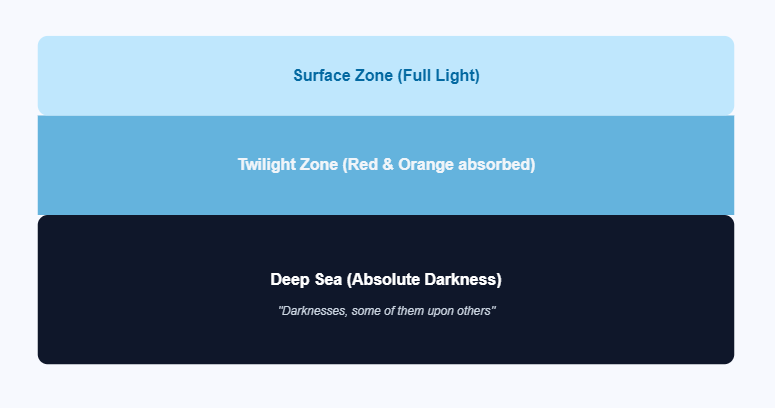
The primary logical pillar of The Quranic Description of the Deep Sea is found in its account of the complete absence of light in the deep ocean. The Quran uses a vivid metaphorical and scientific image:
“Or [it is] like darknesses within a deep sea… darknesses, some of them upon others. When one puts out his hand [therein], he can hardly see it.” (Quran 24:40).
Logically, this description identifies two distinct realities: that the darkness is “within” a deep sea and that it is “layered.” Modern marine biology confirms that sunlight is absorbed by water in a specific spectrum. First, the red color is absorbed in the first 10-15 meters, then orange, then yellow, and finally blue. This creates a “layering” of darkness. Below 1,000 meters (the Aphotic Zone), there is absolute darkness. A desert-dweller 1,400 years ago, who had never dived into the deep ocean, could not have known that light disappears in “layers.” This descriptive accuracy is a hallmark of the Authenticity of the Quran as a divine revelation.
2. Internal Waves: The Mystery of “Waves Upon Waves”
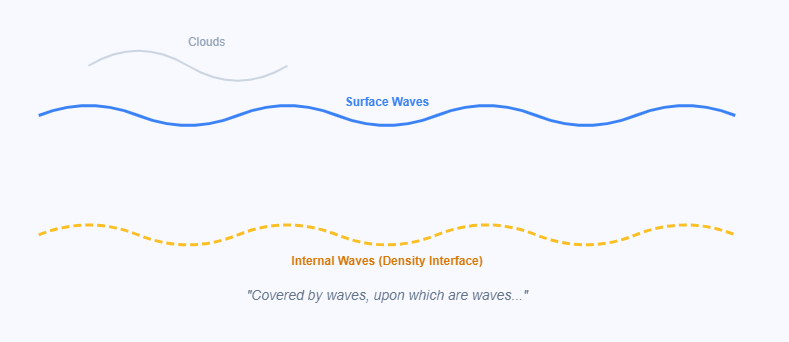
Perhaps the most astonishing aspect of The Quranic Description of the Deep Sea is the mention of a phenomenon that was only discovered by modern oceanography: internal waves. The Quran describes the deep sea as being:
“…covered by waves, upon which are waves, over which are clouds…” (Quran 24:40).
Until the late 19th century, it was assumed that waves only occurred on the surface of the water. However, science now recognizes “Internal Waves” that occur at the interface between layers of water with different densities (due to temperature or salinity). These waves are invisible from the surface but cover the deep ocean just as surface waves cover the top. The Quranic phrase “waves upon waves” is a precise structural description of the ocean’s dual-layered wave system. This knowledge is documented in Britannica’s analysis of ocean waves, highlighting that these internal movements were unknown to 7th-century sailors.
3. The Biological Barrier: The Logic of the Barzakh
While the deep sea is often perceived as a uniform body of water, The Quranic Description of the Deep Sea identifies a logical and physical barrier between different types of water. As we touched upon in our study of The Water Cycle in the Quran, the Quran mentions:
“He released the two seas, meeting [side by side]; Between them is a barrier (Barzakh) so neither of them transgresses.” (Quran 55:19-20).
Modern oceanography uses the term “Pycnocline” or “Halocline” to describe these invisible barriers where waters of different salinities or temperatures meet but do not immediately mix. This maintains the unique biological ecosystems within the ocean. For a text to describe an “invisible barrier” in the middle of the ocean is a profound sign of a Creator who sees every depth from His position High above His Heavens. This scientific reality aligns with the Concept of God in Islam as the Sovereign Controller of all physical boundaries.
4. The Origin of Life and the Aquatic Environment
The Quranic Description of the Deep Sea is inextricably linked to the broader Quranic claim that water is the fundamental building block of all life. As discussed in Islam and Evolution, the Quran asserts: “…and We made from water every living thing.”
Logically, modern biology supports this by identifying the ocean as the cradle of life. The complex chemical reactions required for the first cells to emerge, as analyzed by Nature regarding the origins of life, require an aqueous environment. The Quran’s focus on the sea and water is not a cultural coincidence of being in Arabia; it is a biological truth. By recognizing the sea as a primary source of life and signs, Islam invites the Human Logic to see the universe as a unified and purposeful creation.
5. The Preservation of Information in the Depths
Finally, The Quranic Description of the Deep Sea serves as a logical bridge to the concept of preservation. Just as the deep ocean “hides” and “preserves” things in its darkness, the Creator preserves the records of every soul. The precision of the oceanic descriptions in the Quran—at a time when humanity lacked submarines or diving gear—serves as an empirical “credential” for the text.
Logically, if the Quran is accurate about the parts of the earth we couldn’t see (the deep sea), it is reasonable to trust its descriptions of the parts of existence we cannot yet see (the Life After Death). The Sincerity of Prophet Muhammad is evidenced by his refusal to add any personal guesswork or myths of the time to these descriptions, delivering instead the literal and noble Speech of Allah. This consistency is what leads thousands to ask Why Islam? as they find a religion that honors the intellect and the physical world simultaneously.
Conclusion: The Sign of the All-Seeing Creator
The investigation into The Quranic Description of the Deep Sea leads to a clear rational verdict: the text possesses a degree of geological and oceanographic accuracy that defies human authorship in the 7th century. From the layered darkness of the Aphotic zone to the invisible internal waves, the Quran matches modern scientific discovery with unshakeable precision.
For the skeptical reader, these realities are an invitation to move beyond a materialistic view of the world. The ocean is not just a body of water; it is a “Book of Signs” authored by the same Being who spoke the Quran. By recognizing the harmony between Quran and Modern Science, one discovers that the “Truth Clearly” is present in every depth and every wave—a mercy from Allah, the Most High, who is established over His Throne and knows the secrets of the land and the sea.












Leave a Reply