
This research paper is part of Truth Clearly’s commitment to providing an authentic Islamic perspective on theology and history. We adhere to rigorous academic standards, relying exclusively on the Quran, authentic Prophetic traditions, and verified historical sources to provide clarity for the rational seeker.
In the modern age of neuroscience and cognitive psychology, a provocative question has emerged from laboratories and universities: Is religious belief merely a chemical accident, or is it an inherent part of the human design? For the skeptical Western seeker, the materialist, or the student of medicine, The Neurobiology of Faith presents an extraordinary intellectual crossroads. While atheistic naturalism often portrays faith as a “glitch” in the brain, a rigorous logical and biological inquiry into the Islamic framework reveals that the human brain is not accidentally religious, but is purposefully “hard-wired” to recognize its Creator.
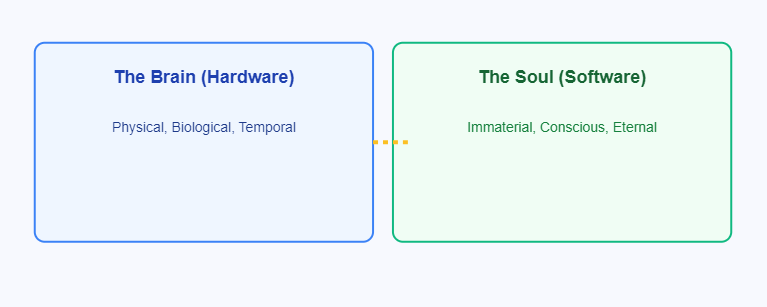
In the Sunni Athari worldview, we recognize that Allah—the unique Creator who is High above His Heavens and established over His Throne—designed the human being as an integrated entity of body and soul. The Neurobiology of Faith is the physical manifestation of the Fitrah—the innate nature placed within us by the All-Knowing. Because the Creator of the brain is the same Being who spoke the Quran, the biological “hardware” of the mind matches the spiritual “software” of revelation. This article explores seven profound logical reasons why the human brain is hard-wired for God, bridging the gap between Islam and Human Logic and modern neurology.
Table of Contents
1. The Pre-Programmed Compass: The Logic of the Fitrah
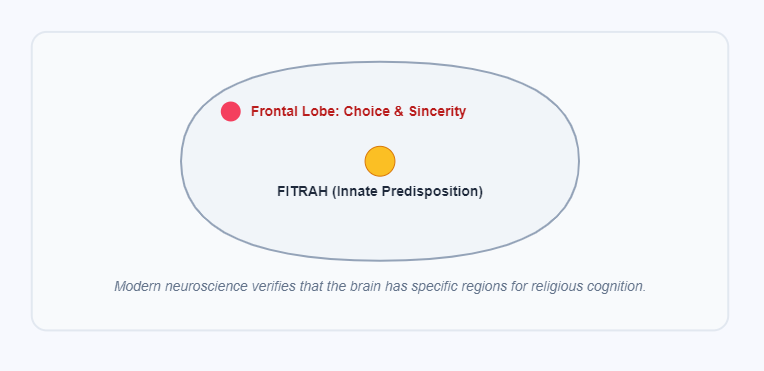
The primary logical pillar of The Neurobiology of Faith is the concept of the Fitrah. Islam teaches that every child is born with a natural inclination to believe in one God. Logically, if belief were purely a cultural construct, we would expect to find large populations of “natural atheists” among children who haven’t been taught religion.
However, cognitive scientists at Oxford University have discovered that children are “born believers.” They possess an innate tendency to see purpose and agency in the natural world. In Islamic logic, this is not an evolutionary survival mechanism, but a “Divine Signature.” The brain is pre-installed with the Concept of God in Islam, ensuring that every individual has an internal starting point for the Why Islam inquiry.
2. The Prefrontal Cortex: The Logic of Moral Agency
A profound reality in The Neurobiology of Faith is the function of the prefrontal cortex—the part of the brain located directly behind the forehead. As we discussed in Quran and Modern Science, the Quran identifies the “Naseyah” (forehead) as the center of lying and sinning (Quran 96:16).
Modern neuroscience confirms that the prefrontal cortex is the executive center for moral decision-making, social behavior, and impulse control. Logically, the existence of a specific biological region dedicated to “Higher Order” choices proves that humans are designed for Objective Morality. If we were mere biological accidents, we would not require such a sophisticated mechanism for moral agency. The Neurobiology of Faith shows that the brain is a tool for the soul to navigate the Logic of Free Will.
3. The “Hard Problem” and the Immaterial Ruh
The study of The Neurobiology of Faith inevitably leads to the “Hard Problem of Consciousness.” Science can map every neuron, but it cannot explain the “Experience” of the Self. Logically, matter cannot feel; a collection of atoms cannot “wonder.”
As analyzed in the Reality of the Soul, Islam asserts that the Ruh (Soul) is the master of the machine. The brain is the “radio,” and the soul is the “signal” from the command of Allah. The Neurobiology of Faith provides the interface between the material and the immaterial. This dual nature is what allows for Worship in Islam to produce a real, measurable physiological change—such as the reduction of stress and the increase of “Sakinah” (tranquility)—proving that the soul and brain are in perfect resonance.
4. The Logic of Transcendence: Rituals and Brain Plasticity
One of the most fascinating realities in The Neurobiology of Faith is “Neuroplasticity”—the brain’s ability to rewire itself. Research into the Logic of Prayer in Islam shows that the rhythmic, focused movements of Salah and the repetition of Dhikr (remembrance) strengthen the neural pathways associated with empathy and peace.
Logically, if the brain were not designed for God, religious rituals would be biologically neutral or harmful. Instead, they act as “spiritual vitamins,” improving mental health and cognitive clarity. This is a primary proof for the Prophetic Medicine approach, where physical health is linked to spiritual alignment. The Neurobiology of Faith demonstrates that the 5 Pillars of Islamic Faith are biologically optimal for the human mind.
5. The Genetic Anchor: The VMAT2 Gene
Skeptics often point to the discovery of the “God Gene” (VMAT2) as proof that religion is purely biological. However, the Neurobiology of Faith dialogue in Islam views this differently. Logically, if the Creator wanted humanity to know Him, He would place a “receiver” within our DNA.
The presence of genetic markers that influence spiritual openness is a sign of “Measured Decree” (Qadar). Allah, the All-Wise, established the Origins of the Universe and then designed a creature with a biological “attunement” to the divine. For the skeptical researcher, this is not an accident of evolution; it is the Fine-Tuning of the Universe manifesting at the genomic level.
6. Sincerity and the Reward System: The Logic of Dopamine
The human brain possesses a reward system (the mesolimbic pathway) that releases dopamine when we achieve a goal. The Neurobiology of Faith shows that altruism and sincere worship trigger this same reward system.
Logically, why would “Helping a Stranger” or “Praying at Dawn” feel rewarding to a biological organism? If we were only designed for selfish survival, these acts should feel like a waste of energy. The Sincerity of Prophet Muhammad in living for the sake of Allah produced a state of psychological peace that modern science is only now beginning to understand. The Neurobiology of Faith proves that the human brain is optimized for a life of purpose and sacrifice.
7. The Final Resolution: Brain Death and the Transition
Finally, The Neurobiology of Faith addresses the limit of biology. When the brain stops functioning (death), the materialist assumes the person is deleted. However, the Islamic worldview—anchored in Life After Death and Divine Justice—asserts that the person remains.
Logically, if the brain is just the “interface,” then the user (the soul) survives when the interface is broken. The Neurobiology of Faith provides the biological “training” for the Purpose of Life, preparing the consciousness for a realm where it is no longer bound by neurons and synapses. The Preservation of the Bible and Quran dialogue serves as a historical reminder that the Creator has always messaged the “mind” to guide the “soul.”
Conclusion: The Rationality of Divine Design
The study of The Neurobiology of Faith leads to a clear rational verdict: the human brain is a masterpiece of divine engineering. Its innate predispositions, its moral executive centers, and its positive response to ritual all point toward a single, Magnificent Designer who is High above His Throne.
For the skeptical mind, the brain is not a prison of matter; it is the gateway to the unseen. By recognizing the harmony between Muhammad as a Leader and the biological reality of our minds, the seeker finds the “Truth Clearly”—that we were created to know, love, and worship the One True God, and our very brains are the evidence of that mission.














Leave a Reply