
This research paper is part of Truth Clearly’s commitment to providing an authentic Islamic perspective on theology and history. We adhere to rigorous academic standards, relying exclusively on the Quran, authentic Prophetic traditions, and verified historical sources to provide clarity for the rational seeker.
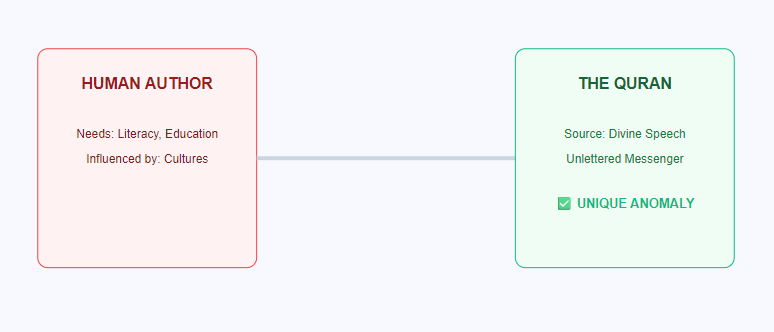
In the history of literature and religion, there is an intellectual anomaly that continues to perplex scholars and skeptics alike: the origin of the Quran. For the skeptical Western reader, the historian, or the academic researcher, the central challenge is to explain how a man in the 7th-century Arabian desert, who could neither read nor write, produced a text that revolutionized human law, science, and linguistics. The Mystery of the Unlettered Prophet (known as the Ummi) is not a point of weakness in Islam; it is one of the most powerful logical credentials of divine authorship.
In the Sunni Athari worldview, we recognize that Muhammad (peace be upon him) was a mortal messenger who faithfully conveyed the literal, uncreated Speech of Allah. Allah, the Most High, who is established over His Throne, chose an unlettered man to receive the final revelation specifically to ensure its purity. If the Prophet had been a scholar or a poet, critics would have claimed he “authored” the text. Instead, The Mystery of the Unlettered Prophet serves as a “Negative Proof”—a logical demonstration that the source of the Quran must be transcendent. This article explores five profound logical proofs of why Muhammad’s illiteracy is a sign of his Sincerity and the Authenticity of the Quran.
Table of Contents
1. The Logic of the Pure Conduit: Preventing Plagiarism
The primary logical pillar of The Mystery of the Unlettered Prophet is the prevention of intellectual doubt. If the Prophet Muhammad had been well-versed in the scriptures of the past or the philosophies of the Greeks, his message would be viewed as a “Synthesis” of existing human knowledge.
Logically, Allah chose an unlettered man to act as a “Pure Conduit.” The Quran states: “And you did not recite before it any scripture, nor did you write one with your right hand. Otherwise, the falsifiers would have had cause to doubt.” (Quran 29:48). This act of Divine Wisdom ensured that the Preservation of the Bible and Quran dialogue remained focused on the divine source. By having no access to written books, the Prophet could not have plagiarized the Muhammad in the Bible prophecies. The information he provided about the ancient prophets was “Fresh Information” from the One who witnessed it.
2. Linguistic Inimitability: The Unlettered Genius Paradox
A profound reality of The Mystery of the Unlettered Prophet is the linguistic miracle of the Quran. In 7th-century Arabia, poetry was the highest form of intellectual achievement. The masters of language spent their lives refining their meters and vocabulary.
Logically, it is an impossibility for an unlettered individual to produce a text that not only matches but surpasses the masters of linguistics. The Quran challenged the experts to produce even a single chapter like it, and for 1,400 years, they have failed. This “Linguistic Challenge” proves that the Concept of Prophethood is not based on human education, but on divine تأييد (support). The Mystery of the Unlettered Prophet turns Muhammad’s lack of formal schooling into an empirical proof: if the student never attended class, how did he produce the perfect exam? The only rational answer is that he was guided by the All-Knowing Creator.
3. Scientific Realities: Knowledge Beyond Observation
How did an unlettered man in the desert describe the Water Cycle or the Origins of the Universe with modern precision? The Mystery of the Unlettered Prophet reaches its peak when we analyze the Quran and Modern Science.
Logically, scientific discovery is a cumulative process requiring libraries, experiments, and written records. Muhammad had none of these. Yet, the Quran contains accurate descriptions of embryology, cosmology, and geology that were unknown to the most advanced civilizations of his time. This “Information Anomaly” proves that his source of knowledge was external and divine. For the skeptical researcher, the Scientific Miracles serve as a modern credential for the unlettered man who spoke the literal Speech of Allah from his position as a servant of the Most High.
4. The Moral Consistency: The Rejection of Self-Glorification
In any human work, the ego of the author is present. A man seeking power or fame through a book would inevitably place himself at the center of the narrative. However, in the Quran, Muhammad is often corrected and even admonished by Allah.
Logically, if Muhammad were the author, he would not write a book that criticized his own actions (such as in Surah ‘Abasa). The Mystery of the Unlettered Prophet highlights his absolute Sincerity. He was a faithful transmitter who did not add or subtract a single letter. He claimed no “Secret Knowledge” or personal “Genius”; he simply said, “I am only a man, like you, to whom it has been revealed.” This psychological honesty is a hallmark of Muhammad as a Leader.
5. The Sociological Transformation: From Illiteracy to the Golden Age
The final reality of The Mystery of the Unlettered Prophet is the cultural legacy he left behind. An unlettered man initiated the most significant literacy campaign in human history. He made seeking knowledge an obligation and described the “Ink of the Scholar” as sacred.
Logically, this led to the Islamic Contributions to Science, where the former unlettered desert tribes became the guardians of global knowledge. This transformation aligns with the Purpose of Life in Islam: to use the Human Logic to understand the Creator’s signs. By starting with an unlettered messenger, Allah proved that true “Enlightenment” comes from the Light of Revelation, which empowers the mind to explore the physical world.

Conclusion: Reclaiming the Rational Miracle
The scholarly inquiry into The Mystery of the Unlettered Prophet leads to a profound logical verdict: Muhammad’s illiteracy is the final seal of the Quran’s authenticity. It removes the possibility of human authorship and positions the text as a direct communication from the One who is High above His Heavens.
For the skeptical mind, the “Ummi” Prophet is a sign to reflect. It invites us to recognize that the greatest masterpiece in human history was delivered by a man who couldn’t read—a fact that forces the intellect to look toward the Divine Source. By understanding Why Islam remains the fastest-growing faith, we find the “Truth Clearly” in the mouth of the unlettered messenger: a message of peace, reason, and absolute Tawhid.











Leave a Reply