

The figure of the Messiah is central to billions. This article seeks to untangle the historical and theological differences between faith traditions using logical analysis, offering the Islamic perspective as a unifying and rational framework.
In the vast landscape of human theology, no concept has ignited as much hope, conflict, and intellectual debate as that of the Messiah. For the skeptical Western seeker, the historian, or the student of comparative religion, the figure of the Messiah is the ultimate puzzle. Why do the three great Abrahamic traditions—Judaism, Christianity, and Islam—possess such radically different definitions of this central figure? This divergence has led to what we call The Messiah Identity Crisis, a theological knot that has shaped the course of empires and the destiny of billions.
In the Islamic worldview, specifically within the Sunni tradition, we recognize that the truth regarding the Messiah is not found in the complex philosophical layers added by men, but in the literal Speech of Allah. Allah, the Most High, who is established over His Throne and is distinct from His creation, sent a succession of prophets to clarify the identity and mission of the Messiah. The Messiah Identity Crisis is not a result of divine ambiguity, but of historical shifts in interpretation and the loss of original manuscripts. This article explores seven profound logical reasons for these disagreements, demonstrating how Islam restores the original, rational prophetic vision of the Messiah.
Table of Contents
1. The Conflict of Expectations: Political King vs. Spiritual Messenger
The primary logical root of The Messiah Identity Crisis lies in the nature of “Messianic Expectations.” Historically, at the time of Jesus (Prophet Isa), the Jewish community was living under the brutal occupation of the Roman Empire. Their logical expectation, derived from their interpretation of the prophets, was for a military leader—a “King of the Jews” who would physically restore the throne of David and liberate the land.
When Jesus appeared as a humble messenger emphasizing spiritual purification, Objective Morality, and the Logic of Suffering, he did not fit the “Job Description” that the political elite had constructed. Logically, the rejection of Jesus by the Jewish establishment was not based on a lack of signs, but on a conflict between their desired “Ends” and God’s decreed “Means.” Islam clarifies this by asserting that the Messiah’s primary role was to confirm the Torah and reform the hearts, as explored in the Islamic view on Jesus.
2. The Ontological Shift: Human Prophet vs. Divine Incarnation
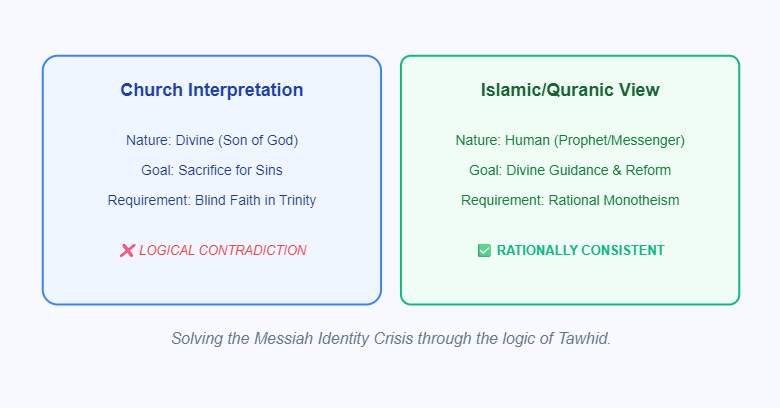
The second profound reality of The Messiah Identity Crisis is the definition of the Messiah’s nature. While Judaism correctly insisted that the Messiah must be a human being, later Christian theology—influenced by Pauline thought and Hellenistic philosophy—elevated Jesus to the status of a divine being, the “Son of God.”
As we analyzed in Paul vs. Jesus, this ontological shift created an unbridgeable gap. Logically, the attributes of the Creator (Infinite, Uncreated, Self-Sufficient) and the attributes of the creation (Finite, Temporal, Dependent) are mutually exclusive. Islam provides the logical corrective to this crisis. By affirming that Jesus in Islam is a majestic, miracle-working messenger but a mortal human servant (Abd), Islam restores the unclouded monotheism that Jesus himself practiced. This alignment with Tawhid (Absolute Monotheism) is the only framework that maintains the absolute majesty of Allah while honoring the Messiah.
3. The Logic of Atonement: Personal Responsibility vs. Original Sin
A major driver of The Messiah Identity Crisis is the doctrine of “Salvation.” Traditional Christianity developed a logic where the Messiah had to die as a blood sacrifice to pay for an “Inherited Debt” of sin.
Logically, as we explored in Salvation in Islam vs. Christianity, the concept of vicarious atonement contradicts the principle of individual justice. In Islam, every human is born in a state of Fitrah (purity) and is responsible only for their own choices. Therefore, the “Crisis” of a dying god is resolved by the Islamic reality: Jesus was not killed, nor was he an atoning sacrifice. He was a messenger who taught that Worship in Islam and sincere repentance are the direct paths to Allah’s mercy. This removes the logical need for a “sacrifice” and replaces it with the Logic of Free Will.
4. Linguistic Drift: The Translation of Titles
The Messiah Identity Crisis is heavily fueled by the loss of original linguistic nuances. The Hebrew word Mashiach and the Arabic Masih both mean “The Anointed One”—a title traditionally given to prophets and kings. In the ancient Hebrew context, calling someone a “Son of God” was a common metaphor for a righteous servant, found throughout the Old Testament.
However, when these Semitic concepts were translated into the Greek Christos and eventually the Latin and English “Christ,” the metaphorical meanings were often “literalized” into pagan-like concepts of divine-human hybrids. Logically, the Preservation of the Bible and Quran dialogue is essential here. The Quran, being preserved in its original Arabic tongue, prevents this linguistic drift. It identifies Jesus specifically as the “Word of Allah” (Kalimatullah) and a “Spirit from Him,” but always within the boundaries of created status, thus solving the identity crisis through linguistic precision.
5. The Prophetic Handover: Muhammad in the Biblical Narrative
For the skeptical researcher, The Messiah Identity Crisis is further complicated by the missing links in the prophetic chain. If Jesus was the “Final End” (as Christianity claims), why did he promise the arrival of another guide?
In the Gospel of John, Jesus speaks of the Paraclete or the “Spirit of Truth” who would come after him. As analyzed in Muhammad in the Bible prophecies, Islamic scholars provide the logical evidence that this refers to Prophet Muhammad. The crisis arises because the Church identifies this figure as a ghost, while the historical data points toward a human messenger who would bring a final, preserved Law. By recognizing Muhammad as the fulfillment of Jesus’s promise, the “Identity Crisis” of the Messiah is resolved—he was the herald of the Final Revelation.
6. Historical Divergence: The Qumran and Ebionite Testimony
Archaeology and history provide objective data that challenge the mainstream Church narrative of the Messiah. The discovery of the Dead Sea Scrolls and the history of the early Judeo-Christian sects (like the Ebionites) show that the earliest followers of Jesus viewed him as a human prophet and kept the Law of Moses.
Logically, if the people closest to Jesus did not believe in the Trinity or the divinity of the Messiah, then these doctrines must be later additions. The Messiah Identity Crisis is thus revealed to be a historical transformation from the “Hebrew Jesus” to the “Gentile Christ.” Islam’s account matches the “Primitive” view of Jesus, providing a historical consistency that is verifiable through Islam and Human Logic. This restorative power is a primary proof for the Authenticity of the Quran.
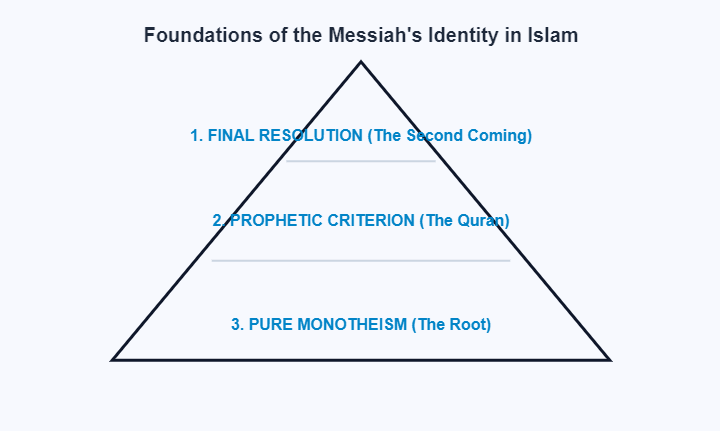
7. The Eschatological Resolution: The Second Coming
The final reality of The Messiah Identity Crisis is that it is destined for a physical resolution. All three faiths expect a future arrival of the Messiah, but their descriptions of his actions are contradictory.
Logically, only one version can be true. In the Islamic worldview—as detailed in the Signs of the Day of Judgment in Islam—Jesus will return not to initiate a new religion, but to clarify the truth for all the “People of the Book.” He will act as a just ruler who follows the final revelation. This return provides the ultimate logical closure: the Messiah himself will end the identity crisis by declaring his true status as a servant of Allah, the Most High, who is established over the Throne. This connects to the Purpose of Life as a preparation for this ultimate meeting.
Conclusion: Solving the Crisis through Sincerity
The scholarly investigation into The Messiah Identity Crisis leads to a profound rational verdict: the confusion surrounding Jesus is a result of human desire and historical intervention clashing with divine truth. By stripping away the deification on one hand and the rejection on the other, Islam offers a Messiah who is both majestic and humanly relatable.
For the skeptical mind, the Islamic portrayal of the Messiah is the only one that satisfies the requirements of monotheistic logic and historical evidence. It respects the Sincerity of the Prophets and the Scientific Miracles of the Quran that verify the messenger. In the end, solving the identity crisis is about finding the “Truth Clearly”—recognizing that the Messiah was a brilliant light sent by the One True God to guide humanity back to the pure worship of their Creator, the King of the Heavens and the Earth.












Leave a Reply