

This research paper is part of Truth Clearly’s commitment to providing an authentic Islamic perspective on theology and history. We adhere to rigorous academic standards, relying exclusively on the Quran, authentic Prophetic traditions, and verified historical sources to provide clarity for the rational seeker.
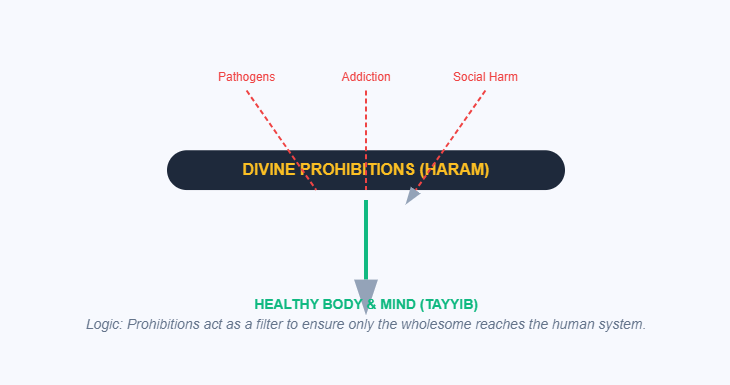
In the modern world, the concept of “freedom” is often equated with the absence of restrictions. For the skeptical Western reader, the traveler, or the student of sociology, the Islamic legal system—specifically its dietary laws—can appear as a rigid list of arbitrary “don’ts.” Why is pork forbidden? Why is alcohol, a social staple in many cultures, strictly prohibited? A rigorous inquiry into The Logic of Prohibitions in Islam reveals that these mandates are not meant to curtail human joy, but to serve as a sophisticated “preventative manual” designed to protect the biological, psychological, and social integrity of the human being.
In the Islamic worldview, specifically within the Sunni Athari tradition, we recognize Allah as the All-Wise Legislator (Al-Hakim) who is High above His Heavens and established over His Throne (Istawa). He is the Creator of the human body and the biological systems that sustain it. Therefore, His prohibitions (Muharramat) are not arbitrary exercises of power, but acts of supreme mercy (Rahmah). As we established in the Concept of God in Islam, Allah is self-sufficient and requires nothing from His creation; rather, His laws are for our benefit. This article explores five revolutionary realities behind The Logic of Prohibitions in Islam, demonstrating how divine decree aligns with rational wellbeing.
Table of Contents
1. The Biological Shield: The Logic Behind the Prohibition of Pork
The primary logical pillar of The Logic of Prohibitions in Islam regarding food is the ban on swine flesh. While ancient civilizations often viewed the pig as a scavenger, modern biological science has provided a clearer picture of why this meat is classified as “impure” (Rijs) in the Quran.
Logically, an organism’s physiology determines its suitability for consumption. The pig is a primary carrier for several pathogens and parasites, most notably Trichinella spiralis. Furthermore, unlike other herbivores used for meat, the pig’s digestive system is extremely rapid, which means it does not effectively filter out toxins from the waste it consumes. This medical reality aligns with Prophetic Medicine, which emphasizes the link between diet and the health of the heart. By prohibiting pork, Islam established a biological shield for humanity 1,400 years before the discovery of helminthology or modern food safety standards. This reflects the perfect Knowledge of Allah, the Creator of the Heavens and the Earth.
2. Preserving the Intellect: The Logic of the Prohibition of Alcohol
If there is one prohibition that defines the social boundary of Islam, it is the total ban on Khamr (intoxicants). In a secular context, alcohol is a multi-billion dollar industry, yet it is also the leading cause of preventable deaths, domestic violence, and social fragmentation globally. The Logic of Prohibitions in Islam addresses this through the principle of “The Preservation of the Intellect” (Hifdh al-Aql).
The intellect is the greatest gift Allah granted to humans, allowing us to engage in Islam and Human Logic. Logically, any substance that temporarily “veils” or disables the mind is an assault on human dignity and responsibility. As documented by the World Health Organization regarding alcohol-related harm, the societal cost of intoxicants is staggering. Islam’s proactive stance—banning even a small amount—prevents the “slippery slope” of addiction. By protecting the mind, Islam ensures that the individual remains a conscious moral agent, capable of fulfilling the Purpose of Life.
3. The Sanctity of Blood: Biological and Legal Logic
The Quran strictly prohibits the consumption of “poured-out blood.” Logically, this mandate serves two critical functions. First, from a biological standpoint, blood is the primary medium through which pathogens, bacteria, and toxins circulate within an animal. Consuming it is an unnecessary medical risk.
Second, from a theological perspective, the blood represents the life-force. By mandating that the animal must be drained of its blood during slaughter, Islam reinforces the Islam and Human Rights framework even in the treatment of animals. It reminds the believer that “killing” for food is a heavy responsibility allowed only by the permission of Allah, the Most High. This ethical drainage ensures that the meat is not only physically pure but also spiritually clean, aligning with the Worship in Islam that integrates the material and the spiritual.
4. Ethical Slaughter: The Logic of Mercy over Cruelty
A profound reality of The Logic of Prohibitions in Islam is the Halal method of slaughter (Dhabihah). Islam prohibits the consumption of animals that have died of natural causes, strangulation, or a violent blow.
Logically, these prohibitions protect the consumer from eating animals that may have been diseased or whose meat has been spoiled by the stress hormones (like adrenaline and cortisol) released during a prolonged or agonizing death. The Islamic method—a swift incision to the major neck vessels—ensures the immediate loss of consciousness and the rapid drainage of blood. This scientific foresight, which we analyzed in the Scientific Miracles of the Quran, ensures that the meat is at its highest quality. It demonstrates that Sharia Law in Islam is a system built on the avoidance of unnecessary harm (Dharar).
5. The Body as an Amanah: The Logic of Stewardship
Finally, The Logic of Prohibitions in Islam is rooted in the concept of Amanah (Trust). In a materialistic worldview, “my body is my own, and I can do what I want with it.” In Islamic logic, the body is a gift from Allah, and we are its stewards, not its absolute owners.
Logically, if you are entrusted with a valuable machine, you must follow the manufacturer’s instructions to keep it running. Following dietary laws is an act of stewardship. By avoiding the Haram (forbidden) and consuming the Tayyib (wholesome), a person aligns their physical self with the Origins of the Universe—which was created with balance (Mizan). This sense of accountability to the Creator, who is established over the Throne, is what gives the believer the Sincerity to maintain a healthy lifestyle even when no other human is watching. It is a psychological shield against the self-destructive tendencies of modern consumerism.
Conclusion: The Wisdom of Divine Boundaries
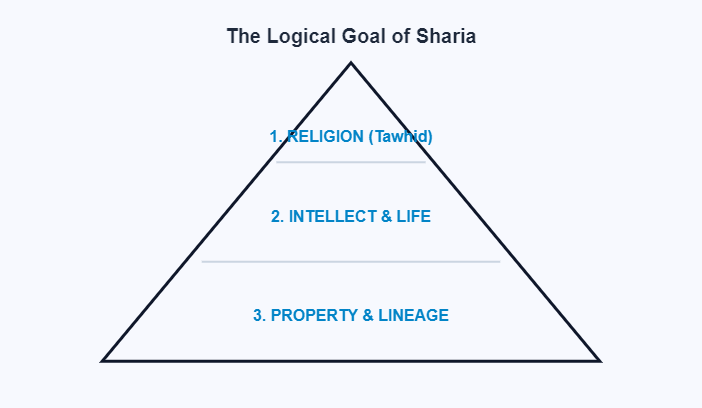
The scholarly inquiry into The Logic of Prohibitions in Islam leads to a profound rational verdict: Islamic dietary laws are not a burden, but a sophisticated system of bio-ethics and social protection. By prohibiting substances that harm the body and cloud the mind, Islam provides the boundaries within which a human can reach their full potential.
For the skeptical mind, these prohibitions are invitations to recognize the Wisdom of the Legislator. Allah, the All-Knowing, has provided a map for health that is as biologically sound as it is spiritually uplifting. By recognizing the “Truth Clearly” in the food we eat, we find the Why Islam answer: a religion that cares for the servant’s physical heart as much as it cares for their spiritual one. Ultimately, the prohibitions are signs of Divine Mercy, ensuring that we return to our Creator in a state of purity and peace.














Leave a Reply