
This research paper is part of Truth Clearly’s commitment to providing an authentic Islamic perspective on theology and history. We adhere to rigorous academic standards, relying exclusively on the Quran, authentic Prophetic traditions, and verified historical sources to provide clarity for the rational seeker.
In a world increasingly defined by high-speed technology, constant digital distraction, and a rising tide of mental exhaustion, the practice of daily ritual often seems like an outdated relic of a simpler past. For the skeptical Western seeker, the agnostic academic, or the individual searching for a centered existence, the Islamic act of prayer (Salah) presents a fascinating subject of study.
Why do over 1.8 billion people stop their lives five times a day to perform specific physical movements facing a single direction? A rigorous logical inquiry into The Logic of Prayer in Islam reveals that this practice is not a burden of “empty rituals,” but a sophisticated spiritual technology designed to align the human body, mind, and soul with the reality of the Creator.
In the Sunni Athari worldview, we recognize Allah as the unique and All-Wise Creator who is High above His Heavens and established over His Throne (Istawa) in a manner that suits His Majesty, distinct from His creation. He spoke the Quran as His literal, uncreated Speech, and in this revelation, He commanded the establishment of prayer as the primary link between the creature and the Creator. The Logic of Prayer in Islam is based on the ontological reality that humans are created beings with an innate need (Fitrah) to connect with their Source. Prayer is a direct meeting without any intermediary. This article explores seven profound logical realities that explain the physical, psychological, and theological depth of Islamic prayer.
Table of Contents
1. The Logic of Mandated Mindfulness: The Cosmic Clock
The primary logical pillar of The Logic of Prayer in Islam is its timing. Unlike secular “meditation” which is often practiced only when one “feels like it,” Salah is anchored to the cosmic clock—the position of the sun. The five daily prayers act as “spiritual anchors” distributed throughout the day’s transition from light to dark.
In modern psychology, this is recognized as “Interval Reinforcement.” By interrupting the material pursuit of wealth, status, and ego five times a day, Islam forces the human mind to pause and remember the Purpose of Life. It prevents the soul from being swallowed by the “entropy” of daily stress. Logically, a mind that re-centers itself on the Creator every few hours remains more resilient and focused than a mind left to wander in a material vacuum. This consistent return to the Divine is a practical manifestation of Worship in Islam.
2. The Physicality of Submission: Prostration and the Ego
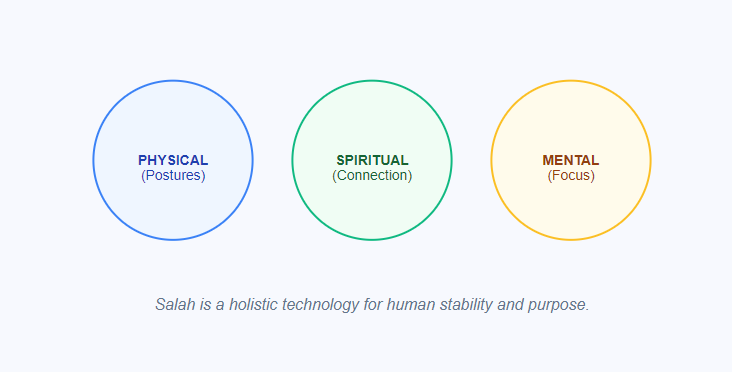
A unique aspect of The Logic of Prayer in Islam is its requirement for specific physical postures. Prayer is not merely a mental exercise; it involves the entire biological entity. The acts of standing (Qiyam), bowing (Ruku), and prostrating (Sujud) carry a profound symbolic and biological logic.
Logically, the most “honored” part of the human body is the face and the forehead—the seat of our identity and intellect. By placing the forehead on the ground in prostration, the believer is making a radical statement of humility before Allah, the Most High. This physical act shatters the arrogance of the ego and reminds the individual of their humble origin, a concept we explored in our analysis of Islam and Evolution. Biologically, prostration has been shown to increase cerebral blood flow and stimulate the prefrontal cortex, which we identified in Quran and Modern Science as the center of moral decision-making and honesty.
3. The Unified Direction: Logic of the Qibla and Global Harmony
Skeptics often ask: “Why face Mecca? Is God not everywhere?” The Logic of Prayer in Islam answers this through the lens of unity and cosmic order. While Allah is distinct from His creation and Above the Throne, He has established the Kaaba as a physical symbol of human unity.
Facing the Qibla is a logical requirement for collective harmony. If every individual prayed in a random direction, the communal prayer would be chaotic. By directing millions of hearts and bodies toward a single point, Islam creates a “Global Grid” of focused intention. This unity reflects the Concept of God in Islam as the One (Al-Wahid) who governs a unified universe. It is a powerful sociological proof of Islam and Human Rights, as it places the king and the laborer in the same row, shoulder to shoulder, facing the same House as equal servants of the One True God.
4. The Psychological Sanctuary: Achieving Sakinah (Tranquility)
Modern life is characterized by “Hyper-Arousal”—a state of constant fight-or-flight due to the demands of a secular society. The Logic of Prayer in Islam provides a mandated “Psychological Sanctuary.” When a Muslim enters prayer, they are forbidden from speaking to people or thinking of worldly affairs; they are in a private audience with the King of kings.
Logically, this creates a state of “Flow” or deep immersion. In Islamic terminology, this is Khushu’ (Focus). This state of mind triggers the release of neurotransmitters associated with peace and tranquility (Sakinah). Unlike secular mindfulness, which often focuses on the “Self,” Salah focuses the attention on the “Creator,” providing an external anchor that is far more stable than the fluctuating human psyche. This psychological resilience is a primary reason why the Sincerity of Prophet Muhammad remained unshakeable despite decades of persecution.
5. Scriptural Resonance: Reciting the Literal Word
During every prayer, a Muslim must recite the opening chapter of the Quran (Al-Fatiha) and other passages. The Logic of Prayer in Islam emphasizes that the believer is not just “thinking good thoughts,” but is actively vocalizing the literal and uncreated Speech of Allah.
As we explored in the Authenticity of the Quran, the Quran is a linguistic and logical miracle. Reciting it in prayer allows the human tongue and heart to vibrate with the divine message. Logically, this serves as a daily “re-calibration” of the human moral compass. By repeating the words of the Creator, the individual reinforces their commitment to Islam and Objective Morality. It is a daily oral reminder where the believer reaffirms their path toward truth and away from the Logic of Suffering caused by error.
6. Biological Prerequisite: The Logic of Wudu (Ablution)
One cannot engage in The Logic of Prayer in Islam without the prerequisite of Wudu. The mandate to wash the hands, face, and feet before standing in prayer is a revolutionary standard of hygiene and mental preparation.
From a logical medical perspective—as detailed in our study of Prophetic Medicine—this practice ensures that the believer is physically clean and mentally transitioned. It creates a psychological trigger: the cool water on the skin signals the brain to move from the chaotic “World of Matter” into the serene “World of Spirit.” This focus on purity as a requirement for divine connection is a logical sign that Islam addresses the human as a unified being—biological and spiritual—not just as a disembodied mind.
7. Preparation for the Final Meeting: The Logic of Accountability
Finally, The Logic of Prayer in Islam is a continuous “dress rehearsal” for the ultimate meeting with the Creator. Islamic theology teaches that on the Day of Judgment, the first thing a person will be asked about is their prayer.
Logically, if you are preparing for a life-altering meeting with a high authority, you practice and refine your etiquette. Salah is the daily practice for the Life After Death. It instills a sense of “Eternal Accountability.” By standing alone before Allah five times a day, the believer becomes comfortable with the reality of being “exposed” before the All-Seeing Creator. This removes the existential dread of the unknown and replaces it with the “Anticipation of Grace,” which is the logical goal of any rational faith system as discussed in the Why Islam inquiry.
Conclusion: Reclaiming the Rhythm of the Soul
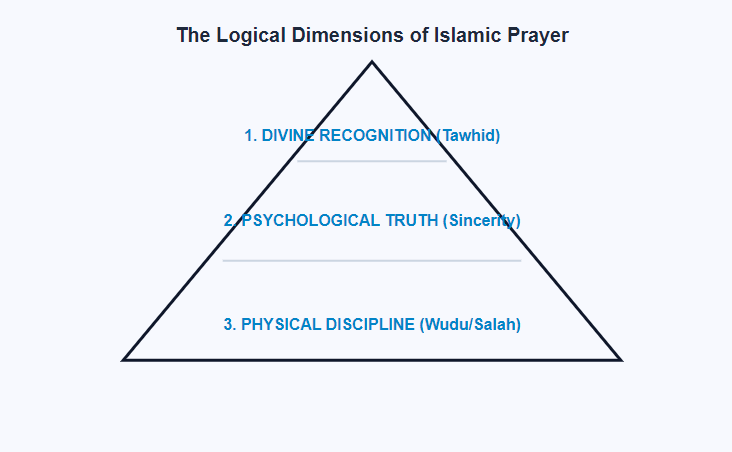
The scholarly investigation into The Logic of Prayer in Islam reveals a worldview where physical discipline is the gateway to spiritual freedom. By stopping the world to face the Creator, the Muslim declares that their life is governed by a Higher Decree (Qadar) and a Higher Wisdom.
For the skeptical mind, the consistency of prayer is an invitation to reflection. It is a system that protects the intellect from arrogance, the heart from despair, and the body from stagnation. In the rhythmic movements and precise timings of Salah, one finds the truth clearly revealed: that we were created to know and worship the One True God, the Most High, who is established over His Throne and hears the whisper of every bowing servant. Just as the Origins of the Universe were initiated with a command, the human soul is sustained by its daily response to that same Divine Voice.













Leave a Reply