

This research paper is part of Truth Clearly’s commitment to providing an authentic Islamic perspective on theology and history. We adhere to rigorous academic standards, relying exclusively on the Quran, authentic Prophetic traditions, and verified historical sources to provide clarity for the rational seeker.
In the modern age, the term “miracle” is often met with immediate skepticism. For the Western reader, the scientist, or the agnostic seeker, the idea that a natural law could be suspended—such as a sea parting or a virgin giving birth—seems like a direct violation of the foundations of reason. The common argument suggests that because science describes a consistent, law-governed universe, the supernatural must be an impossibility. However, a rigorous inquiry into The Logic of Miracles in Islam reveals that there is no inherent contradiction between the laws of physics and divine intervention.
In the Sunni Athari worldview, we recognize Allah as the absolute Creator who is High above His Heavens and established over His Throne (Istawa). He is the Legislator of the laws of science; therefore, He is not governed by them—they are governed by Him. A miracle (Mu’jizah) is not a “magic trick” without a cause, but an extraordinary effect whose cause is the direct Will of the Creator. This article explores seven profound realities regarding The Logic of Miracles in Islam, demonstrating why the supernatural is the ultimate extension of a purposeful cosmic order.
Table of Contents
1. The Sovereignty of the Legislator: The Author vs. The Law
The primary pillar of The Logic of Miracles in Islam begins with the identity of the Lawgiver. In science, “laws” are descriptions of how matter habitually behaves. In Islamic theology, these are not independent forces but are the “Habits of Allah” (Sunan Allah). Logically, the one who establishes a law possesses the inherent authority to suspend or alter that law for a specific purpose.
Consider a computer programmer who creates a virtual simulation with fixed gravity and physics. If the programmer decides to make an object float to send a signal to the inhabitants of that simulation, has the internal logic of the world broken? No; the programmer has simply introduced an external variable. Allah, who initiated the Origins of the Universe, remains the Sovereign Controller of the “code” of reality. By recognizing the Concept of God in Islam as a Being of absolute power and will, the suspension of a physical law becomes a logical certainty in the face of divine intent.
2. Miracles as Intellectual “Signatures” of Verification
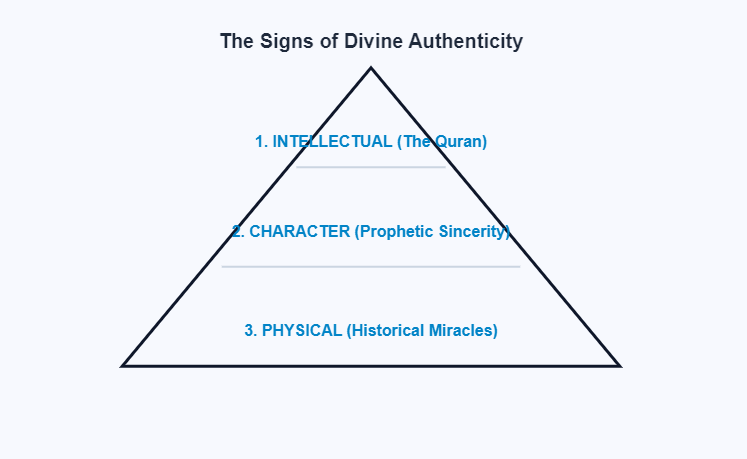
From a rational perspective, the purpose of a miracle in the Islamic framework is verification. If a man claims to be a messenger from the King of kings, he must present credentials that no ordinary human can produce. The Logic of Miracles in Islam positions these events as “Divine Signatures.” They are meant to shatter the illusion of a self-contained material world and point the observer toward the Source.
Logically, if anyone could perform these acts by their own power, they would lose their value as evidence. The rarity and habitual “impossibility” of the miracle are what make it a valid proof of Prophethood. It serves as a clear sign to the human intellect (‘Aql) that the message being delivered—such as the Authenticity of the Quran—is supported by the One who holds the keys to the physical elements. This is why the Sincerity of Prophet Muhammad was backed by signs that left his contemporaries in awe.
3. The Logic of the Miraculous Birth: Omnipotence over Biology
A central miracle in the Abrahamic heritage is the miraculous birth of Jesus (Prophet Isa). While skeptics view the virgin birth as a biological impossibility, The Logic of Miracles in Islam applies a different rational conclusion. If we accept that Allah created the first human (Adam) without a father or a mother, then creating a human (Jesus) without a father is logically equally possible.
The Quranic narrative emphasizes the logic of divine command: “When He decrees a matter, He only says to it, ‘Be,’ and it is” (Quran 19:35). In the Islamic view on Jesus, the miraculous birth is not a proof of Jesus’s divinity, but a proof of Allah’s absolute creative power. It demonstrates that the biological “laws” of reproduction are merely tools used by the Creator, which He can bypass to manifest a specific sign. This reinforces the Purpose of Life as a recognition of our total dependence on the One who is Above the Throne.
4. Status of Prophet Isa: Distinguishing the Logic of Miracles in Islam from Divinity
A frequent point of confusion is whether performing a miracle makes the performer a deity. The Logic of Miracles in Islam provides a firm rational “No.” Every miracle performed by Jesus, Moses, or Muhammad was accompanied by the prerequisite: “By God’s Permission” (Bi-idhnillah).
Logically, if a miracle-worker were a god, they would not need permission. The fact that the miracles were contingent upon the Will of Allah proves that the Prophet was a dependent servant (Abd). This distinction is vital for maintaining the logic of Tawhid (Absolute Monotheism). Miracles are the “Credentials of the Messenger,” not the “Attributes of the Creator.” By understanding this, the skeptical mind can appreciate the supernatural without falling into the logical trap of deifying a mortal man, a theme we explored in Salvation in Islam vs. Christianity.
5. Habitual Necessity vs. Rational Necessity: How the Logic of Miracles in Islam Functions
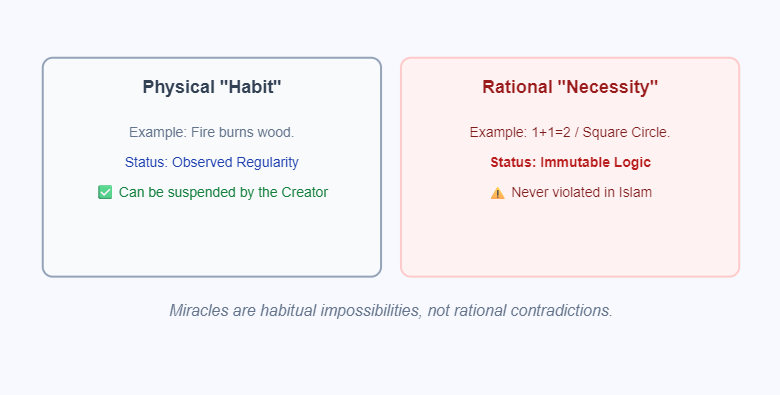
Classical Islamic scholars made a profound logical distinction that is often missed in modern debates: the difference between “Habitual Impossibility” and “Rational Impossibility.” This is a core component of The Logic of Miracles in Islam.
- Rational Impossibility: Something that contradicts the laws of basic thought, such as a square circle. Miracles never fall into this category.
- Habitual Impossibility: Something that contradicts our daily observation, such as fire not burning.
Islam asserts that the laws of physics are “Habits” established by Allah. Fire burns because Allah habitually creates the property of heat when fuel meets oxygen. However, there is no logical reason why Allah cannot stop creating that heat for a moment, as He did for Abraham. Logically, we assume the future will be like the past, but we cannot prove it is “necessary.” As documented by Britannica’s analysis of the history of miracles, philosophy acknowledges that we cannot prove laws of nature are unchangeable. Islam provides the reason: they are decrees from the One Above the Throne.
6. Information Theory: The Logic of Miracles in Islam as a System Override
Modern science increasingly views the universe through the lens of information and mathematical laws. In The Logic of Miracles in Islam, a miracle can be understood as an “Information Override.” If the Creator wrote the mathematical laws that govern the Scientific Miracles of the Quran, He can introduce new data into the system at any time.
When the Prophet Muhammad split the moon, or when Moses split the sea, it was a physical manifestation of a higher command. Logically, the One who manages the Water Cycle in the Quran and the orbits of the stars has the absolute data-control to alter the state of any material object. For the skeptical researcher, this aligns with the idea that the universe is not a closed, blind machine, but a responsive creation overseen by an All-Hearing, All-Seeing Master.
7. The Quran: The Perpetual and Intellectual Miracle
Unlike the physical miracles of previous prophets, which were witnessed only by their contemporaries, the primary miracle of Islam—the Quran—is an intellectual and perpetual one. The Logic of Miracles in Islam reaches its peak in the linguistic and structural inimitability of the text.
Logically, if a book challenges the masters of a language for 1,400 years to produce a single chapter like it and they fail, that failure constitutes an empirical proof of its non-human origin. This is a miracle that can be verified today through Islam and Human Logic. It does not require a time machine; it only requires an open mind and a study of the Authenticity of the Quran. This ensures that every generation has a rational “Sign” to lead them toward the truth.
Conclusion: The Harmony of Faith and Reason
The investigation into The Logic of Miracles in Islam leads to a profound rational verdict: the supernatural is not the enemy of the natural; it is its Source. By recognizing that the laws of science are the “decreed habits” of a Wise Creator who is High above His Throne, we find that miracles are not “illogical,” but are a higher level of logic in action.
For the skeptical mind, miracles are an invitation to recognize that we are not living in an accidental cage of physics, but in a purposeful masterpiece of design. Through the miracles of the past and the perpetual miracle of the Quran, the “Truth Clearly” shines through—reminding us that the same God who governs the stars has the power to intervene in our lives and guide us back to Him. By following the Worship in Islam, we align our souls with the One who possesses the absolute power to say “Be,” and it is.






Leave a Reply