

This research paper is part of Truth Clearly’s commitment to providing an authentic Islamic perspective on theology and history. We adhere to rigorous academic standards, relying exclusively on the Quran, authentic Prophetic traditions, and verified historical sources to provide clarity for the rational seeker.
In the modern discourse on gender equality, few topics are as frequently weaponized against the Islamic worldview as the system of wealth distribution. For the skeptical Western reader, the activist, or the student of law, The Logic of Inheritance in Islam is often reduced to a single, misinterpreted binary: “men get twice as much as women.” However, a rigorous logical and economic inquiry reveals that this simplistic narrative fails to account for the comprehensive financial ecosystem of Islam. Islamic inheritance is not a tool for patriarchy; it is a sophisticated mechanism for social stability and economic equity.
In the Sunni Athari perspective, we recognize that Allah—the All-Wise and All-Just Creator who is established over His Throne—is the Author of the laws of inheritance. He spoke these laws as His literal Speech in the Quran, providing a mathematical blueprint for justice that balances rights with responsibilities. The Logic of Inheritance in Islam is part of the broader Sharia Law in Islam, intended to protect the Human Rights of every family member. This article explores seven revolutionary truths that demonstrate why the Islamic system is the most rational and fair method of wealth distribution.
Table of Contents
1. Equity vs. Equality: The Logic of Financial Burden
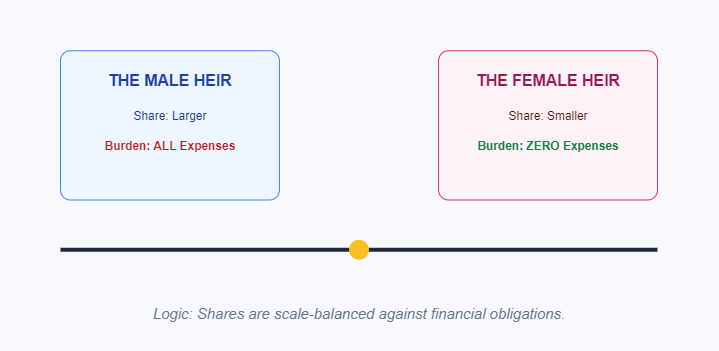
The primary logical pillar of The Logic of Inheritance in Islam is the distinction between “Equality” (giving everyone the same) and “Equity” (giving everyone what is fair based on their needs). In Islam, wealth is tied to financial obligation (Nafaqah).
Logically, under Islamic law, a man is legally obligated to provide for his wife, children, parents, and often his unmarried sisters. A woman, however, has zero legal obligation to spend a single penny of her wealth on anyone else; her earnings and her inheritance are hers alone. As we explored in Women in Islam, a woman’s wealth is “Tax-Free,” while a man’s wealth is “Heavily Taxed” by his responsibilities. Therefore, giving the man a larger share of the “gross” inheritance is a logical way to ensure that the “net” disposable wealth of the woman remains equal or often greater than that of the man.
2. The 30+ Cases: Debunking the “Always Half” Myth
A staggering reality in the study of The Logic of Inheritance in Islam is that the “half share” rule only applies in four specific cases. There are over thirty cases in Islamic law where a woman inherits the same as a man, more than a man, or even where she inherits and the man is excluded entirely.
Logically, if the system were designed to suppress women, they would always get less. The fact that the distribution fluctuates based on the proximity to the deceased proves that the logic is built on “Generational Continuity” rather than “Gender Superiority.” This mathematical flexibility is a credential for the Authenticity of the Quran as a guide that addresses the complex realities of family life.
3. Preserving the Family Unit: The Logic of Dispersion
Unlike some systems that favor the eldest son (primogeniture), The Logic of Inheritance in Islam mandates the wide dispersion of wealth. The Quran identifies a broad circle of heirs, including parents, spouses, and multiple children.
Logically, this prevents the hoarding of capital within a single individual, which is a major cause of economic inequality in secular societies. By forcing wealth to flow through the entire family tree, Islam ensures that every branch is supported. This aligns with Islamic Environmental Ethics regarding the fair distribution of resources and the rejection of greed. It reflects the Concept of God in Islam as Ar-Razzaq (The Provider) who ensures that everyone’s needs are met.
4. The Right to Property: Logical Autonomy for Women
A profound reality of The Logic of Inheritance in Islam is that it established women as independent economic agents 1,200 years before the Western world. Under the Sharia, a woman’s inheritance does not become her husband’s property.
Logically, this provides a “Safety Net” that protects a woman’s dignity. Whether she is a daughter, a mother, or a wife, her share is a guaranteed divine right that no male relative can revoke. This logical autonomy is why Islam and Secularism studies often find that Islamic law provided more protection for women’s assets than medieval common law systems. It is a manifestation of the Sincerity of Prophet Muhammad who championed the rights of the vulnerable.
5. Mathematical Precision: A Sign of the Creator
The laws of inheritance in the Quran are presented with extreme mathematical detail. For the skeptical seeker or the mathematician, the way these fractions (1/2, 1/4, 1/8, 1/3, 1/6) always resolve into a perfect whole—regardless of the complexity of the family—is a miracle of design.
Logically, such a precise and error-free system being delivered by an unlettered man in the 7th century points toward a divine source. This is a primary example of Scientific Miracles in the Quran applied to social science. The mathematical consistency of inheritance is the “Macro” version of the Fine-Tuning of the Universe; it ensures that the “Social Universe” remains in balance (Mizan).
6. The Logic of the Will (Wasiyyah): Flexibility for the Needy
While the Quran fixes the primary shares, it also allows for a “Will” (Wasiyyah) for up to one-third of the estate. Logically, this provides the flexibility to care for those who are not primary heirs, such as adopted children, charities, or non-Muslim relatives.
This balance between “Rigid Justice” and “Flexible Mercy” is the hallmark of Muhammad as a Leader. It ensures that the Purpose of Life—to act with compassion and wisdom—is fulfilled even in the distribution of death. It prevents the law from becoming a cold, unfeeling machine, anchoring it instead in the Mercy of Allah.
7. Psychological Peace: Ending Inheritance Disputes
Finally, The Logic of Inheritance in Islam serves a vital psychological function: it prevents family conflict. In systems where the deceased can choose to “disinherit” children or where the laws are vague, inheritance often leads to decades of litigation and hatred.
Logically, because the shares are fixed by Allah, the Most High, the heirs accept their portion as a “Divine Decree” (Qadar). This removes the blame from the deceased and the envy between siblings. By removing human bias from the calculation, Islam provides a state of “Sakinah” (peace) during the difficult time of bereavement. This is consistent with the Logic of Free Will, where we accept the parameters set by the Creator to live a better life.

Conclusion: The Justice of the All-Wise
The scholarly inquiry into The Logic of Inheritance in Islam leads to an inescapable rational verdict: it is a system of profound equity designed to protect the social fabric. By balancing wealth with responsibility, protecting women’s autonomy, and ensuring mathematical precision, Islam provides the only legal framework that truly honors the human condition.
For the skeptical mind, the Islamic system is an invitation to look beyond the surface. It is a worldview where every dollar is a trust and every heir is a servant of the One who is Above the Throne. By recognizing the “Truth Clearly” in the laws of the Quran, the seeker finds the Why Islam answer: a religion that ensures justice in life and in death, leading humanity back to the worship of the All-Just Creator.














Leave a Reply