
This research paper is part of Truth Clearly’s commitment to providing an authentic Islamic perspective on theology and history. We adhere to rigorous academic standards, relying exclusively on the Quran, authentic Prophetic traditions, and verified historical sources to provide clarity for the rational seeker.
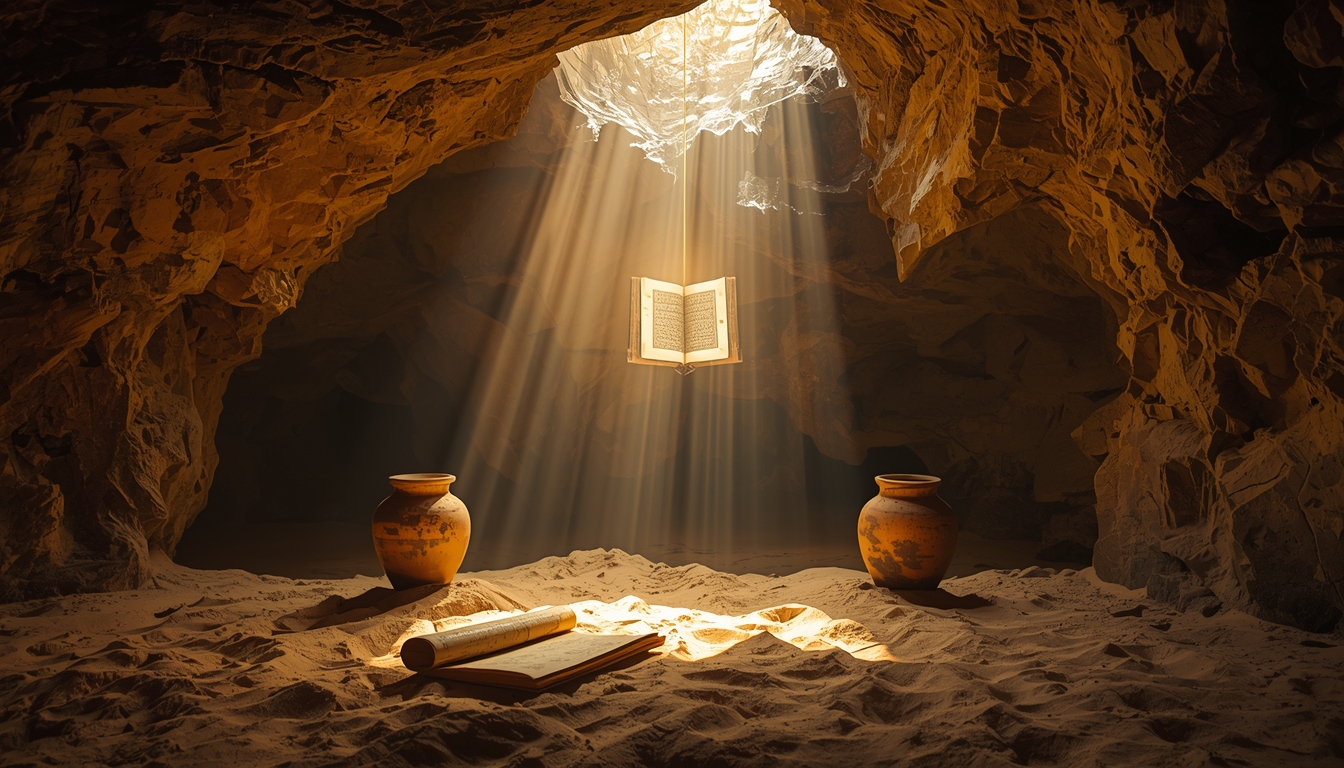
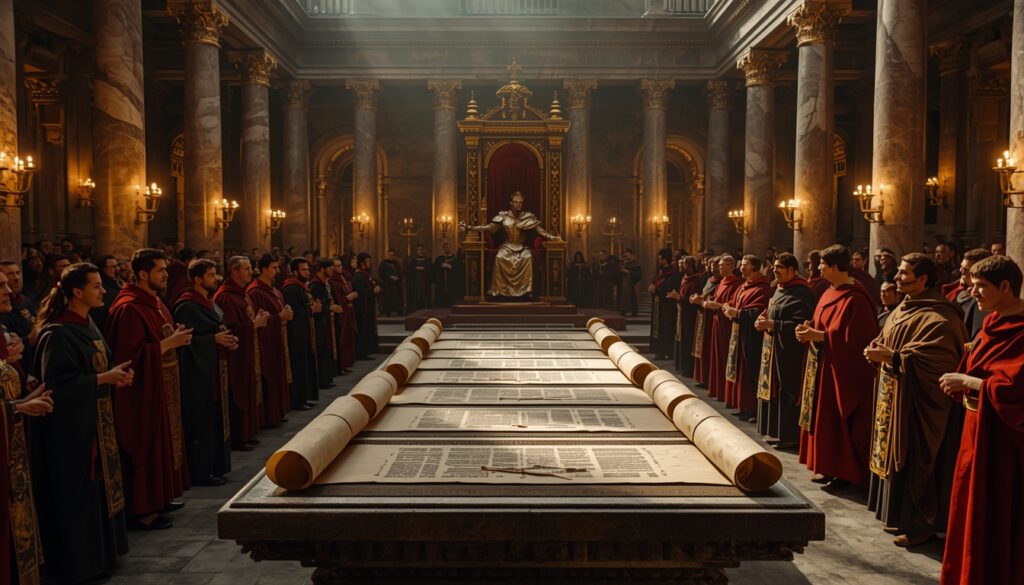
The discovery of the Dead Sea Scrolls in the caves of Qumran between 1947 and 1956 is widely regarded as the greatest archaeological find of the 20th century. These ancient manuscripts, dating back over two thousand years, provided a “time capsule” into the religious world of late antiquity—a period before the rise of modern Trinitarian Christianity and the final canonization of the Rabbinic Bible.
For the skeptical Western reader, the historian, or the student of theology, the study of the Dead Sea Scrolls and the Quran presents a fascinating intellectual phenomenon. It reveals that many concepts central to the Islamic worldview, often dismissed by critics as 7th-century inventions, were actually present in the oldest surviving monotheistic records.
In the Islamic perspective, we recognize Allah as the unique Creator who is High above His Heavens and established over His Throne. He is the Source of all true revelation, speaking His literal and uncreated Speech to a long chain of prophets throughout human history. The Dead Sea Scrolls and the Quran dialogue serves as a material witness to the Quranic claim: that the final revelation is a “Guardian” (Muhaimin) over previous scriptures, confirming what remains of the original truth and correcting what was altered by human hands. This article explores seven profound logical realities that connect these ancient scrolls to the final message of Islam.
Table of Contents
1. The Logic of the Time Capsule: Bridging the “Silent Interval”
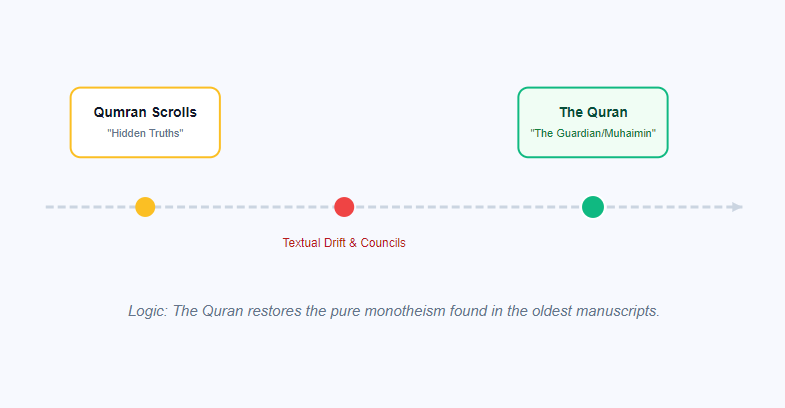
The primary logical pillar of the Dead Sea Scrolls and the Quran connection is the historical gap they bridge. For centuries, biblical scholars relied on manuscripts that were nearly a thousand years younger than the original events. This “silent interval” allowed for significant “interpretative drift,” where original monotheistic nuances were often lost through translation and human editing, as we explored in our study of the Preservation of the Bible and Quran.
The Dead Sea Scrolls provided a direct look at the Hebrew text as it existed centuries before the era of Muhammad and even before the mission of Jesus. Logically, if the Quran were a human invention based on 7th-century hearsay, it would likely repeat the theological biases and errors prevalent in the Byzantine and Sassanid worlds of that time. However, the Quran often aligns with the older, more “primitive” monotheistic traditions found in the scrolls rather than the later developed dogmas. This historical alignment is a powerful logical credential for the Authenticity of the Quran as a divinely preserved corrective to the historical narrative.
2. Absolute Monotheism: Rejection of the Hellenistic Shift
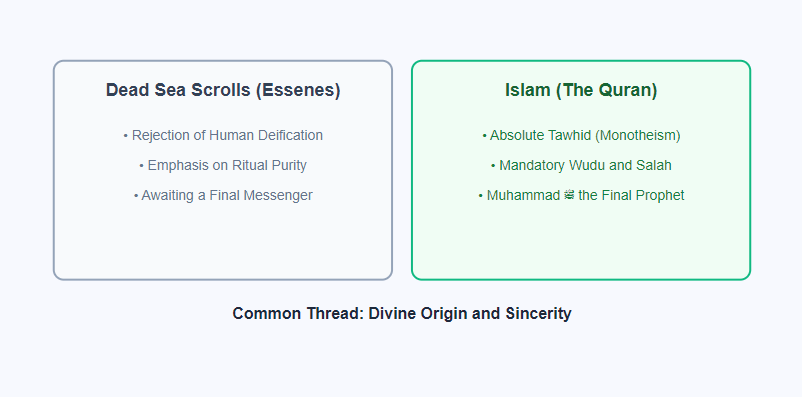
A central theme in both the Dead Sea Scrolls and the Quran is the absolute nature of the Divine. The Qumran community, often identified as the Essenes, was known for its fierce commitment to the oneness of God and its rejection of the pagan Hellenistic influences that were beginning to permeate the Mediterranean world during that era.
Logically, the scrolls contain no trace of the complex Trinitarian formulas or the literal deification of a human messenger that later came to define orthodox church doctrines. Instead, they emphasize a Sovereign Lord who is distinct from His creation.
This aligns perfectly with the Concept of God in Islam and the principle of Tawhid. The Dead Sea Scrolls and the Quran both present a worldview where God is the only One worthy of worship, and all messengers—including Jesus in Islam—are viewed as His humble and chosen servants. According to Britannica’s review of the Dead Sea Scrolls, the theology of the Qumran community was one of strict, legalistic monotheism, mirroring the Islamic call to return to pure worship.
3. The Expectation of the Final Prophet: The “Teacher of Righteousness”
The study of the Dead Sea Scrolls and the Quran reveals a society in a state of intense prophetic expectation. The scrolls speak of the coming of a “Teacher of Righteousness” and a “Prophet” who would clarify the law and lead the faithful in the final struggle against falsehood. These ancient texts reflect a people waiting for a definitive guide who would restore the original covenant.
While various traditions attempt to identify these prophecies with different historical figures, the logical “profile” of this expected messenger often matches the mission of Muhammad (peace be upon him). The scrolls describe a leader who would bring a new covenant and establish a community based on Islam and Objective Morality. This continuity of expectation is what we explored in the study of Muhammad in the Bible prophecies, where we see that the ancient world was geologically and scripturally prepared for a final guide arising from the wilderness of Arabia.
4. Linguistic Consistency: Ancient Hebrew and Quranic Arabic
Language is the vessel through which revelation is conveyed and preserved. A profound reality in the Dead Sea Scrolls and the Quran dialogue is the preservation of linguistic and Semitic roots. The scrolls proved that the Hebrew Bible had remained remarkably stable in its “consonantal” form for centuries, but they also revealed where later vowel points and human translations had shifted meanings.
The Quran, being the literal Speech of Allah spoken with Letter and Voice, was revealed in Classical Arabic—a language that belongs to the same Semitic family as the Hebrew found in the scrolls.
Logically, the Quran acts as a linguistic “anchor.” It utilizes terms like Allah, Salam, and Rahman—roots that are found in the most ancient layers of the Dead Sea Scrolls. For the skeptical mind, this linguistic resonance proves that the Quran is not a “foreign” theological invention, but the final, perfected version of the same divine language that spoke to the ancient patriarchs. This is why Islam and Human Logic find the Semitic continuity of the Quran so compelling in its claim to be the final word.
5. The Concept of the “Muhaimin” (The Guardian Filter)
The Quran identifies itself as a Muhaimin over previous scriptures (Quran 5:48). This means it acts as a “Guardian” or a “Filter” that determines what is historically true and what has been corrupted in the records of the past. The Dead Sea Scrolls and the Quran provide a practical, empirical demonstration of this logic in action.
For instance, the scrolls contain versions of the stories of Noah, Abraham, and Moses that differ from the “Standardized” Bible used today but often align with the specific details mentioned in the Quran. Logically, if the Quran can “restore” or “confirm” the contents of manuscripts that were buried in caves for 2,000 years and unknown to the world in the 7th century, it proves its source is the All-Knowing Creator who witnessed the original events. This restorative function is a primary proof of the Sincerity of Prophet Muhammad, as he provided information he could not have accessed through any human scholarly means available in his time.
6. The Logic of Moral Rigor: The Essenes and the Sunnah
The Dead Sea Scrolls and the Quran both describe a community of believers defined by intense moral discipline, ritual purity, and a life of purpose. The Essenes of Qumran practiced regular ritual ablutions, emphasized communal prayer, and lived a life of ascetic simplicity, avoiding the corruption of the materialist elite.
Logically, this “Lifestyle of Sincerity” mirrors the Worship in Islam and the structural requirements of the 5 Pillars of Islamic Faith. The scrolls prove that the “Islamic way of life”—often criticized by modern secularists as being too rigid—was actually the standard for the most pious monotheists in history. The logic of Free Will and Accountability found in the scrolls resonates with the Islamic belief that our daily actions are a test of our devotion to Allah, the Most High, who observes the conduct of His servants from Above the Heavens.
7. The Miracle of Preservation: The Caves vs. The Quranic Memory
The final reality in the study of the Dead Sea Scrolls and the Quran is the logic of preservation itself. The scrolls were preserved by the “Habit of Allah” through the extremely dry and protective environment of the Judean caves. This was a physical miracle intended to provide evidence for the modern world in the age of archaeology.
In contrast, the Quran was preserved by the “Will of Allah” through the hearts of men and the precision of the mass oral transmission system (Tawatur). Logically, the preservation of the scrolls serves as a “hint” for the rational seeker: if Allah can preserve ink on leather in a hidden cave for two millennia, He can certainly preserve His final and most important message in the Logic of Final Revelation.
The Dead Sea Scrolls and the Quran both testify to the fact that Divine Truth is never truly lost; it is simply waiting for those who are sincere enough to look for it. This scientific and historical stability is a recurring theme in our exploration of the Quran and Modern Science.
Conclusion: Reclaiming the Unchanged Truth
The scholarly inquiry into the Dead Sea Scrolls and the Quran leads to a profound rational verdict: the Quran is the definitive successor to the ancient monotheistic tradition. By aligning with the oldest surviving manuscripts and correcting later theological deviations like the Salvation through Original Sin myth, the Quran proves its status as the final and perfected Speech of the Creator.
For the skeptical mind, the scrolls are a bridge to the past, while the Quran is a bridge to the Eternal. By recognizing the “Truth Clearly” present in both, the seeker finds a religion that is historically verified, logically consistent, and spiritually complete. Allah, the Most High, has left His signs in the caves of Qumran and in the verses of the Quran, inviting all of humanity to return to the worship of the One True God, the Lord of all existence.



Leave a Reply