

This research paper is part of Truth Clearly’s commitment to providing an authentic Islamic perspective on theology and history. We adhere to rigorous academic standards, relying exclusively on the Quran, authentic Prophetic traditions, and verified historical sources to provide clarity for the rational seeker.
In the contemporary intellectual landscape, dominated by the philosophy of empiricism, the idea of “The Unseen” is often dismissed as a relic of a pre-scientific age. For the skeptical Western reader, the agnostic academic, or the student of physics, the standard of truth is often reduced to what can be measured, touched, or observed in a laboratory. However, a rigorous logical inquiry into The Concept of the Unseen in Islam (known as Al-Ghaib) reveals a paradigm where the recognition of a reality beyond the physical senses is not a “leap into the dark,” but the ultimate conclusion of human reason.
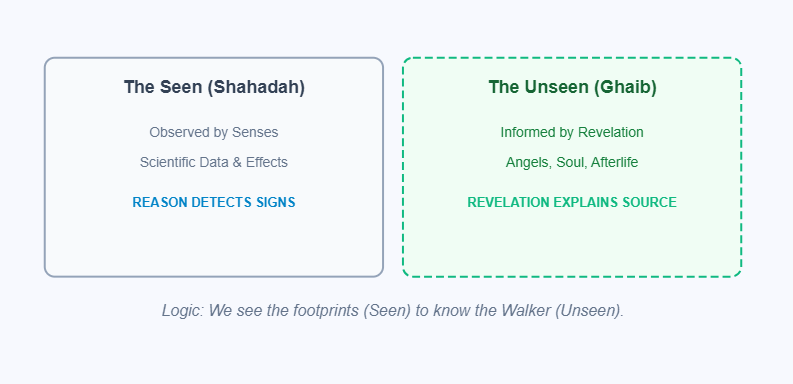
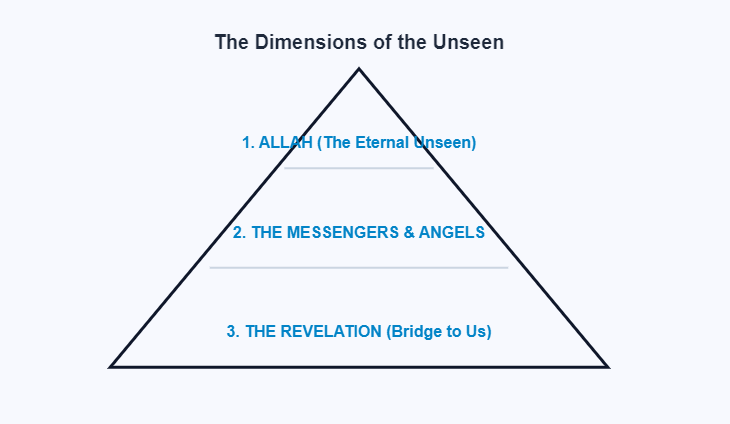
In the Sunni Athari worldview, we recognize that the universe is far more complex than what our limited sensory apparatus can perceive. We believe in Allah, the Most High, who is established over His Throne and is distinct from His creation. Allah, the All-Knowing (Al-Alim), has informed humanity of realities that lie beyond the reach of telescopes and microscopes—such as the existence of angels, the reality of the soul, and the details of the afterlife.
The Concept of the Unseen in Islam is not an invitation to blind superstition; it is an epistemological framework that acknowledges the boundaries of human observation while relying on verified revelation. This article explores seven profound logical realities that demonstrate why belief in the unseen is the most rational response to the complexity of existence.
Table of Contents
1. The Logic of Limitations: Recognizing the Sensory Horizon
The first logical reality of The Concept of the Unseen in Islam is the acknowledgment of human limitation. Logically, the fact that we cannot see something does not constitute evidence of its non-existence. Modern science itself operates on this principle; we cannot “see” gravity, dark matter, or the subatomic building blocks of reality, yet we infer their existence through their effects.
In Islamic logic, the human eye is designed to perceive a specific spectrum of light, and the human ear is tuned to a specific range of frequencies. To claim that the physical world is the “total” of reality is an unscientific assumption. The Concept of the Unseen in Islam asserts that just as there are physical realities beyond our current technology, there are metaphysical realities beyond our current dimension. By recognizing the “Sensory Horizon,” the human intellect remains open to the truth revealed by the Creator, who initiated the Origins of the Universe and knows what remains hidden from His creatures.
2. Epistemology of Trust: The Role of Verified Revelation
For the skeptical researcher, the question is: “If we cannot see the unseen, how can we know it is true?” The Concept of the Unseen in Islam relies on the logic of the “Reliable Messenger.” This is a standard epistemological practice; we believe in historical events or scientific facts we haven’t witnessed ourselves because we trust the reliability of the source.
Once the Authenticity of the Quran is established through its linguistic miracles and the Sincerity of Prophet Muhammad is proven through historical analysis, it becomes logically necessary to accept the information they provide about the unseen. If a messenger is proven to be truthful in everything we can verify—such as the Scientific Miracles of the Quran—it is only rational to trust him in matters that we cannot yet verify.
3. The Logic of Causality: The Unseen Cause of the Seen World
The Concept of the Unseen in Islam provides the only comprehensive answer to the principle of causality. Logically, a finite, organized, and fine-tuned universe cannot be self-caused. Every effect we observe in the “Seen world” (Ash-Shahadah) must have a cause that is ultimately rooted in the “Unseen world.”
As we explored in the Concept of God in Islam, Allah is the First Cause. He is not a physical object within the universe; He is the Creator of the universe. Therefore, the Source of all physical laws is itself “Unseen” to those within the system. To reject the unseen is to reject the logical necessity of a Creator. The Concept of the Unseen in Islam anchors the physical world in a transcendent reality, ensuring that Islam and Human Logic are never in conflict.
4. The Fitrah: The Soul’s Intuition of the Unseen
A profound reality of The Concept of the Unseen in Islam is the Fitrah—the innate nature of the human soul. Every human being feels a persistent “moral and spiritual tug” that cannot be explained by material chemistry alone. We have an unshakeable sense of justice, a hunger for meaning, and an intuition that our lives have an eternal consequence.
Islam posits that this internal experience is a “Sign” of the unseen soul (Ruh). Logically, if we were merely biological accidents in a random universe, we would not possess the capacity to contemplate the infinite. The Concept of the Unseen in Islam explains that the Fitrah is a pre-programmed recognition of the Creator, who is High above His Heavens. This intuition is what makes the Worship in Islam feel like a “homecoming” for the seeker of truth.
5. The Logic of Moral Necessity: Unseen Accountability
Without The Concept of the Unseen in Islam, morality loses its objective foundation. In a purely material world, “good” and “evil” are just subjective social constructs. Logically, if there is no unseen Day of Judgment and no Life After Death, then the tyrant who escapes earthly justice has “won.”
Islamic theology asserts that the unseen reality of accountability is what gives weight to Islam and Objective Morality. It ensures that every atom of weight—good or evil—is accounted for by Allah, the Most High, who hears and sees all. This logical framework provides a robust defense for Islam and Human Rights, as it establishes that every human is a sacred trustee accountable to an All-Seeing Sovereign.
6. The Angelic Realm: The Logic of Divine Administration
A unique aspect of The Concept of the Unseen in Islam is the belief in angels (Mala’ikah). In the Athari perspective, angels are real, created beings who execute the commands of Allah. They are not “metaphors” for natural forces, but literal servants of the Most High.
Logically, a grand design—as seen in the Fine-Tuning of the Universe—requires an administration. Just as a kingdom has messengers and executors of the king’s law, Allah uses angels to manage the complexities of the heavens and the earth. This reality demonstrates that the “Unseen” is not a place of chaos, but a place of supreme order and submission to the One who is established over His Throne.
7. The Ultimate Transition: From Faith to Vision
The final reality of The Concept of the Unseen in Islam is that it is temporary. Faith (Iman) is defined as believing in the unseen while we are in this world of trial. However, the Islamic worldview promises a transition where the “Unseen” will become the “Seen.”
At the moment of death—as discussed in the Logic of Suffering and Trial—the veil is lifted. On the Day of Judgment, the realities of the grave, the scales, and the presence of Allah will be manifest to all. For the believer, the greatest reward is the literal Vision of Allah (Ru’yah), where they will see their Lord with their eyes in a way that suits His Majesty. Logically, this provides a unified narrative to human existence: we move from the test of the unseen to the certainty of the seen.
Conclusion: The Rationality of the Veiled Reality
The scholarly inquiry into The Concept of the Unseen in Islam leads to a profound logical verdict: the unseen is not the opposite of the rational; it is its completion. By acknowledging the limits of the senses, trusting in verified revelation, and recognizing the necessity of a First Cause, the human mind finds a coherent and unshakeable worldview.
For the skeptical mind, the unseen is an invitation to humility. It reminds us that we are guests in a magnificent palace whose Architect is still in control. By embracing The Concept of the Unseen in Islam, the individual moves from the shadows of materialism into the brilliant light of Why Islam remains the final and perfected guide. The “Truth Clearly” is that there is more to existence than what meets the eye—a reality governed by Allah, the Most High, the King of the Unseen and the Seen.










Leave a Reply