

This research paper is part of Truth Clearly’s commitment to providing an authentic Islamic perspective on theology and history. We adhere to rigorous academic standards, relying exclusively on the Quran, authentic Prophetic traditions, and verified historical sources to provide clarity for the rational seeker.
In the modern secular and philosophical discourse, the term “faith” is often treated with a mixture of respect and suspicion. For the skeptical Western reader, the agnostic academic, or the seeker of truth, faith is frequently defined as a “blind leap”—a decision to believe in something despite a lack of evidence. However, a rigorous logical and scriptural inquiry into The Concept of Faith in Islam (known as Iman) reveals a paradigm that is fundamentally different. In Islam, faith is not a suspension of the intellect, but its ultimate fulfillment; it is not a static emotion, but a dynamic, three-dimensional reality that integrates the mind, the heart, and the body.
In the Sunni Athari worldview, we recognize that Allah—the unique Creator who is High above His Heavens and established over His Throne—has defined Iman through His literal Speech, the Quran, and the authentic teachings of His Prophet. Unlike systems that reduce belief to a private mental state, The Concept of Faith in Islam asserts that true conviction must be verifiable through speech and action. It is a holistic framework where what is known by the intellect must be confirmed by the heart and manifested by the limbs. This article explores seven profound logical realities of Iman, demonstrating why this comprehensive definition is the most rational and psychologically stable approach to the Divine.
Table of Contents
1. The Tripartite Structure: Heart, Tongue, and Limbs
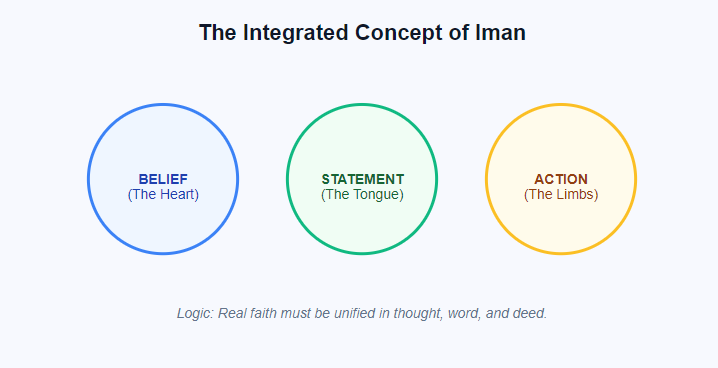
The primary logical pillar of The Concept of Faith in Islam is its definition. According to the scholarly tradition of the Salaf (the early generations), Iman is “Statement and Action” (Qawl wa ‘Amal). It consists of three inseparable components:
- Belief in the Heart: A sincere internal conviction and submission.
- Statement of the Tongue: The verbal declaration of the truth.
- Action of the Limbs: The outward manifestation of that belief through deeds.
Logically, this definition provides a “Check and Balance” system. A person who claims to believe but never acts accordingly is logically inconsistent. Conversely, a person who performs the rituals without internal conviction is a hypocrite. By making “Action” a part of the very definition of faith, Islam ensures that the Worship in Islam is a living reality, not a theoretical philosophy. This structural unity is essential for the Sincerity of Prophet Muhammad, whose faith was visible in every action of his 23-year mission.
2. Faith as a Conclusion of Reason, Not a Blind Leap
A common misconception is that The Concept of Faith in Islam requires the abandonment of logic. On the contrary, the Quran presents faith as the natural conclusion of a sound mind. As we discussed in Islam and Human Logic, the Quran relentlessly invites humans to “reflect,” “observe,” and “calculate.”
Logically, if we observe a universe governed by precise mathematical laws—as seen in the Scientific Miracles of the Quran—the rational mind concludes that there is an All-Wise Creator. Faith (Iman) is the act of submitting to this logical conclusion. It is the “Moral Response” to “Scientific Data.” In the Islamic framework, doubt is resolved through inquiry and evidence, as demonstrated by Abraham in the Quran. Therefore, faith is the peak of rational certainty, providing the soul with a solid foundation to understand the Origins of the Universe.
3. The Logic of Fluctuation: Faith Increases and Decreases
One of the most psychologically profound realities of The Concept of Faith in Islam is the recognition that it is not a static “on or off” switch. Islamic theology asserts that faith increases with acts of obedience and decreases with acts of disobedience.
Logically, this aligns with human experience. Just as physical fitness increases with exercise and decreases with neglect, spiritual health follows a similar pattern. When a person practices Objective Morality and performs Supplication (Dua), their sense of certainty and proximity to the Creator grows. This dynamic nature of Iman prevents arrogance in the believer and offers hope to the struggling soul. It acknowledges that the Purpose of Life is a continuous climb toward perfection, where every choice has a direct impact on the quality of one’s faith.
4. The Direct Relationship: Rejection of Institutional Intermediaries
A unique reality in The Concept of Faith in Islam is the absolute directness of the connection to the Divine. In the Athari perspective, Allah is the Most High, who hears and sees all. There is no requirement for a priestly caste to “grant” or “validate” an individual’s faith.
Logically, if every human is a direct creation of Allah, then every human must have direct access to Him. This empowers the individual, granting them a spiritual autonomy that secular systems often fail to provide. By removing intermediaries, Islam protects the Human Rights of the believer, ensuring that no institution can stand between the heart and its Creator. This unmediated link is what makes the Concept of Prophethood so logical; the Prophet is a “Messenger” who delivers the path, not a “Gatekeeper” who controls the door.
5. The Balance of Hope and Fear: The Wings of the Soul
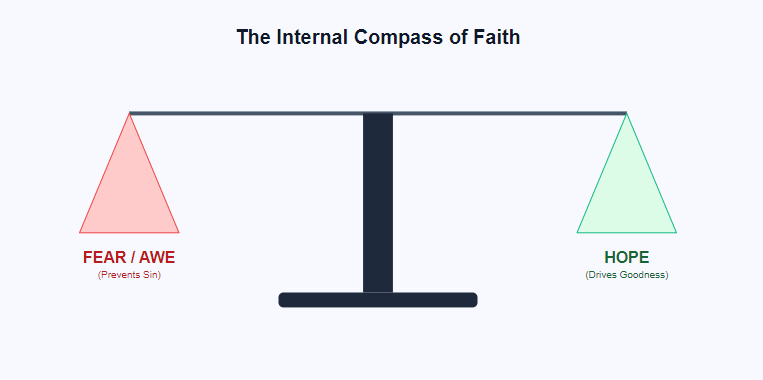
The Concept of Faith in Islam provides a sophisticated psychological stability through the “Balance of the Two Wings”: Khawf (Fear/Awe) and Raja (Hope).
Logically, a healthy moral agent needs both. A person who has only hope becomes complacent and ignores the Logic of Accountability. A person who has only fear becomes despairing and paralyzed. Islam balances the two by reminding the believer of Allah’s absolute Justice and His infinite Mercy. This ensures that the believer is always productive, moving toward the Creator with a focused mind and a hopeful heart. This balance is vital for navigating the Logic of Suffering and Trial, as it prevents both the “nihilism” of the materialist and the “despair” of the fatalist.
6. Sincerity (Ikhlas) as the Heart of Conviction
In the study of The Concept of Faith in Islam, the internal state of Ikhlas (Sincerity) is paramount. Logic dictates that for an action to be meaningful, the motive behind it must be pure.
In Islam, an act of “charity” done for the sake of public praise is not an act of faith; it is an act of social vanity. True faith requires that the orientation of the heart be directed solely to Allah, the Most High, who is established over His Throne. This internal transparency is what Allah judges. By focusing on sincerity, Islam ensures that morality is not a “performance” for other humans, but a “relationship” with the Truth. This depth of character is what we see in the Prophetic Leadership, where the goal was always the pleasure of the Creator, never the applause of the crowd.
7. The Final Seal: Faith as a Prerequisite for Salvation
The final reality of The Concept of Faith in Islam is its role in the ultimate destiny of the human soul. As we explored in Salvation in Islam vs. Christianity, Islam does not rely on inherited debt or vicarious atonement. Instead, it relies on the individual’s choice to recognize the Truth.
Logically, if the Creator has provided Signs in the Universe and Preserved Revelations, the failure to acknowledge them is a logical and moral error. Faith is the “Key” that unlocks the door to Divine Mercy. It is the recognition of the Final Revelation as the completed guide for humanity. In the Islamic worldview, the “Truth Clearly” is that faith is the most important asset a human can possess, as it is the only thing that survives the transition into the next life.
Conclusion: The Rational Peace of Iman
The scholarly investigation into The Concept of Faith in Islam leads to a profound rational verdict: faith is the highest expression of a unified life. By integrating the conviction of the heart with the testimony of the tongue and the actions of the body, Islam provides a worldview that is both intellectually satisfying and practically transformative.
For the skeptical mind, the Islamic model of Iman is an invitation to consistency. It is a system where you don’t have to choose between your brain and your soul. By recognizing the Authenticity of the Quran and the majesty of the Creator who is High above all, the seeker finds the “Peace of Rational Conviction.” In the end, faith in Islam is the bridge that carries the traveler from the shadows of doubt into the brilliant sunlight of the Truth.














Leave a Reply