
This research paper is part of Truth Clearly’s commitment to providing an authentic Islamic perspective on theology and history. We adhere to rigorous academic standards, relying exclusively on the Quran, authentic Prophetic traditions, and verified historical sources to provide clarity for the rational seeker.
In the journey of human inquiry, no question is more fundamental than the origin of all that exists. For the skeptical Western seeker, the modern astrophysicist, or the student of philosophy, the discovery of the Big Bang theory in the early 20th century was a watershed moment. It transformed our understanding from a “Static Universe” to a dynamic, expanding cosmos that had a specific beginning in time. However, for those who analyze The Big Bang in the Quran, the most staggering realization is that the core mechanics of this theory were described with absolute precision fourteen centuries ago.
In the Sunni Athari worldview, we recognize the Quran as the literal, uncreated Speech of Allah, who is High above His Heavens and established over His Throne (Istawa). Allah is the Creator of time, space, and matter, and His Knowledge (Ilm) encompasses the beginning and the end. The Big Bang in the Quran is not presented as a scientific paper, but as a series of “Signs” (Ayat) intended to prompt the human intellect (‘Aql) to recognize the Power of the One who said “Be,” and the universe was. This article explores seven profound logical realities that connect modern cosmology to the divine revelation.
Table of Contents
1. The Logic of Singularity: “Ratq” and “Fataq”
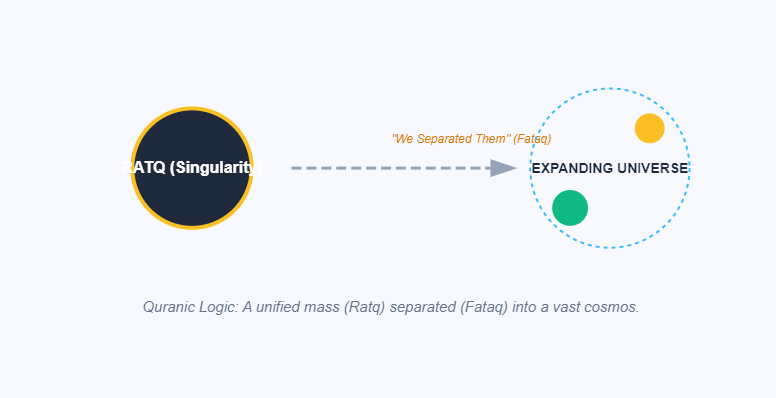
The primary scientific pillar of the Big Bang theory is that the entire universe began as a single, infinitely dense point (a singularity). The study of The Big Bang in the Quran centers on a specific verse that uses remarkably precise terminology:
“Have those who disbelieved not considered that the heavens and the earth were a joined entity (Ratq), and We separated them (Fataq)…?” (Quran 21:30).
Logically, the term Ratq in Arabic refers to something that is sewn together or a unified, homogenous mass. The term Fataq refers to the act of breaking apart, separating, or unsewing. Modern cosmology confirms that in the earliest nanoseconds, all matter and energy were a “joined entity.” This alignment between the literal Speech of Allah and the Origins of the Universe provides a logical credential for the Authenticity of the Quran that is undeniable to the rational mind.
2. The “Smoke” Phase: The Opaque Early Universe
Modern astrophysics describes the early universe as being in a state of hot, opaque, ionized gas (plasma) before stars were formed. Light could not travel through this dense medium. When discussing The Big Bang in the Quran, we find an accurate description of this state:
“Then He directed Himself to the heaven while it was smoke (Dukhan)…” (Quran 41:11).
To the skeptical researcher, the choice of the word “smoke” (Dukhan) is fascinating. Unlike the general term “gas,” smoke implies a hot, dark, and particulate-heavy substance—which is exactly what the “Opaque Era” of the cosmos was. This descriptive precision is a major proof of the Scientific Miracles of the Quran, suggesting that the information could only have come from the One who is High above His creation and witnessed the first light.
3. The Continuous Expansion: Beyond Hubble’s Law
The Big Bang was not just an explosion in the past; it initiated a continuous expansion of space itself. While Western science only discovered this in 1929 through Edwin Hubble, the framework of The Big Bang in the Quran stated it as an active reality centuries earlier:
“And the heaven We constructed with strength, and indeed, We are [its] expander (Musi’un).” (Quran 51:47).
The Arabic word Musi’un is a present participle, indicating an ongoing, continuous action. Logically, for a desert-dwelling man in the 7th century to claim that the “Heavens” (Space) are currently expanding—a fact confirmed by modern redshift observations—is a profound sign. This confirms the Concept of God in Islam as the Sovereign Sustainer who actively manages the vastness of the cosmos.
4. The Logic of Fine-Tuning: Precision from the Start
A critical logical reality associated with The Big Bang in the Quran is the “Initial Conditions.” If the expansion rate of the Big Bang had been different by one part in a quadrillion, the universe would have either collapsed back on itself or expanded too fast for stars to form.
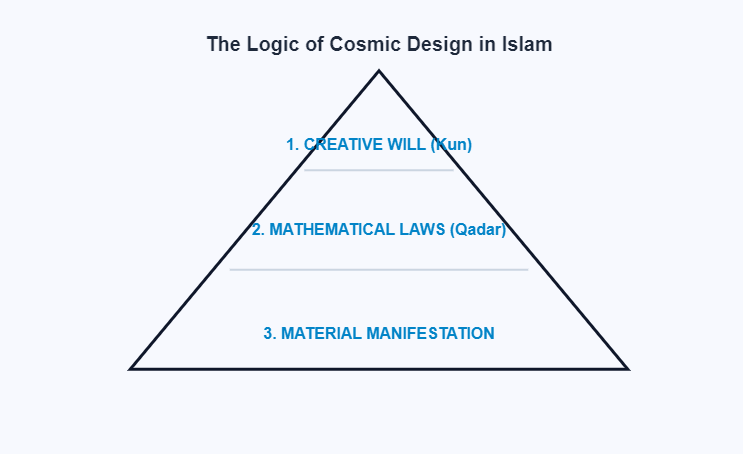
As we explored in the Fine-Tuning of the Universe, this precision suggests a “Measured Decree” (Qadar). Allah, the All-Wise, did not just “explode” matter; He designed the initial explosion with mathematical perfection. Logically, order does not arise from chaos without an Intelligent Agent. The Big Bang serves as the ultimate proof that the universe is a purposeful design of the One who is established over the Throne.
5. The Synthesis of Elements: Iron and the Stars
Following the Big Bang, the universe began to form heavier elements. A fascinating reality of The Big Bang in the Quran is how it addresses the “descent” of elements like iron. Modern science confirms that iron was formed in the hearts of distant stars through supernovae and then “sent down” to Earth via meteorites.
The Quran uses the specific verb Anzalna (We sent down) when referring to iron. Logically, the Creator who designed the Water Cycle in the Quran and the cosmic origins is the same One who provided the minerals necessary for human civilization. This biological and geological connection reinforces the Purpose of Life as a journey of recognizing the Sustainer through His material gifts.
6. The Logic of Finite Time: A Beginning and an End
One of the most profound logical conclusions of The Big Bang in the Quran is that the universe has a finite age. Materialist philosophies once argued that the universe was eternal, attempting to remove the need for a Creator. The Big Bang destroyed this logic by proving a “Starting Point.”
Logically, anything that has a beginning must have a Beginner. Anything that is finite requires a “Necessary Being” to bring it into existence. This supports the Logic of Free Will and the reality of the Afterlife; if the universe had a beginning (Big Bang), it must also have a purposeful end (Big Crunch or Day of Judgment). In the Athari perspective, Allah is the “First” (Al-Awwal) and the “Last” (Al-Akhir), and the Big Bang is the physical manifestation of His first creative command.
7. The Fitrah: The Soul’s Intuition of Creation
Finally, the study of The Big Bang in the Quran resonates with the Fitrah—the innate nature of the human soul. Every human being feels an instinctive “awe” when contemplating the vastness of the stars.
Islam teaches that this awe is a “home-signal.” Our souls recognize the “Singularity” and the “Order” of the cosmos because they were created by the same Source. When we bridge Islam and Human Logic, we find that the Big Bang is not just a scientific theory; it is a theological proof. It invites the Why Islam inquiry, showing that the final revelation is perfectly synced with the physical reality of our origins.
Conclusion: The Signature of the One True God
The investigation into The Big Bang in the Quran leads to an inescapable rational verdict: the descriptions of the Ratq (joined mass), the Dukhan (smoke), and the Musi’un (expansion) are not the products of 7th-century guesswork. They are the “Signs” of an All-Knowing Creator who is High above His Throne and knows the secrets of the heavens.
For the skeptical mind, these realities are invitations to reflect. The universe is a grand book of truth, and the Quran is its perfect commentary. By recognizing the harmony between modern cosmology and divine revelation, one finds the “Truth Clearly” present in the very atoms of the cosmos—a testament to the Wisdom of Allah, the Lord of all existence.







Leave a Reply