

This research paper is part of Truth Clearly’s commitment to providing an authentic Islamic perspective on theology and history. We adhere to rigorous academic standards, relying exclusively on the Quran, authentic Prophetic traditions, and verified historical sources to provide clarity for the rational seeker.
The human obsession with the end of time is a universal phenomenon. From ancient Mayan calendars to modern secular doomsday clocks, humanity has always sought to decode the final chapter of its history. For the skeptical Western reader, the historian, or the rational observer, the Signs of the Day of Judgment in Islam (known as Ashrat al-Sa’ah) present a staggering intellectual challenge. How could a man in the 7th-century Arabian desert describe specific social, technological, and environmental changes that would not manifest until fourteen centuries later?
In the Sunni Athari worldview, we recognize that Allah—the Most High, who is established over His Throne and is distinct from His creation—possesses absolute Knowledge of the future. He spoke the Quran as His literal Speech and inspired His Prophet with authentic traditions that act as a “Map of Time.” The Signs of the Day of Judgment in Islam are not intended to induce blind panic, but to serve as logical “Credentials of Truth.” This article explores seven profound realities of Islamic eschatology, demonstrating how ancient prophecies align with contemporary reality in a way that defies human guesswork.
Table of Contents
1. The Logic of Entropy: Why the World Must End
The primary logical argument for the Signs of the Day of Judgment in Islam begins with the nature of the universe itself. Science confirms the Law of Entropy: every closed system moves from order to disorder. Logically, the universe had a beginning—as we explored in the Origins of the Universe—and therefore must have a logical conclusion.
Islamic theology asserts that this conclusion is not a random heat death, but a purposeful “Settling of Accounts.” Allah, the All-Wise, did not create the world for eternal play. The Day of Judgment is the logical prerequisite for Divine Justice and the Afterlife. Without an “End,” the moral struggles of humanity would remain unresolved. The Signs of the Day of Judgment in Islam are the warning bells of this inevitable transition, proving that the world is moving toward a destination, not a void. This scientific and philosophical necessity is documented in Britannica’s analysis of eschatology.
2. The Tall Buildings Prophecy: A Mathematical Anomaly
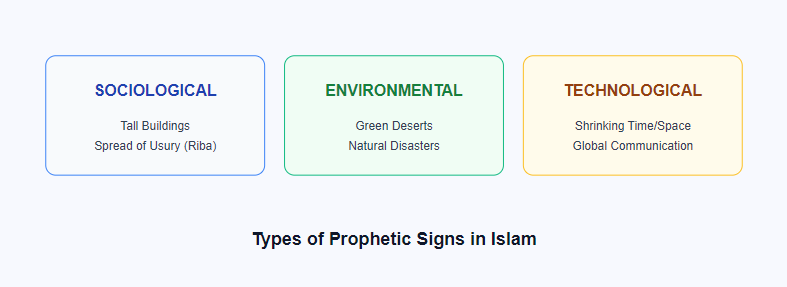
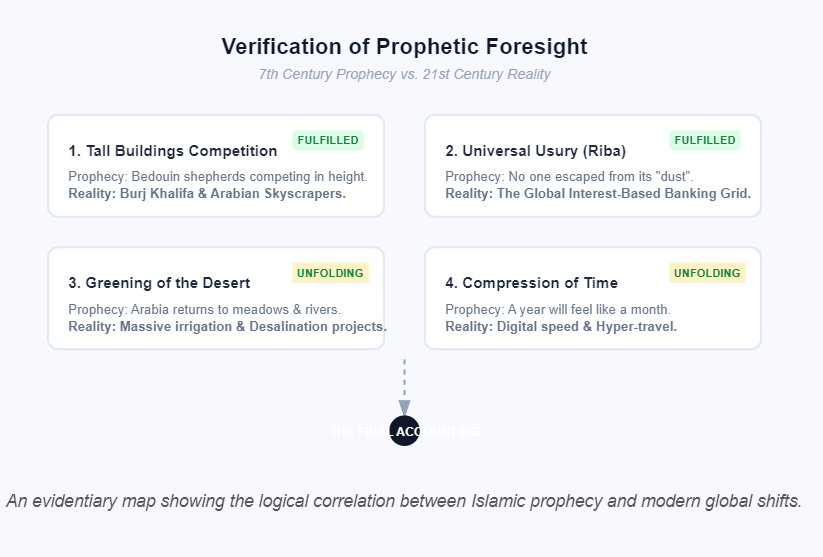
Perhaps the most famous of the Signs of the Day of Judgment in Islam is a specific sociological prediction. In an authentic tradition (The Hadith of Gabriel), Prophet Muhammad (peace be upon him) mentioned that one of the signs is: “When you see barefoot, naked, poor shepherds competing in the construction of tall buildings.” (Sahih Muslim).
From a logical and historical perspective, this is an extraordinary prediction. For millennia, the Arabian Peninsula was home to nomadic tribes with no architectural ambition. Yet, in the last 50 years, the descendants of these very tribes (once poor shepherds) have constructed the world’s tallest skyscrapers, such as the Burj Khalifa. Logically, a 7th-century man could have predicted many things—famine, war, or drought—but to specify “competing in building height” among a specific demographic is a statistical anomaly that points toward a divine source of information.
3. The Shrinking of Time and Space: Technological Foresight
The Signs of the Day of Judgment in Islam include descriptions of the “shrinking of time.” The Prophet stated that as the end approaches, “Time will pass quickly, such that a year will feel like a month, a month like a week…” (Sahih Tirmidhi).
While this has a spiritual meaning (the loss of blessing in time), it also carries a profound technological logic. Today, through global travel and digital communication, the “Time-Space Compression” is a recognized reality. A journey that took months in the 7th century now takes hours. Information that took weeks to transmit now travels at the speed of light. This technological acceleration is a hallmark of the Scientific Miracles of the Quran and the Sunnah, demonstrating that the Prophet was informed of a world where physical barriers would be dismantled.
4. The Global Economic Grid: The Spread of Usury (Riba)
A profound and sober sign among the Signs of the Day of Judgment in Islam is the prediction of a global economic system built on usury. The Prophet said: “A time will come when there will be no one left who does not consume usury, and whoever does not consume it will still be affected by its dust.” (Sahih – Abu Dawud/Nasa’i).
Logically, in the 7th century, the world operated on various independent trade systems. The idea of a singular, interconnected global financial grid where Riba (interest/usury) is unavoidable was unthinkable. Yet, today, the global banking system is exactly what the Prophet described. This economic prophecy is part of the broader Sharia Law in Islam framework, which seeks to protect the Human Rights of the poor from systemic exploitation. The accuracy of this prediction regarding the “dust of usury” is a powerful proof of the Sincerity of Prophet Muhammad.
5. Environmental Shifts: The Greening of the Desert
The Signs of the Day of Judgment in Islam also touch upon geological and environmental changes. The Prophet stated: “The Hour will not be established until the land of the Arabs returns to being meadows and rivers.” (Sahih Muslim).
To a skeptical seeker, this sounds like a geographic impossibility for the arid Arabian desert. However, modern geology has revealed that the Arabian Peninsula was once lush and green with flowing rivers during previous ice ages. Furthermore, through modern irrigation and desalination, we are witnessing a literal “greening” of the desert today. Logically, the use of the word “returns” (Ta’ud) in the Hadith is scientifically accurate, implying that the desert was green before and will be green again. This environmental foresight aligns with the Islamic Environmental Ethics that emphasize the earth as a living sign of the Creator.
6. The Crisis of Truth: The Era of Deception (Dajjal)
A major psychological sign among the Signs of the Day of Judgment in Islam is the rise of widespread deception and the “reversal of values.” The Prophet described a time of “Fitna” where the truthful will be called liars, and the liars will be trusted.
This culminates in the “Major Sign” of the Dajjal (the False Messiah). Logically, the Dajjal represents the ultimate “Challenge of Materialism.” He will offer bread and paradise in exchange for the soul, testing whether humanity will follow the Logic of Free Will toward the Creator or toward material illusion. This era of “Post-Truth” and “Deepfakes” is the logical precursor to a world ready to accept a grand deceiver. It forces every rational mind to ask: Why Islam?—because only a preserved revelation can provide an anchor in an ocean of lies.
7. The Return of Jesus: The Final Logical Resolution
No discussion of the Signs of the Day of Judgment in Islam is complete without the most powerful metaphysical sign: the return of Jesus (Prophet Isa). As we explored in the Miracles of Jesus in Islam, Jesus did not die but was raised by Allah.
Logically, his return serves as a final resolution to the Abrahamic narrative. He will return not as a god, but as a servant of Allah, High above His Throne, to break the cross and unify the believers. This event connects the Muhammad in the Bible prophecies to the end of history. It is the ultimate logical proof that the message of all prophets was one: to worship the Creator alone. The presence of Jesus at the end of time is the bridge that links the Authenticity of the Quran to the final destiny of mankind.
Conclusion: Prophecy as the Gateway to Certainty
The study of the Signs of the Day of Judgment in Islam leads to a profound rational verdict: the descriptions provided 1,400 years ago are too specific, too varied, and too accurate to be the result of human imagination. They are the fingerprints of the One who designed time itself.
For the skeptical mind, these signs are invitations to wake up. They prove that we are not living in a random, directionless world, but in a purposeful creation that is rapidly approaching its climax. By recognizing these signs, the individual moves from the confusion of the material world to the clarity of divine truth. Just as the Five Pillars of Faith provide the structure for our actions, the signs of the hour provide the perspective for our souls, reminding us that the “Truth Clearly” is that we are all returning to Allah, the Most High, the King of the Day of Judgment.












Leave a Reply