

Exploring how different faiths approach salvation helps build theological literacy. Here, we respectfully compare the concepts of original purity in Islam with other historical doctrines, aiming to provide clarity on the Islamic framework of divine justice.
For the skeptical Western reader, the academic researcher, or the individual raised in a traditional Christian environment, the concept of “Salvation” is perhaps the most fundamental point of theological divergence between the world’s two largest faiths. The inquiry into Salvation in Islam vs. Christianity is not merely a debate over rituals or nomenclature; it is a profound investigation into the very nature of human existence, the character of the Creator, and the definition of justice. While Christianity is primarily built upon the doctrine of “Original Sin” and the necessity of vicarious atonement, Islam presents a paradigm of “Original Purity” and “Personal Responsibility.”
In the Sunni Athari worldview, we recognize Allah as the unique and supreme Creator who is High above His Heavens and established over His Throne (Istawa) in a manner that suits His Majesty. He is the All-Just (Al-Adl) and the All-Merciful (Al-Rahim). Islam asserts that every soul is born in a state of Fitrah (innate goodness) and is held accountable solely for its own choices. This article explores seven profound realities of Salvation in Islam vs. Christianity, demonstrating why the Islamic model of individual agency is the most logical and scripturally consistent path to the Divine.
Table of Contents
1. Original Purity (Fitrah) vs. Original Sin
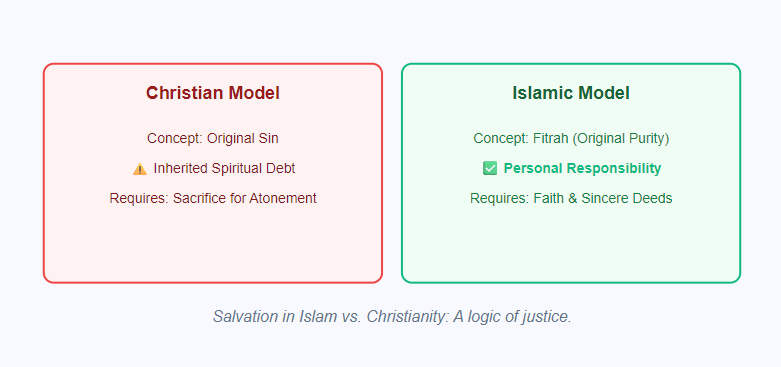
The primary logical distinction in the study of Salvation in Islam vs. Christianity begins at the moment of birth. Traditional Christian theology, as formalized by figures like Augustine, posits the doctrine of “Original Sin”—the belief that every human being inherits the guilt of Adam’s disobedience. This suggests that humans are born spiritually “fallen” and are intrinsically separated from God from their first breath.
Islam radically rejects this premise. In the Islamic framework, every child is born upon the Fitrah—a state of natural submission to the Creator and inherent purity. The Quran clarifies that when Adam (peace be upon him) erred, he turned directly to Allah in sincere repentance, and Allah, the Most Merciful, forgave him completely. Logically, if the father was forgiven, the descendants cannot inherit a debt that no longer exists. Salvation in Islam vs. Christianity thus starts with a different view of human nature: one is a “debtor by birth,” while the other is an “honored trustee” of their own soul. This concept is foundational to our understanding of Islam and Human Logic.
2. Personal Responsibility: The Logic of “No Bearer of Burdens”
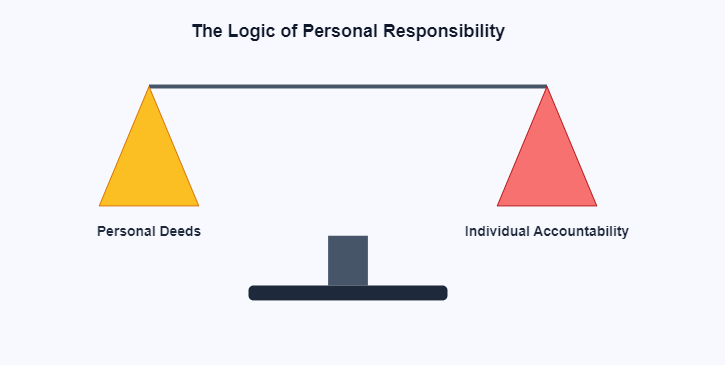
A cornerstone of Salvation in Islam vs. Christianity is the principle of individual accountability. The Quran establishes a core logical and legal truth that is repeated multiple times: “And no bearer of burdens shall bear the burden of another” (Quran 35:18).
In Islamic logic, justice necessitates that the one who commits the act is the one who carries the consequence. To punish an innocent person for the crime of another is an ontological contradiction to the Attribute of Divine Justice. While Christianity relies on “Substitutionary Atonement”—the idea that Jesus died to pay for the sins of humanity—Islam teaches that every individual possesses a direct relationship with Allah. This ensures that Islam and Objective Morality are grounded in actual conduct rather than an inherited spiritual status.
3. The Role of the Messiah: Jesus in Islam vs. Christianity
The identity and mission of Jesus are central to the Salvation in Islam vs. Christianity dialogue. In orthodox Christian doctrine, Jesus must be divine (the Son of God) to act as a perfect, infinite sacrifice capable of washing away humanity’s infinite sin. Logically, if the premise of “Original Sin” is removed, the necessity for a divine sacrifice also vanishes.
Islam restores Jesus (Prophet Isa) to his original, noble role as a mortal Prophet and Messenger. As we explored in the Islamic view on Jesus, he was created by the creative command “Be” from Allah. In Islam, Jesus does not “save” people through his blood, but through his “guidance” and “example.” Salvation is achieved by following the pure message he and all other prophets brought—to worship the One True God alone, who is High above His Throne. By recognizing Jesus as a servant rather than a deity, Islam maintains the unclouded logic of Tawhid (Absolute Monotheism).
4. The Synergy of Faith and Works: The Logic of Sincerity
A frequent point of friction in Salvation in Islam vs. Christianity is the relationship between belief and action. Many Protestant traditions emphasize “Sola Fide” (Faith Alone), suggesting that human works have no role in securing salvation because humans are too fallen to produce anything of value.
Islam provides a more integrated logical framework. Faith (Iman) is viewed as a seed that must naturally produce the fruit of action (Amal). Logically, if a person claims to believe in the Creator but intentionally violates His laws and ignores the 5 Pillars of Islamic Faith, their claim of faith is logically inconsistent. Salvation in Islam is a synergy: we are judged by our Sincerity and our active striving. Allah, the All-Knowing, weighs both the internal conviction of the heart and the external effort of the limbs.
5. Divine Mercy as the Ultimate Key to Salvation in Islam vs. Christianity
A common skeptical misconception is that Muslims believe they “earn” their way into Paradise through a “points system” of good deeds. This is logically refuted by the authentic Sunnah. The Prophet Muhammad (peace be upon him) stated in a Sahih (authentic) report: “No one’s deeds will ever admit him to Paradise.” The companions asked, “Not even you, O Messenger of Allah?” He replied, “Not even me, unless Allah showers me with His Mercy.” (Sahih Bukhari).
This highlights a profound reality in the Salvation in Islam vs. Christianity comparison. In Islam, salvation is a gift of Divine Grace. Our deeds are simply a “sign” of our sincerity to receive that grace. Unlike the Christian model where a “legal price” must be paid (blood) to satisfy God’s justice, the Islamic model asserts that Allah is so Great and Merciful that He forgives simply because He chooses to, provided the servant turns to Him. This reflects the Concept of God in Islam as the Sovereign King who is not bound by the mechanics of an “atoning sacrifice.”
6. Repentance (Tawbah): The Logic of Direct Access
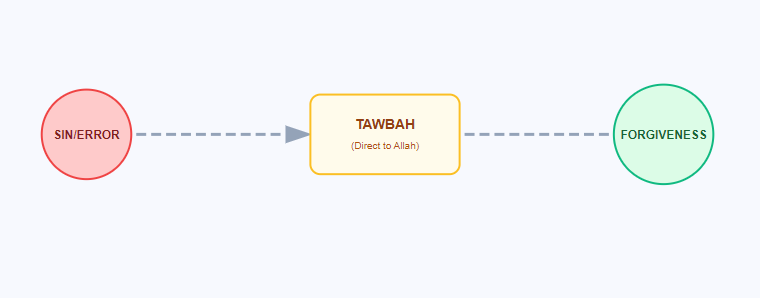
The logical efficiency of Salvation in Islam vs. Christianity is most evident in the mechanism of repentance. In many Christian traditions, finding peace with God requires an intermediary—be it a priest or the acceptance of a specific historical sacrificial event.
In Islam, the path to forgiveness is direct, immediate, and unmediated. Allah, who is established over His Throne, hears the whisper of the sinner directly. Tawbah (repentance) in Islam requires only three logical steps: recognizing the error, feeling sincere regret, and resolving not to return to it. There is no need for a “blood sacrifice” to enable divine forgiveness. Logically, if God is the All-Powerful Creator, He does not require a third party to “reconcile” Him with His own creation. This directness is what makes the Logic of Supplication a powerful tool for every believer.
7. The Final Scales: The Logic of Perfect Accountability
Finally, the study of Salvation in Islam vs. Christianity concludes at the “Mizan” (The Scales) on the Day of Judgment. Christianity often posits an “all-or-nothing” binary: those “in Christ” are saved regardless of their specific deeds, while those “outside” are lost.
Islam presents a more granular and logical justice. Every atom of good and every atom of evil is accounted for. As explored in our inquiry into Life After Death and Divine Justice, the scales will be set with absolute precision. This ensures that no act of kindness is wasted and no act of oppression is ignored. Salvation is a journey of maintaining a “positive moral balance” through faith, deeds, and constant repentance. For the skeptical mind, this system of absolute accountability is far more consistent with the observable laws of cause and effect found in the Scientific Miracles of the Quran.
Conclusion: The Rational Choice for the Soul
The scholarly inquiry into Salvation in Islam vs. Christianity leads to a profound logical verdict: the Islamic model of original purity and personal responsibility aligns more accurately with the human experience and the attributes of a Just Creator. By removing the need for a vicarious blood sacrifice, Islam restores the dignity of the human intellect and the directness of the relationship between the servant and Allah, the Most High.
For the skeptical reader, the choice is between a system of inherited debt or a system of personal agency. Islam invites you to the latter—to a life where your destiny is in your own hands, supported by the infinite mercy of the One who created the Origins of the Universe. As we see in the Why Islam analysis, truth is not a mystery to be solved with blood; it is a reality to be recognized with the heart and the mind.












Leave a Reply