

In the ongoing dialogue between science and spirituality, this article investigates the concept of consciousness. We present the Islamic perspective on the human soul, inviting readers to explore the profound intersection of biology and divine revelation.
In the modern intellectual era, the dominant worldview is often defined by “Materialism”—the philosophical conviction that nothing exists except matter and energy. For the skeptical Western seeker, the neuroscientist, or the agnostic student, this leads to the conclusion that the human being is merely a sophisticated “biological machine.” In this view, thoughts are just electrical impulses, and “self” is an illusion produced by brain chemistry. However, a rigorous logical inquiry into the Reality of the Soul in Islam reveals that this materialistic reductionism fails to account for the most fundamental aspect of our existence: consciousness.
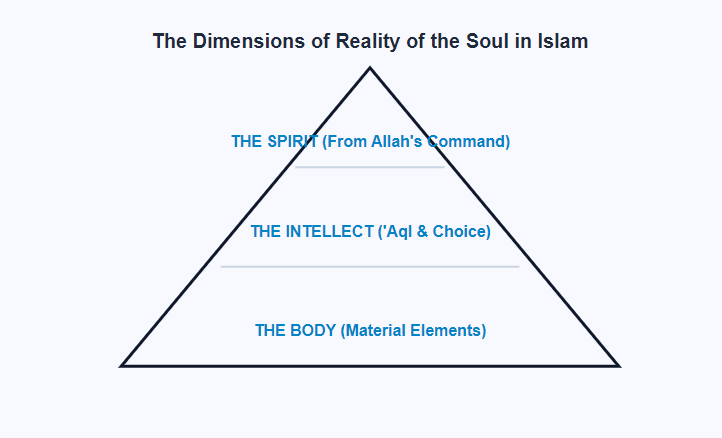
In the Sunni Athari worldview, we recognize that the human being is a dual entity consisting of a physical body created from clay and an immaterial soul (Ruh) which is from the command of Allah. Allah, the Most High, who is established over His Throne and is distinct from His creation, created the soul as a real, existing entity that survives the death of the body. The Reality of the Soul in Islam is not a “ghost in the machine” myth, but a logical necessity that explains why we possess an unshakeable sense of identity, morality, and purpose. This article explores five profound logical proofs that demonstrate why the soul is a reality that transcends the limitations of matter.
Table of Contents
1. The “Hard Problem” of Consciousness: Matter vs. Experience
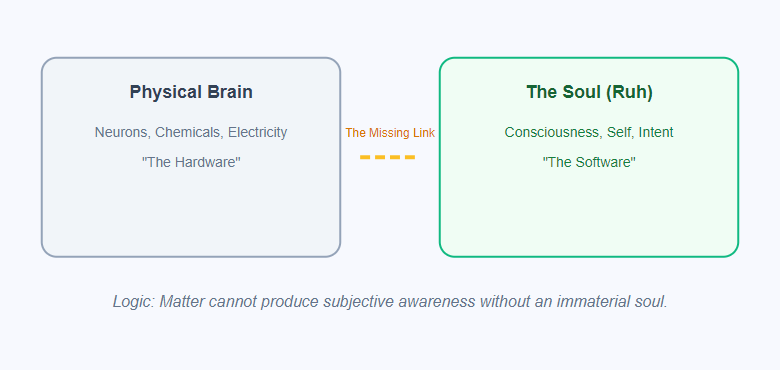
The primary logical challenge to materialism is what philosophers call “The Hard Problem of Consciousness.” Logically, one can describe every physical process in the brain—the firing of synapses and the flow of neurotransmitters—but this does not explain the “Subjective Experience” (Qualia). Knowing the chemical formula of a strawberry is not the same as the “experience” of tasting its sweetness.
The Reality of the Soul in Islam provides the missing link. In Islamic logic, the brain is the “instrument,” while the soul is the “user” of that instrument. Just as a piano cannot produce a symphony without a pianist, the physical brain cannot produce “meaning” without an immaterial soul. As documented in Britannica’s analysis of consciousness, the gap between objective matter and subjective experience remains the greatest mystery of science. Islam asserts that this experience originates from the Ruh, a non-material entity granted by Allah, the All-Knowing Creator. This aligns with our previous inquiry into Islam and Human Logic, which mandates that we follow evidence to its ultimate source.
2. The Persistence of Identity: Cellular Change vs. The Unified Self
A staggering biological fact is that the human body is in a state of constant flux. Every few years, almost every cell in your body is replaced. Logically, the “you” from ten years ago is physically a completely different collection of atoms than the “you” today. Yet, your memory, your personality, and your sense of being “Self” remain unified and continuous.
If the “Self” were purely material, your identity would dissolve as your cells changed. The Reality of the Soul in Islam offers the only logical explanation for this persistence. The soul is the “Constant” in a universe of “Variables.” It is the immaterial anchor that maintains the unity of the individual across time. This unified self is what will eventually be held accountable in the Life After Death, as the moral weight of an action belongs to the soul that intended it, not just the atoms that executed it. This logical continuity is essential for the framework of Divine Justice.
3. The Logic of Intention and Will: The Master of the Machine
Materialism suggests that every human choice is “determined” by prior physical causes—essentially, that you are a biological robot with no real choice. However, the human experience of Free Will contradicts this. We have the ability to resist our biological urges; a hungry person can choose to fast for a higher purpose, and a fearful person can choose to be courageous.
Logically, if we were purely material, we would always follow the strongest physical impulse. The Reality of the Soul in Islam posits that the Ruh possesses a degree of agency that can override the “biological programming” of the body. This ability to choose based on abstract values—like Objective Morality—proves that the source of our will is not contained within the physical laws of chemistry. The Sincerity of Prophet Muhammad in choosing poverty over Meccan gold is a historical proof of this spiritual agency.
4. The Fitrah and the Hunger for the Infinite
Material evolution focuses on survival and reproduction. Logically, a purely material being should only care about food, shelter, and security. Yet, human beings across all history have exhibited a “Spiritual Hunger”—a desire for meaning, ultimate justice, and a connection to the Transcendent.
In Islamic theology, this is the Fitrah. The Reality of the Soul in Islam explains that this hunger exists because the soul is a stranger in the material world. Just as physical hunger proves the existence of food, the “soul’s hunger” for the Divine proves the existence of a spiritual reality and a Creator who is High above His Heavens. As explored by scientific inquiries into the “God Spot” in the brain, even neurology recognizes that humans are “hard-wired” for belief. Islam asserts that this wiring is not an evolutionary accident but a homing signal from Allah to the soul.
5. Information Theory and the Soul’s Command
Modern science recognizes that information is distinct from the medium that carries it. A book’s weight and ink are material, but the “story” it tells is immaterial information. Similarly, the Reality of the Soul in Islam can be understood through the lens of information. The Quran describes the soul as being “from the command (Amr) of my Lord” (Quran 17:85).
Logically, the biological data of our DNA—as analyzed in the Scientific Miracles of the Quran—requires a “Receiver” to interpret it. The soul acts as the metaphysical software that gives life to the biological hardware. Without the soul, the body is a lifeless machine; with the soul, it becomes a conscious servant of Allah. This distinction is what allows for the Preservation of the Bible and Quran to have meaning—it is the soul that perceives the truth of the Word, not just the physical eyes.
Conclusion: The Soul as the Gateway to Truth
The study of the Reality of the Soul in Islam leads to a clear rational verdict: we are more than the sum of our atoms. Materialism, while useful for studying the physical world, fails to explain the mystery of our consciousness, our identity, and our moral depth.
For the skeptical reader, recognizing the soul is the first step toward recognizing the Creator. Allah, the Most High, who is established over His Throne, gave us this “Divine Trust” to navigate the world with wisdom. By understanding our true nature, we move from the chaos of accidental existence to the clarity of a purposeful journey. As we see in the Why Islam analysis, the soul is the mirror in which the light of truth is reflected, calling us back to our Originator.













Leave a Reply