
In the modern era, the relationship between religion and science is often portrayed as one of perpetual conflict. For the skeptical Western reader, the common narrative suggests that faith requires a suspension of intellect, while science demands its full engagement. However, when we examine the relationship between the Quran and Modern Science, a different, more harmonious picture emerges.
The Quran, revealed over 1,400 years ago in a desert society with no access to telescopes, microscopes, or advanced laboratories, contains statements about the natural world that are staggering in their precision. Unlike ancient myths that often explained natural phenomena through superstitious lenses, the Quran speaks of the universe in a way that aligns remarkably with 21st-century discoveries.
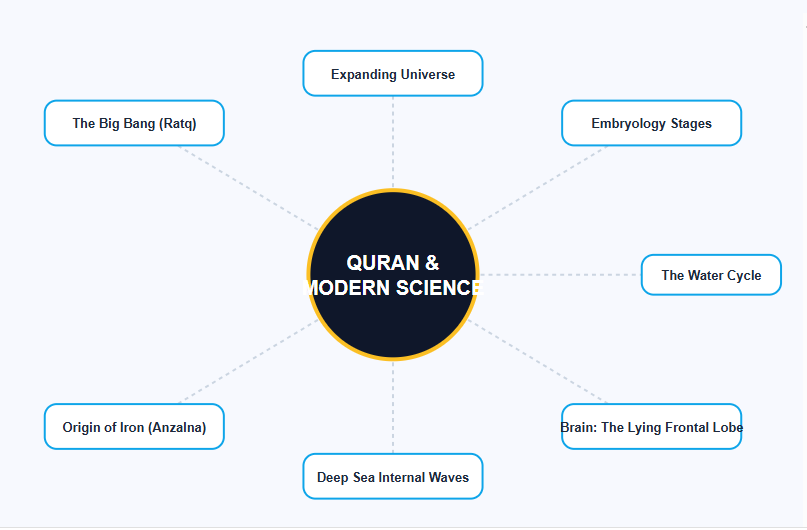
This article invites you to a logical investigation into the Quran and Modern Science. We will explore seven specific phenomena—from cosmology to embryology—that suggest the information within the text could not have originated from a human source in the 7th century.
Table of Contents
1. The Islamic Philosophy of Science
To understand the connection between the Quran and Modern Science, one must recognize that Islam does not view science as a rival to faith, but as a tool for its realization. The Quran repeatedly urges humanity to “reflect,” “observe,” and “think” about the universe.
In Islamic theology, the “Book of Revelation” (the Quran) and the “Book of Nature” (the Universe) are seen as two manifestations of the same Divine Truth. Therefore, a contradiction between a clear scientific fact and a clear Quranic verse is considered ontologically impossible. This intellectual openness laid the foundation for the Islamic Golden Age, where Muslim scientists led the world in optics, mathematics, and medicine.
2. Cosmology: The Big Bang and the ‘Smoke’ Phase
One of the most profound intersections of the Quran and Modern Science lies in the origins of the universe. Modern cosmology, through the Big Bang Theory, posits that the universe began as a single, infinitesimal point of infinite density.
The Quran described this “singular” origin 1,400 years ago:
“Have those who disbelieved not considered that the heavens and the earth were a joined entity (Ratq), and We separated them (Fataq)…?” (Quran 21:30).
The Arabic word Ratq refers to something sewn together or a unified mass, while Fataq refers to the process of breaking apart or separating. Furthermore, modern science describes the early universe as being in a state of hot, opaque gas or plasma. The Quran uses a strikingly accurate word for this:
“Then He directed Himself to the heaven while it was smoke (Dukhan)…” (Quran 41:11).
To a skeptical mind, the use of the word “smoke” (Dukhan) is more scientifically accurate than the word “gas,” as it implies a hot, opaque, and dense substance—exactly what the early universe was.
3. The Expanding Universe: Beyond Hubble’s Law
Until the early 20th century, the scientific consensus was that the universe was static. It wasn’t until 1929 that Edwin Hubble provided the observational evidence that galaxies are moving away from us, a discovery documented by NASA’s Hubble Site regarding the expanding universe.
However, the Quran and Modern Science converged on this point centuries earlier. The Quran states:
“And the heaven We constructed with strength, and indeed, We are [its] expander.” (Quran 51:47).
The Arabic term Musi’un is a present participle indicating a continuous action of expansion. This aligns perfectly with modern astrophysics, which confirms that the universe is not only expanding but is doing so at an accelerating rate. This verse is a primary pillar in the study of the Authenticity of the Quran.
4. Embryology: The Precision of Human Development
The field of embryology provides perhaps the most detailed evidence for the Quran and Modern Science dialogue. The Quran describes the development of the human embryo in stages that were invisible to the naked eye.
The Quranic stages include:
- Nutfah: The drop of fluid.
- Alaqah: A leech-like substance that clings.
- Mudghah: A chewed-like substance.
Dr. Keith Moore, one of the world’s most prominent anatomists, noted that the term Alaqah is a perfect description of the early embryo (around 7-24 days), as it physically resembles a leech and “clings” to the uterine wall for nourishment. He stated that this level of detail, mentioned in the Quran and Modern Science, could not have been known without modern ultrasound and microscopy.
These stages were later reviewed by experts in the field of human development and embryology, confirming the remarkable nature of these 7th-century descriptions.
5. Iron: An Extra-Terrestrial Origin?
A fascinating geological fact mentioned in the Quran is the origin of iron. Modern science confirms that iron was not formed on Earth but was sent down from space via supernovae explosions that occurred billions of years ago. Earth’s core did not have the energy required to produce iron atoms.
The Quran uses a very specific verb when referring to iron:
“…And We sent down (Anzalna) iron, in which is great military might and benefits for the people…” (Quran 57:25).
The verb Anzalna in Arabic means “to send down” from above. While ancient people might have thought iron was just another rock from the earth, the Quran and Modern Science both confirm that iron is an “alien” element that literally fell from the stars.

6. The Deep Sea: Internal Waves and Darkness
Until the development of modern oceanography and submarines, humans knew very little about the deep ocean. The Quran, however, describes the environment of the deep sea with remarkable accuracy:
“Or [it is] like darknesses within a deep sea which is covered by waves, upon which are waves, over which are clouds…” (Quran 24:40).
This verse mentions a phenomenon called “internal waves.” Oceanographers have discovered that waves do not only occur on the surface but also exist deep within the ocean at the interface of different densities. Furthermore, the description of “darkness upon darkness” aligns with the fact that light is absorbed by the ocean in stages, eventually leading to total darkness below 1,000 meters. A desert-dwelling man in the 7th century could not have known about internal waves or the light spectrum of the deep sea, making this a cornerstone of Quran and Modern Science.
7. The Frontal Lobe: The Center of Honesty and Lying
In a verse describing a rebellious individual, the Quran says:
“No! If he does not desist, We will surely drag him by the naseyah (forehead/profront)—A lying, sinful naseyah.” (Quran 96:15-16).
Why does the Quran attribute “lying” and “sinning” to the forehead (Naseyah) rather than the person as a whole?
Modern neuroscience has discovered that the prefrontal cortex (the part of the brain located behind the forehead) is responsible for decision-making, executive functions, and—crucially—the act of lying. Research using functional MRI (fMRI) shows that when a person lies, the prefrontal cortex becomes highly active. The Quran and Modern Science thus agree on the biological center of moral decision-making.
8. Conclusion: Harmonizing Faith and Reason
The evidence found in the Quran and Modern Science suggests that the text contains a depth of knowledge that transcends its historical context. These verses were not meant to be a science manual, but a series of “signs” (Ayat) intended to prompt the human mind to recognize a higher intelligence behind the design of the universe.
For the skeptical reader, the harmony between 1,400-year-old scripture and 21st-century science is a powerful invitation to reflection. Whether it is the prophecies of Muhammad in the Bible or the structural discipline of the Five Pillars, Islam presents a unified worldview where faith and reason are two sides of the same coin.
By exploring the Quran and Modern Science, we move away from the myth of conflict and toward a future where the pursuit of scientific truth is seen as a form of worship—a search for the handiwork of the Creator in the masterpiece of the cosmos.
Leave a Reply