

This research paper is part of Truth Clearly’s commitment to providing an authentic Islamic perspective on theology and history. We adhere to rigorous academic standards, relying exclusively on the Quran, authentic Prophetic traditions, and verified historical sources to provide clarity for the rational seeker.
For over fourteen centuries, the figure of Muhammad, the Prophet of Islam, has been a subject of intense fascination, debate, and scrutiny in the Western world. For the skeptical Western reader, the academic historian, or the seeker of objective truth, the narrative of Prophet Muhammad in Western Thought has evolved from medieval polemics to a modern, more nuanced recognition of his unprecedented influence. The central question that arises is not merely one of faith, but of historical logic: How did a single individual, born in a remote desert, manage to leave a signature on human civilization that remains unmatched by any emperor, philosopher, or scientist?
In the Sunni Athari worldview, we recognize that the greatness of Muhammad (peace be upon him) was not a product of personal ambition or human genius alone. He was the chosen vessel for the literal and uncreated Speech of Allah—the Most High, who is established over His Throne and is distinct from His creation. His impact, which even non-Muslim thinkers have felt compelled to acknowledge, is the external proof of the Sincerity of Prophet Muhammad and the divine origin of his mission. This article explores seven profound realities of Prophet Muhammad in Western Thought, analyzing why the most rational minds in history have identified him as a unique force of change.
Table of Contents
1. The Logic of Supremacy: Michael Hart’s Numerical Verdict
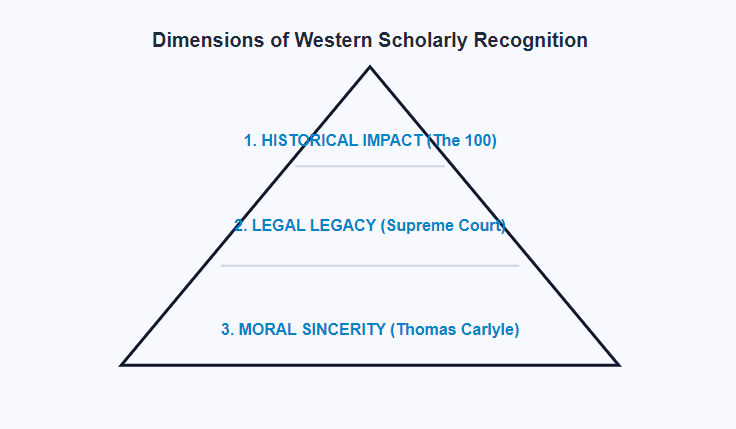
The most famous modern entry in the discourse of Prophet Muhammad in Western Thought is found in the work of the American astrophysicist and historian Michael H. Hart. In his book, The 100: A Ranking of the Most Influential Persons in History, Hart placed Muhammad at the absolute top of the list.
Logically, Hart’s reasoning was based on a dual impact: religious and secular. He noted that Muhammad was the only man in history who was “supremely successful on both the religious and secular levels.” Unlike Jesus in Islam (and Christianity), who provided the spiritual foundation but not the legal or political structure during his lifetime, or secular leaders who provided the law but not the faith, Muhammad unified both. For a rational researcher, this “total success” points to a mission that was supported by the One who manages the Origins of the Universe, providing a complete system for human flourishing.
2. The Character Analysis: Thomas Carlyle and Hero-Prophethood
In the 19th century, the Scottish philosopher Thomas Carlyle challenged the medieval European stereotypes of Muhammad. In his lecture series On Heroes, Hero-Worship, and the Heroic in History, he dedicated a full chapter to “The Hero as Prophet,” focusing on the Prophet Muhammad in Western Thought as a model of absolute sincerity.
Carlyle’s logic was simple: a “false man” could not build a religion that lasted for centuries and inspired millions. He argued that an impostor would have been exposed by the heat of the desert and the trials of war. Logically, the unshakeable nature of Muhammad’s message—even during the most brutal years of the Meccan boycott—proves that he was a man of “deep sincerity” and “original truth.” This philosophical recognition aligns with the Islamic logic of Prophetic Sincerity, where the character of the messenger is the first credential of the message.
3. The Legal Architect: Recognition by the US Supreme Court
A fascinating and often overlooked reality of Prophet Muhammad in Western Thought is his recognition as one of the world’s greatest lawgivers. In 1935, the Supreme Court of the United States honored Muhammad as one of the “Greatest Lawgivers of the World” in a marble frieze within the courtroom.
From a logical legal perspective, the Sharia Law in Islam introduced concepts of justice, due process, and human rights that were centuries ahead of their time. By establishing a system where the ruler and the ruled are equal before Allah, who is established over His Throne, Muhammad created a society of accountability. This legal legacy is what modern Western jurists recognize as a foundational contribution to the development of global jurisprudence and Islam and Human Rights.
4. The Social Reformer: Lamartine’s Logic of Scale
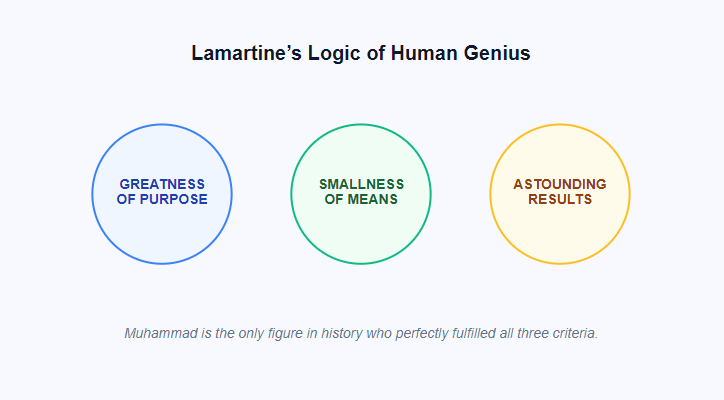
Alphonse de Lamartine, the French poet and historian, provided a rigorous logical framework for evaluating human greatness. In his Histoire de la Turquie, he asked: “If greatness of purpose, smallness of means, and astounding results are the three criteria of human genius, who could dare to compare any great man in modern history with Muhammad?”
Logically, the scale of Muhammad’s achievement is a statistical anomaly. He started with no wealth, no army, and no political support in an environment of total Tribalism. Yet, within 23 years, he abolished racism, empowered Women in Islam, and unified the Arabian Peninsula. For a skeptical researcher, this “Astounding Result” from “Smallness of Means” suggests that the source of his power was not material, but derived from the Authenticity of the Quran—the uncreated Speech of the Creator.
5. The Intellectual Catalyst: Preservation of the Mind
The Prophet Muhammad in Western Thought is frequently cited as the catalyst for the European Renaissance. Historians like Will Durant and scientific journals acknowledge that without the Islamic Golden Age, the knowledge of the ancient world would have been lost.
Logically, this intellectual explosion was the direct result of the Prophetic mandate to “Seek knowledge.” By making the Contributions to Science an act of worship, Muhammad created a civilization that valued reason (Aql) and empirical observation. This harmony between faith and science—which we explored in the Quran and Modern Science—is what many Western thinkers, such as George Bernard Shaw, identified as the quality that makes Islam “the only religion which appears to me to possess that assimilating capacity to the changing phase of existence.”
6. The Logic of Pluralism: The Medina Covenant
Modern political thinkers often look for the origins of pluralism and secular-legal coexistence. The Prophet Muhammad in Western Thought is increasingly recognized for the “Covenant of Medina”—the first written constitution that established a pluralistic state.
Logically, this document proved that Islam does not require the forced conversion of its citizens. It established the “Logic of Coexistence” between Muslims, Jews, and other groups. By anchoring these rights in a divine covenant from Allah, who is High above His creation, Muhammad ensured that minority rights were not subject to human whims. This historical reality challenges the modern skepticism regarding Islam and Secularism by showing that Islam provides a superior model for a just public order.
7. The Final Prophet: Fulfilled Expectations
Finally, many Western scholars of the 19th and 20th centuries have explored the “Biblical Expectations” of a prophet arising in Arabia. As we analyzed in Muhammad in the Bible prophecies, researchers like Rev. David Benjamin Keldani found that the linguistic and historical clues in previous scriptures point directly to Muhammad.
Logically, if a messenger appears in the exact location (Paran/Sela) and at the exact time predicted by ancient texts—and brings a preserved message as seen in the Preservation of the Bible and Quran—it is only rational to accept him as the final link in the chain. The Prophet Muhammad in Western Thought is thus not just a historical figure, but a fulfilled logical requirement for the completion of the Abrahamic narrative.
Conclusion: The Rational Recognition of Muhammad
The scholarly investigation into Prophet Muhammad in Western Thought leads to a profound logical verdict: the admiration of non-Muslim thinkers for Muhammad is not based on religious sentiment, but on an objective analysis of his fruits. From Michael Hart to Thomas Carlyle, the greatest minds have recognized that his impact on the human soul, law, and science is a unique phenomenon.
For the skeptical reader, these testimonies are invitations to investigate the Source of such greatness. Muhammad was a servant-messenger who transformed the world because he was guided by the One who is established over the Throne. By understanding Why Islam resonated with the world’s most critical thinkers, the seeker finds the “Truth Clearly”—that the message of Muhammad is the final, logical, and perfected guidance for all of humanity. Just as the Water Cycle in the Quran is a sign for our bodies, the character and legacy of the Prophet are signs for our rational souls.











Leave a Reply