
This research paper is part of Truth Clearly’s commitment to providing an authentic Islamic perspective on theology and history. We adhere to rigorous academic standards, relying exclusively on the Quran, authentic Prophetic traditions, and verified historical sources to provide clarity for the rational seeker.
In the shared history of the Abrahamic faiths, the figure of Jesus of Nazareth is inseparable from the concept of the supernatural. For the skeptical Western seeker, the historian, or the student of theology, the extraordinary acts attributed to him often serve as a primary point of either deep faith or intense skepticism. However, when we analyze the Miracles of Jesus in Islam (known as Mu’jizat Isa), we encounter a unique logical framework that differs significantly from the traditional Christian interpretation. In Islam, miracles are not evidence of the performer’s divinity, but rather “Logical Signatures” from the Creator to verify the authenticity of His messenger.
In the Sunni Athari worldview, we recognize that Allah—the Most High, who is established over His Throne and is distinct from His creation—possesses absolute power over the laws of nature. He is the One who spoke the Quran as His literal Speech, and within that Speech, He details the specific wonders granted to Prophet Isa. The Miracles of Jesus in Islam are presented as historical realities performed by the permission of Allah (Bi-idhnillah). This article explores seven profound logical truths regarding these miracles, demonstrating how they confirm the high status of Jesus while maintaining the unshakeable logic of Tawhid (Absolute Monotheism).
Table of Contents
1. The Logic of “By God’s Permission”: The Servant vs. The Source
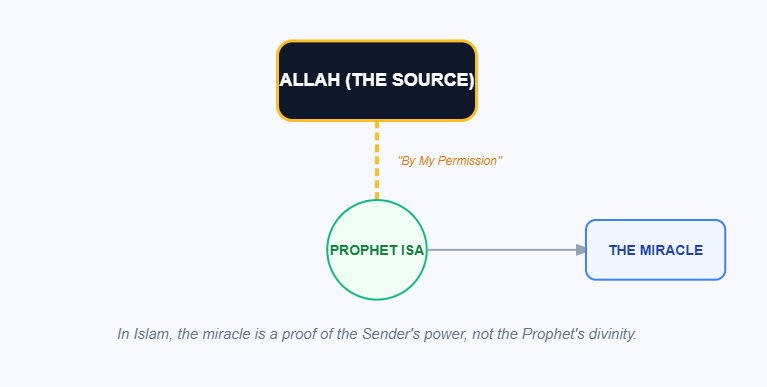
The primary logical distinction in the study of the Miracles of Jesus in Islam is the recurring phrase in the Quran: “By My permission” or “By Allah’s permission.” Unlike narratives that might imply Jesus performed these acts through his own inherent divine essence, the Islamic perspective emphasizes that he was a conduit for Allah’s power.
Logically, if a messenger claims to represent a King, he must show the King’s seal. The miracle is that seal. In the Athari creed, we believe that Allah, who is High above His Heavens, suspended the habitual laws of biology and physics specifically for Jesus to prove his Prophethood. By emphasizing that these acts were only possible through divine permission, Islam provides a logically consistent framework: the miracle proves the Sincerity of the Messenger, but the power belongs solely to the Sovereign Lord.
2. Defending Honor: The Miracle of the Cradle
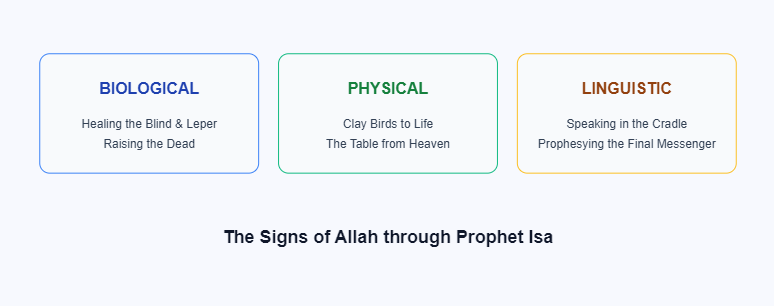
One of the most unique and profound Miracles of Jesus in Islam is his speaking from the cradle. When the Virgin Mary returned to her people with her newborn son, she was met with intense suspicion and accusation. In response, the infant Jesus spoke to the crowd to defend his mother’s chastity and declare his mission.
Logically, this miracle served a critical legal and social purpose. It removed the stigma from Mary and provided an immediate, undeniable credential for Jesus before he even began his public ministry. The Quran records his words: “Indeed, I am the servant of Allah. He has given me the Scripture and made me a prophet” (Quran 19:30). This miracle highlights that the Authenticity of the Quran protects the reputation of the righteous, establishing Jesus as a “servant” from his very first breath.
3. Power Over Matter: The Creation of Clay Birds
Among the most striking Miracles of Jesus in Islam is his ability to fashion a bird out of clay and breathe life into it. The Quran states: “…and [remember] when you designed from clay [what was] like the form of a bird with My permission, then you breathed into it, and it became a bird with My permission” (Quran 5:110).
From a logical perspective, this miracle challenged the contemporary understanding of matter and life. It was a direct sign that the One who initiated the Origins of the Universe has the authority to grant a mortal man the ability to manifest a creative act. However, the logic remains anchored in Tawhid: Jesus did not “create” in the sense of bringing something out of nothing; he transformed matter by the permission of the only True Creator. This miracle invited the Israelites to recognize that the same God who gives life to the earth after rain is the God who supported Jesus.
4. Defying Biology: Healing the Incurable
The society into which Jesus was sent was one that prided itself on its knowledge of medicine. Therefore, the Miracles of Jesus in Islam were specifically tailored to challenge the expertise of the time. He was given the power to heal the blind from birth and the leper—conditions that were considered medically impossible to cure in late antiquity.
Logically, a miracle must surpass the highest human achievement of its era to be recognized as divine. By healing what the best physicians could not, Prophet Isa proved that his source of knowledge and power was transcendent. This aligns with the Scientific Miracles of the Quran, where revelation provides information that exceeds human observation. These acts of mercy were signs for the rational mind to conclude that the Sincerity of Prophet Muhammad in confirming Jesus’s miracles was based on shared divine truth.
5. The Ultimate Sign: Raising the Dead
Perhaps the most monumental of the Miracles of Jesus in Islam was the raising of the dead. Like the previous miracles, the Quran emphasizes that this was done “by Allah’s permission.”
Logically, the restoration of life is the ultimate proof of the Creator’s existence. If a human being can be brought back from the state of death through a prophet’s prayer, it serves as a powerful empirical evidence for the possibility of Life After Death and Divine Justice. It proves that the human soul is real and that the Creator, who is established over His Throne, has the power to reconstruct the body. For the skeptical researcher, this miracle serves as a bridge between the physical world and the eschatological reality of the hereafter.
6. The Logic of the Table (Al-Ma’idah)
A unique narrative in the Quran involves the disciples of Jesus asking for a “Table spread with food” from heaven. They said they wanted it “that we may eat from it and our hearts be assured and we may know that you have indeed spoken the truth to us…” (Quran 5:113).
This miracle represents the “Logic of Assurance.” Even the most devoted followers sometimes require a tangible sign to strengthen their Worship in Islam. The response to this request was a miraculous provision that served as a festival and a sign for all generations. It demonstrates that Allah, the Most Merciful, provides physical signs to support the psychological and spiritual certainty of the believers. It connects the mundane act of eating to the divine reality of Divine Provision and Supplication.
7. Miracles as a Rejection of Divinity, Not a Proof of It
The final and most important logical reality regarding the Miracles of Jesus in Islam is their purpose. In the Islamic worldview, the more great the miracle, the more it proves the greatness of the God who sent the prophet, not the prophet himself.
Logically, if Jesus were God, he would not need to ask for “permission” or pray for the miracle to occur. The fact that his miracles were contingent upon the Will of Allah, who is High above His creation, proves that Jesus was a dependent servant (Abd). This logic is what distinguishes the Islamic view on Jesus from the later Trinitarian developments. Miracles are the “Credentials of Prophethood,” not the “Attributes of Godhead.” By maintaining this distinction, Islam protects the human intellect from falling into the logical traps of secularism or polytheism.
Conclusion: The Rationality of the Supernatural
The investigation into the Miracles of Jesus in Islam leads to a profound logical verdict: these extraordinary events were purposeful, verified, and strictly monotheistic. They were designed to heal the body, defend the innocent, and—most importantly—to guide the human intellect back to the worship of the One True God, the Most High.
For the skeptical reader, the miracles of Isa are invitations to look beyond the material surface of the world. They prove that the laws of nature are not independent masters but are subservient to the All-Wise Creator who is established over His Throne. By recognizing these signs, one finds the Why Islam answer: a religion that honors the miraculous while remaining unshakeably anchored in reason. In the figure of Prophet Isa, we find a majestic messenger whose miracles still speak to the hearts of those seeking “Truth Clearly.”




Leave a Reply