
This research paper is part of Truth Clearly’s commitment to providing an authentic Islamic perspective on theology and history. We adhere to rigorous academic standards, relying exclusively on the Quran, authentic Prophetic traditions, and verified historical sources to provide clarity for the rational seeker.
In the intersection of history, theology, and the Abrahamic heritage, few figures command as much universal respect as Mary, the mother of Jesus. For the skeptical Western reader, the academic researcher, or the student of comparative religion, the portrayal of Mary in Islam (known as Maryam) presents a staggering intellectual and spiritual revelation. While many assume that Mary is exclusively a Christian figure, the Quran devotes an entire chapter to her name (Surah Maryam) and presents her as the absolute pinnacle of human purity and devotion.
In the Sunni Athari worldview, we recognize Allah as the All-Powerful Creator who is High above His Heavens and established over His Throne. He spoke the Quran as His literal, uncreated Speech, and in this Speech, He established Mary as a “Sign” (Ayah) for all of humanity. The study of Mary in Islam is not merely a historical account; it is a logical inquiry into the potential of the human soul to reach the highest levels of sincerity. This article explores seven profound logical realities of Mary’s status in Islam, demonstrating how her story bridges the gap between ancient prophecy and final truth.
Table of Contents
1. The Logic of Absolute Purity: The Siddiqah
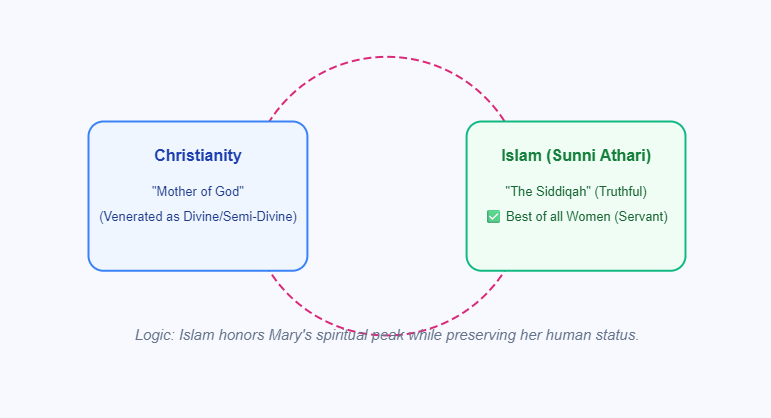
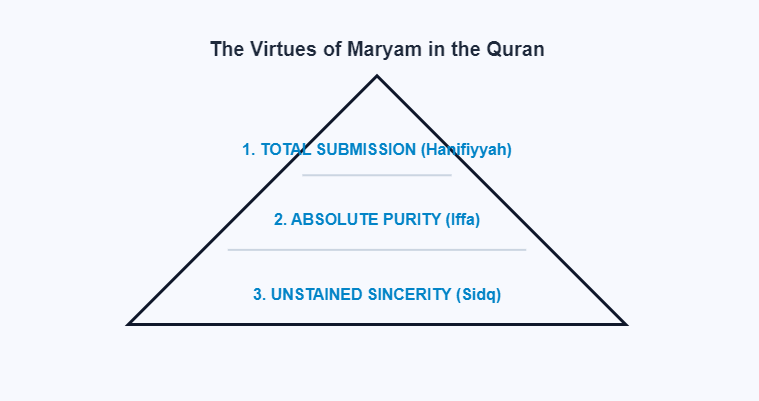
The primary logical pillar of Mary in Islam is her title: As-Siddiqah (The Truthful). In Islamic theology, Mary is recognized as a woman who achieved the highest level of faith possible for a non-prophet. She was chosen and purified by Allah above all the women of the world.
Logically, for a woman to be entrusted with the miraculous birth of the Messiah, her own character had to be beyond reproach. Allah, the Most High, who knows the secrets of the hearts, chose Mary because of her unshakeable devotion and her absolute adherence to Tawhid (Monotheism). Unlike later mythological additions that might attempt to deify her, Islam preserves her humanity while elevating her spiritual rank to a level that challenges every human to seek similar excellence. Her life is the ultimate proof of Islam and Objective Morality, where true virtue is recognized and rewarded by the Creator.
2. The Sanctuary Dedication: The Logic of Total Devotion
The story of Mary in Islam begins before her birth. Her mother, the wife of Imran, dedicated the child in her womb to the service of Allah. In a revolutionary act for 1st-century society, a female child was accepted into the service of the Sanctuary (Bayt al-Maqdis).
Logically, this established Mary as a person of focus and spiritual discipline from her earliest days. She was raised under the guardianship of Prophet Zechariah in a state of continuous Worship in Islam. This early environment of seclusion and prayer provided the psychological and spiritual foundation for the trials she would later face. It demonstrates the logical principle that great responsibility—such as bearing a prophet—requires a lifetime of preparation and a soul anchored in the recognition of the One who is High above the Throne.
3. Divine Provision: Miracles as Logic of Certainty
A profound reality mentioned in the Quran regarding Mary in Islam is the divine provision she received. Zechariah would find out-of-season fruits in her prayer chamber. When he asked where they came from, she replied: “It is from Allah. Indeed, Allah provides for whom He wills without account” (Quran 3:37).
From a logical perspective, these minor miracles served as “Assurance” for both Zechariah and Mary. They proved that Allah, the Sustainer of the Origins of the Universe, has the absolute power to provide through non-material means. These signs prepared the intellect for the much greater miracle that was to follow: the virgin birth of Jesus in Islam. This consistency in the “Signs of Allah” is a recurring theme in Scientific Miracles of the Quran, where the laws of nature are seen as subservient to the Divine Will.
4. The Annunciation: The Logic of Divine Omnipotence
The defining moment of Mary in Islam is the Annunciation. The Angel Gabriel appeared to her in the form of a man to deliver the news of a “pure son.” Her logical response was one of bewilderment: “How can I have a boy while no man has touched me…?” (Quran 19:20).
The divine response established the ultimate logic of creation: “It is easy for Me” (Quran 19:21). Islamic theology asserts that Allah creates through His command “Be” (Kun). Logically, the One who created the first human (Adam) without a father or a mother has the absolute authority to create a human (Jesus) without a father. This event is a primary proof for the Authenticity of the Quran as it clarifies the nature of the Messiah—he is a created sign, and Mary is the chosen vessel, but neither possesses divine essence. This maintains the unshakeable logic of the Creator’s distinction from His creation.
5. The Trial of Childbirth: Human Vulnerability and Divine Mercy
The Quranic narrative of Mary in Islam provides a deeply human and empathetic account of her childbirth. In a state of intense physical and emotional pain, she withdrew to a remote place, wishing she had died before facing this trial.
Logically, this inclusion of her “moment of weakness” is a powerful proof for the Sincerity of Prophet Muhammad in delivering the message. If the story were a fabrication to glorify a religious figure, it would likely omit her crying in pain. However, Islam shows that even the most honored of women is still human. Allah’s response—providing a stream of water and fresh dates—demonstrates that divine mercy is always near those who are sincere. This reality anchors the Logic of Suffering, showing that pain is often the prelude to a great divine gift.
6. Defending the Innocent: The Logic of the Miraculous Speech
When Mary returned to her people with the infant Jesus, she was met with accusations of unchastity. Logically, as a lone woman in a traditional society, her word would not have been enough to clear her name.
The Mary in Islam dialogue reaches a climax when she points to the child. Jesus, by the permission of Allah, spoke from the cradle to defend his mother’s honor. This miracle was not for entertainment; it was a “Legal Necessity” to establish the Human Rights and dignity of Mary. It proved that her son was a Prophet of Allah and that she was the most truthful of women. This event provided a historical credential that protected the lineage of Jesus and the reputation of Mary for all generations.
7. The Final Witness: Mary as an Absolute Paradigm for Believers
The final reality of Mary in Islam is her role as a universal example. The Quran explicitly cites her as a model not just for women, but for all believers—men and women alike. She is praised for her “Chastity” and her “Faith in the Words of her Lord.”
Logically, Mary represents the perfect synthesis of Free Will and Divine Decree. She chose to believe, she chose to submit, and she chose to remain steadfast through the most difficult social trial imaginable. By following the 5 Pillars of Islamic Faith in spirit—devoting oneself to Allah and maintaining moral purity—every believer is following the footsteps of Mary. She stands as a bridge between the Bible and Quran prophecies, confirming that God’s grace is for those who are sincere.
Conclusion: The Truth Clearly Revealed through Mary
The scholarly inquiry into Mary in Islam reveals a figure of unmatched dignity, logic, and spiritual power. By stripping away the layers of deification on one hand and the accusations of critics on the other, Islam restores Mary to her rightful place: as the supreme model of human sincerity and the chosen mother of the Messiah.
For the skeptical mind, the Islamic portrayal of Mary offers a compelling rational framework. It respects her miraculous life while maintaining the absolute transcendence of Allah, who is established over His Throne. In the story of Maryam, we find the “Truth Clearly”—that the highest honor a human can achieve is to be a faithful servant of the One True God. Her legacy remains a light for all seekers, inviting them to the path of Why Islam is the final and perfected guidance for all of mankind.




Leave a Reply