

This research paper is part of Truth Clearly’s commitment to providing an authentic Islamic perspective on theology and history. We adhere to rigorous academic standards, relying exclusively on the Quran, authentic Prophetic traditions, and verified historical sources to provide clarity for the rational seeker.
In the modern intellectual era, the rise of “New Atheism” and materialistic naturalism has presented a significant challenge to traditional faith systems. For the skeptical Western reader, the scientist, or the student of philosophy, the existence of God is often portrayed as an unprovable hypothesis that contradicts the findings of modern science. However, a rigorous logical and ontological inquiry into Islam and the Challenge of Atheism reveals that belief in a Creator is not a flight from reason, but its ultimate fulfillment. Islam does not ask the seeker to abandon logic; it presents logic as the primary vehicle to recognize the Divine.
In the Sunni Athari worldview, we recognize Allah as the unique Creator who is High above His Heavens and established over His Throne (Istawa) in a manner that suits His Majesty. He is distinct from His creation, and His Attributes of Knowledge, Power, and Wisdom are manifest in every atom of the cosmos. Islam and the Challenge of Atheism is not a conflict between “Science” and “Religion,” but between a worldview of “Blind Chance” and a worldview of “Intelligent Design.” This article explores seven profound logical realities that demonstrate why the existence of a Sovereign Creator is the only rational explanation for the universe and human experience.
Table of Contents
1. The Principle of Contingency: Why is there Something Rather than Nothing?
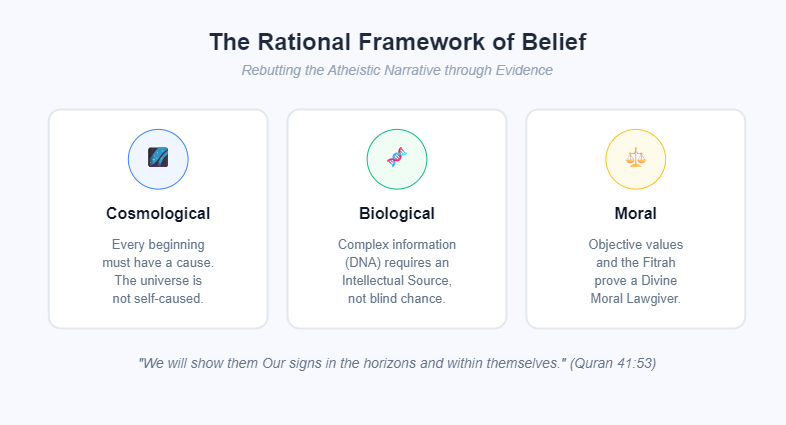
The most fundamental question in the study of Islam and the Challenge of Atheism is the origin of existence. Logically, the universe is “contingent”—it does not have to exist, and it could have been different. Anything that is contingent requires a “Necessary Being” to bring it into existence. If we trace the chain of causes back to the beginning, we must reach an Uncaused Cause.
Islamic logic, specifically the Origins of the Universe framework, asserts that an infinite regress of causes is a logical impossibility. Just as a row of falling dominoes must have a first pusher who is not himself a falling domino, the universe must have a Creator who is not Himself created. Allah is Al-Awwal (The First), the Necessary Being upon whom all things depend, but who depends on nothing. By following this principle of causality, the human mind moves from the finite world to the recognition of the Concept of God in Islam as the absolute Source of all.
2. Information Theory and the Biological Signature of Allah
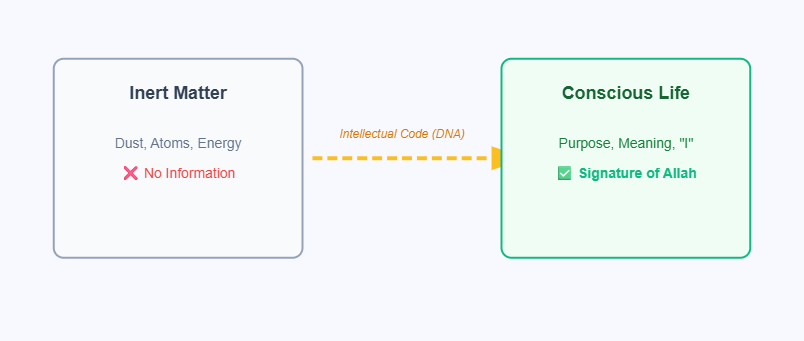
One of the strongest rebuttals in the Islam and the Challenge of Atheism dialogue comes from the field of information theory. Modern biology has revealed that the foundation of life—the DNA molecule—is a digital code of staggering complexity. Logically, information is never produced by blind, undirected matter. A book requires an author; a computer program requires a coder; and a genetic sequence requires an Intelligent Mind.
In Islamic theology, this biological complexity is a manifestation of Allah’s Attribute of Knowledge (Ilm). As explored in our study of Quran and Modern Science, the Quran invites humanity to look at the “Signs” (Ayat) within themselves. Logically, the transition from inert matter to a conscious, reproducing cell containing millions of instructions cannot be attributed to “luck.” The Islam and the Challenge of Atheism perspective argues that the universe is a “Written Text” of physical laws that points directly to the Authenticity of the Quran as the spoken Word of the same Designer.
3. The Moral Argument: Objective Ethics vs. Social Construction
If there is no Creator, then morality is merely a biological byproduct of evolution, designed for tribal survival. Logically, in an atheistic world, “good” and “evil” are subjective labels with no ultimate authority. However, human beings possess an unshakeable sense that certain acts—like the murder of an innocent child—are objectively wrong across all cultures and times.
The Islam and the Challenge of Atheism framework posits that this sense of Objective Morality is a reflection of the Fitrah (innate nature) placed in us by a Just Creator. If morality is not anchored in the Divine Command of Allah, then human rights are merely temporary social contracts that can be revoked by the powerful. By recognizing Allah as the Ultimate Legislator who is Above His Throne, Islam provides a stable foundation for Islam and Human Rights, ensuring that justice is an eternal reality, not a human opinion.
4. The Fine-Tuning of the Cosmos: The Anthropic Reality
Modern physics has discovered that the fundamental constants of the universe—such as gravity, electromagnetism, and the expansion rate of space—are tuned to an impossible degree of precision to allow for life. The study of the Fine-Tuning of the Universe is perhaps the most difficult challenge for atheistic naturalism.
Atheism often resorts to the “Multiverse” theory to explain this precision, suggesting that there are infinite universes and we just happen to be in the “lucky” one. Logically, however, the Multiverse theory violates “Occam’s Razor,” which states that the simplest explanation is usually the correct one. Proposing an infinite number of unobservable universes to avoid one Creator is a massive philosophical leap. Islam and the Challenge of Atheism provides the more rational conclusion: the universe is “mizaan” (balanced) because it was created by the All-Wise (Al-Hakim) for the specific Purpose of Life.
5. Consciousness and the Soul: Transcending the Material
The “Hard Problem of Consciousness” remains the graveyard of materialistic theories. Science can describe the brain’s “hardware,” but it cannot explain the “software” of subjective experience—the “I” that feels, loves, and contemplates.
In Islamic thought, we recognize the Reality of the Soul as an immaterial entity from the command of Allah. Logically, matter cannot produce consciousness any more than a collection of rocks can produce a poem. The Islam and the Challenge of Atheism dialogue emphasizes that our awareness is a divine trust (Amanah). By recognizing that we are more than the sum of our atoms, we align our Human Logic with the reality of our spiritual origin. This dual nature—body and soul—explains our capacity for Worship in Islam and our longing for the infinite.
6. The Problem of Evil: Logic vs. Emotion
Atheists often point to suffering as proof that God does not exist. However, a logical analysis reveals that the “Problem of Evil” actually requires the existence of God. To call something “evil,” one must have an objective standard of “good.” In a random, godless universe, suffering is just a neutral biological event.
The Islam and the Challenge of Atheism perspective offers a sophisticated solution through the Logic of Suffering and Trial. We believe that Allah, the All-Knowing, creates for a Wise purpose. This world is a testing ground where Free Will allows for the development of moral character. Logically, a perfect resort is reserved for the Life After Death, while this life is the school. For the rational mind, suffering is not a sign of God’s absence, but a sign of the temporary and transitional nature of the material world.
7. Historical Evidence and the Prophetic Seal
The final reality in the Islam and the Challenge of Atheism dialogue is the historical phenomenon of Prophethood. Atheism dismisses prophets as deluded or fraudulent. However, when we apply a forensic analysis to the Sincerity of Prophet Muhammad, the data contradicts the atheistic claim.
A man who spent 23 years in extreme sacrifice, refused kingship and wealth, and delivered a message of unparalleled linguistic and scientific depth—as seen in the Preservation of the Bible and Quran—cannot logically be dismissed as an accident of history. Furthermore, the presence of Muhammad in the Bible prophecies provides an external, documented handover that spans centuries. This historical consistency is a powerful logical “credential” for the divine origin of the Islamic message.
Conclusion: The Intellectual Triumph of Tawhid
The scholarly inquiry into Islam and the Challenge of Atheism leads to an inescapable rational verdict: the universe is a masterpiece of design that requires an All-Powerful, All-Wise Designer. From the contingency of matter to the digital code of DNA, the signature of the Creator is undeniable.
For the skeptical seeker, the Why Islam answer is found in its unshakeable commitment to reason and truth. Islam does not offer a comfortable myth; it offers a rigorous clarity that positions the Creator in His rightful place: High above the Throne, distinct from His creation, and the Source of all guidance. By embracing the logical framework of Islam, humanity moves from the dark shadows of a random existence into the brilliant light of a purposeful journey toward the Truth.














Leave a Reply