
This research paper is part of Truth Clearly’s commitment to providing an authentic Islamic perspective on theology and history. We adhere to rigorous academic standards, relying exclusively on the Quran, authentic Prophetic traditions, and verified historical sources to provide clarity for the rational seeker.
In the contemporary geopolitical landscape, the relationship between Islam and Secularism is often presented as a clash of irreconcilable civilizations. For the skeptical Western reader, the agnostic academic, or the student of political science, the term “Secularism” is frequently equated with progress and neutrality, while “Islam” is often perceived through the prism of a restrictive “theocracy.” However, a rigorous logical and historical inquiry into the framework of Islam and Secularism reveals that the Islamic tradition offers a unique model of public life that challenges the binary choices of modern political theory.
In the Sunni Athari worldview, we recognize Allah as the absolute Sovereign and the All-Wise Legislator who is High above His Heavens and established over His Throne (Istawa) in a manner that suits His Majesty. He is distinct from His creation, yet His Speech, the Quran, provides the ultimate moral and legal compass for humanity. Unlike the Western historical experience—where secularism emerged as a reaction to ecclesiastical overreach—the Islamic experience was founded on a divine law that mandated justice, pluralism, and the use of reason. This article explores seven profound realities regarding Islam and Secularism, demonstrating why the Islamic worldview is a sophisticated blueprint for a just public order.
Table of Contents
1. The Ontological Distinction: Divine Sovereignty vs. Human Autonomy
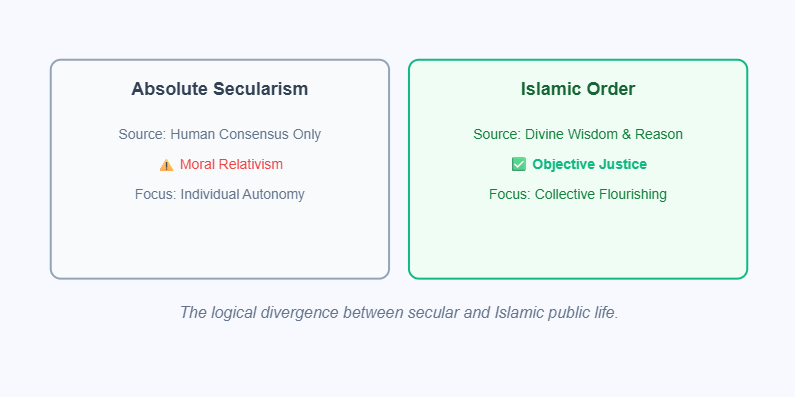
The primary logical tension in the study of Islam and Secularism lies in the source of authority. Secularism, in its absolute form, posits that human reason and consensus are the sole sources of law. In contrast, Islam asserts that while human reason is a divine gift, it must be anchored in the Wisdom of the Creator. Logically, if we accept the Concept of God in Islam as the All-Knowing Creator who is High above His Throne, then He is the most qualified to define the boundaries of human conduct.
In the Athari perspective, Allah spoke His laws as His literal and uncreated Speech. Secularism often suffers from “Moral Relativism,” where laws change based on popular whims. Islam provides an objective standard that protects the weak from the tyranny of the majority, ensuring that the foundations of Islam and Objective Morality remain unshakeable across centuries. By anchoring morality in the Divine, Islam prevents the public sphere from becoming a vacuum of shifting values.
2. The Medina Model: A Logical Framework for Pluralism
Many skeptics argue that Islam and Secularism are incompatible because Islam supposedly requires the forced conversion of all citizens. However, history and logic refute this. When Prophet Muhammad (peace be upon him) established the first Islamic state, he drafted the “Constitution of Medina.” This document was a revolutionary social contract that recognized Jews, pagans, and Muslims as a single political entity (Ummah).
It granted each group autonomy over their religious and legal affairs. Logically, this was a form of “Procedural Pluralism” that existed long before the modern era. As explored in our analysis of Muhammad as a Leader, the Islamic model was designed to protect the rights of minorities through a divine mandate. This historical reality is documented in Britannica’s review of Islamic political history, proving that Islam does not require a monolithic social structure to function effectively.
3. The Purpose of Governance: The Maqasid Framework
In the framework of Islam and Secularism, the state is not an end in itself, but a means to achieve specific objectives known as Maqasid al-Sharia. These objectives are designed to protect five essential human necessities: Religion, Life, Intellect, Lineage, and Property. Logically, any state—secular or otherwise—that fails to protect these five things is failing its citizens.
By making the protection of these elements a divine obligation, Islam elevates governance from a pursuit of power to an act of worship. This holistic approach ensures that the state remains a servant of the people’s wellbeing. When we examine Sharia Law in Islam, we see a system that seeks the benefit of all of society, ensuring that the Purpose of Life can be fulfilled in a safe and just environment. This is why Islam views the public order as a sacred trust (Amanah) from Allah.
4. Reason and Revelation: Partners, Not Rivals
A core tenet of secular thought is the “liberation” of reason from the “shackles” of faith. The Islam and Secularism dialogue, however, demonstrates that in the Islamic tradition, reason (Aql) and revelation (Wahy) are two harmonious rays from the same Divine Source. As discussed in our inquiry into Islam and Human Logic, the Quran mandates rational inquiry.
The Islamic Golden Age was not a “secular” movement; it was a deeply religious one. Early Muslim scientists viewed their research as an act of devotion to Allah, the Most High. Logically, a mind that recognizes its Creator is more motivated to understand the Creator’s laws in physics and chemistry. Islam does not fear the secular world; it seeks to understand it through the light of divine truth, a fact reinforced by the Scientific Miracles of the Quran.
5. The Fallacy of Neutrality: Secularism as a Competing Worldview
For the skeptical seeker, it is important to logically analyze the claim that Secularism is “neutral.” In reality, Secularism is often a set of values—such as materialism—that can be just as dogmatic as any religion. The Islam and Secularism debate highlights that every public space is governed by a certain “Logic of Truth.”
If a society removes God from the public sphere, it does not become “empty”; it fills that space with new idols like consumerism or nationalism. Islam provides a logical alternative: the recognition that the public sphere belongs to Allah, the King of kings. By acknowledging the Creator in public life, society remains grounded in the Sincerity of Prophet Muhammad’s teachings, which prioritize the eternal soul over temporary political gains. This prevents the state from becoming a god in itself.
6. Social Welfare: The Logic of Non-State Empowerment
One of the strengths of the Islamic system within the Islam and Secularism context is the institution of Zakat and the “Waqf” (Endowment) system. In many secular nations, social welfare is entirely dependent on the government and its fluctuating budgets. In Islam, it is an individual and communal obligation to Allah.
Logically, this creates a resilient society that is not vulnerable to the failures of the state. For centuries, the Islamic world provided free education and healthcare through private endowments. This decentralized power structure ensures that Human Rights are maintained even during political instability. It is a manifestation of the 5 Pillars of Islamic Faith acting as a stabilizer for the public good, as further discussed in our article on Islamic Environmental Ethics.
7. The Final Accountability: Politics and the Afterlife
The final reality of Islam and Secularism is the concept of ultimate accountability. In a purely secular system, a leader is only responsible to the voters or the law, both of which can be manipulated. In Islam, every leader is personally accountable to Allah, who sees and hears all from His position High above the Throne.
This belief in the Life After Death provides the ultimate check on power. It creates a psychological environment where “Justice” is a requirement for spiritual salvation. Logically, the most stable society is one where its members believe that their actions have eternal consequences. This ethical rigor is what makes the Authenticity of Hadith so critical for modern governance—it provides the verified examples of accountability at the highest levels of power, reconciling Free Will with divine decree.
Conclusion: Reconciling Public and Private Truth
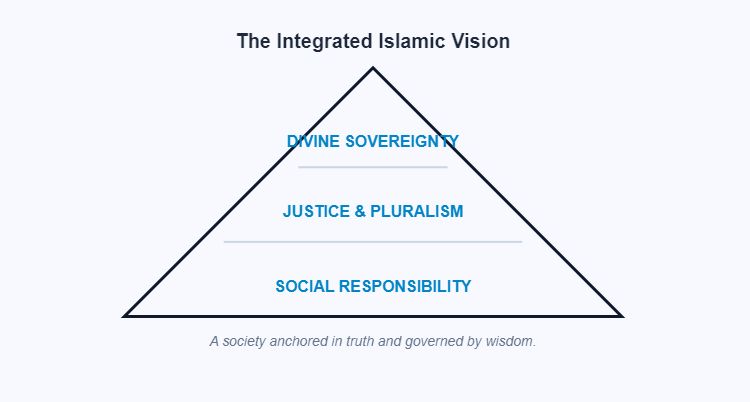
The scholarly inquiry into Islam and Secularism leads to a profound logical verdict: Islam does not seek to abolish public life, but to sanctify it through justice and wisdom. It offers a framework where divine law protects human rights, where reason enhances revelation, and where justice is an absolute mandate from the Creator of the Universe.
For the skeptical mind, the choice is not between a cold secularism and a chaotic theocracy. The choice is to recognize that a universe designed with such precision—as seen in the Origins of the Universe—must also have a design for human society. Islam provides that design, inviting humanity to step out of man-made ideologies and into the clear, logical light of the Final Revelation.













Leave a Reply