

This research paper is part of Truth Clearly’s commitment to providing an authentic Islamic perspective on theology and history. We adhere to rigorous academic standards, relying exclusively on the Quran, authentic Prophetic traditions, and verified historical sources to provide clarity for the rational seeker.
In the contemporary secular world, one of the most persistent and challenging questions in ethics and philosophy is: “Can we be good without God?” For the skeptical Western reader, the agnostic academic, or the individual searching for a stable moral foundation, morality is often viewed as a product of social evolution, cultural consensus, or biological survival. However, when we apply a rigorous logical lens to the framework of Islam and Objective Morality, we find that ethics are not a fluctuating human invention but are rooted in the Wisdom and Command of the Creator.
The Islamic worldview posits that while humans have an innate sense of right and wrong, this sense needs a Transcendent anchor to remain objective. Without a Divine Lawgiver, morality becomes a matter of shifting opinions, subject to the whims of time, power, and cultural trends. In the Sunni Athari perspective, we recognize Allah as the All-Wise Creator who is High above His Heavens and established over His Throne. He is the source of all Truth (Al-Haqq), and His commands provide the ultimate “North Star” for human conduct. This article explores seven profound logical proofs for Islam and Objective Morality, demonstrating why a belief in God is the only rational foundation for a stable ethical system.
Table of Contents
1. The Fitrah: The Innate Moral Compass
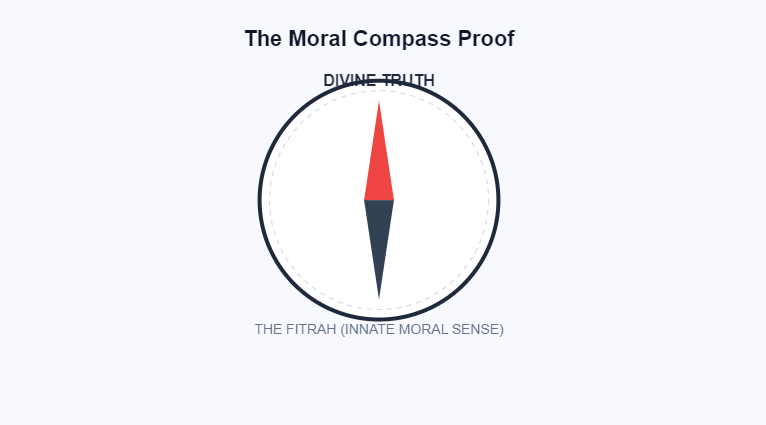
The primary evidence for Islam and Objective Morality is the concept of the Fitrah. Islam teaches that every human being is born with an innate, natural inclination to recognize the Creator and to value fundamental virtues like truth, justice, and compassion. This is not a learned behavior or a cultural construct; it is the “pre-installed” spiritual software within the human soul.
Logically, if morality were purely a result of blind biological evolution, it would be limited to behaviors that ensure physical survival. Yet, humans often value self-sacrifice, honesty even when it leads to material loss, and the protection of the weak—acts that frequently contradict basic evolutionary “survival of the fittest.” The Islam and Objective Morality paradigm argues that this universal “moral tug” is the signature of the Creator. This innate compass is what allows humans to recognize the Authenticity of the Quran as it resonates with their internal sense of truth.
2. The Logical Failure of Moral Relativism
Without the framework of Islam and Objective Morality, society falls into the trap of moral relativism. If there is no Divine Lawgiver, then “good” and “evil” are merely labels given by the majority or the ruling class. Historically, this has led to moral catastrophes; if a society collectively agrees that slavery or genocide is “beneficial,” a secular relativist has no objective standard to say they are wrong—only that they personally disagree.
Islamic logic provides the necessary solution. Morality is objective because it is based on the unchangeable commands of Allah, the Sovereign of the Universe, who is distinct from His creation. Because God’s nature and Wisdom are eternal, the prohibition of murder or the mandate of justice remains absolute, regardless of whether a culture accepts them or not. This provides a solid foundation for Islam and Human Rights, protecting human dignity from being redefined by political convenience.

3. Divine Wisdom vs. Human Subjectivity
A core pillar of Islam and Objective Morality is the recognition that human beings are limited in their knowledge. We often judge “good” based on immediate pleasure and “evil” based on immediate pain. We lack the “Macro” view required to see the long-term consequences of our actions across generations.
The Quranic framework asserts that Allah, the All-Knowing (Al-Alim), possesses absolute Knowledge of all things. As we discussed in the Concept of God in Islam, the Creator’s laws are not arbitrary; they are based on perfect Divine Wisdom (Hikmah). Therefore, the moral laws in Islam (the Sharia) are an act of mercy designed to protect the well-being of humanity. Logically, a perfectly designed universe—as seen in the Scientific Miracles of the Quran—must have a perfectly designed moral code to govern its most complex inhabitants.
4. The Necessity of Accountability and Justice
If morality exists but there is no ultimate consequence, it becomes a mere suggestion rather than a law. The Islam and Objective Morality dialogue is inextricably linked to the reality of Life After Death. Logically, if an honest person and a cruel oppressor both end up as dust in the grave with no further reckoning, then morality was a strategic disadvantage for the honest person.
For morality to be truly “objective,” it must have a final settlement. Islam teaches that every human will stand before Allah, who hears and sees all from His position Above the Throne, to be judged for their choices. This accountability ensures that doing the right thing is always the most rational choice, even when it brings no worldly reward. The absolute Sincerity of Prophet Muhammad was fueled by this conviction: that he was accountable to the Lord of the Heavens and the Earth.
5. The Preservation of Inherent Human Dignity
Islam and Objective Morality is the only system that grants humans an inherent, unchangeable sanctity. In a purely materialistic worldview, a human is merely a “biological machine” or a “lucky accident.” If we are just a collection of atoms, there is no logical reason why we should have “rights” or “dignity” over a rock or a plant.
In Islam, the human is the “honored creation” of Allah. God created Adam with His own Hands and breathed life into him. This divine origin gives every individual a sanctity that no human law can erase. By anchoring morality in the Creator, Islam ensures that every person—regardless of race, wealth, or status—is treated as a sacred being with a divine purpose. This objective dignity is why Jesus in Islam and all prophets are revered; they were sent to remind us of our origin and our moral potential.
6. The Logic of Divine Speech as an Unchanging Standard
Skeptics often ask how we can know the “Objective Standard” without it being corrupted. This is where the Preservation of the Bible and Quran becomes a logical necessity. If the standard for morality is not preserved, it ceases to be objective for future generations.
The Quran is the literal and uncreated Speech of Allah, spoken by Him and preserved without a single letter of change for 1,400 years. This provides humanity with a “Moral Constant.” Unlike secular laws that must be constantly updated to fit new social norms, the core ethical principles of Islam remain as sharp and clear today as they were in the 7th century. This textual stability is the “External” proof that mirrors the “Internal” proof of the Fitrah, creating a unified system of Islam and Objective Morality.
7. Psychological Coherence and the Purpose of Life
Finally, the Islam and Objective Morality framework provides a level of psychological coherence that secularism cannot offer. When a person aligns their actions with the divine will, they experience a state of “Sakinah” (tranquility). They are no longer a “rowing boat in a stormy ocean of opinions” but are anchored in the Purpose of Life.
Logically, if we were designed for a purpose, our greatest fulfillment must come from acting in accordance with that purpose. When we practice the 5 Pillars of Islamic Faith, we are engaging in a spiritual “maintenance” of our soul. Following the Logic of Free Will, we use our agency to choose the path that the All-Wise Creator has designated as the best for us.
Conclusion: The Rational Choice for a Just World
The study of Islam and Objective Morality leads to a profound rational verdict: either morality is a fleeting human illusion based on biological survival, or it is a solid reality anchored in the One who created the heavens and the earth. Islam invites humanity to the latter—a world where being “good” is not just a social preference, but a divine mandate that aligns our souls with the truth of existence.
By recognizing the Sincerity of the Messenger and the logic of the Quran, we move toward a future where justice is absolute and human dignity is sacred. For the skeptical mind, the framework of Islam and Objective Morality offers the only intellectually consistent way to explain why we feel the weight of “right” and “wrong”—it is the echo of the Divine Voice calling us back to our Creator, the Most High, who is established over His Throne and knows the secrets of the hearts.














Leave a Reply