
This research paper is part of Truth Clearly’s commitment to providing an authentic Islamic perspective on theology and history. We adhere to rigorous academic standards, relying exclusively on the Quran, authentic Prophetic traditions, and verified historical sources to provide clarity for the rational seeker.
In the contemporary discourse on global ethics, the relationship between Islam and Human Rights is frequently presented as a site of irreconcilable conflict. For the skeptical Western reader, the term “human rights” often evokes the 1948 Universal Declaration, while “Islam” is sometimes perceived through the lens of restrictive cultural practices. However, a logical and historical inquiry reveals that Islam established a comprehensive framework for human dignity fourteen centuries before the modern era.
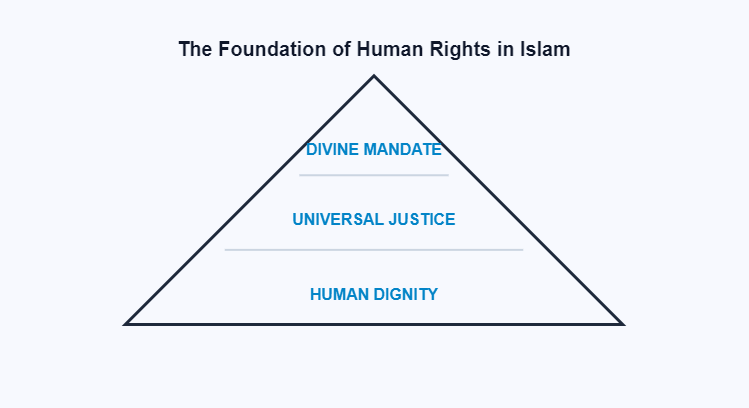
The core of the Islam and Human Rights dialogue rests on a fundamental theological premise: that rights are not granted by a state or a monarch—which can be revoked at any time—but are divinely mandated. In the Sunni Athari worldview, we recognize Allah as the absolute Sovereign and the All-Wise Legislator who is High above His Heavens and established over His Throne. Because Allah is the Creator of all, every human being possesses an inherent “sanctity” (Hurmah) that no government has the authority to infringe upon. This article explores seven revolutionary realities about Islam and Human Rights, analyzing how Islamic theology provided a blueprint for racial equality, religious freedom, and social justice.
Table of Contents
1. The Divine Source of Rights: Trusts vs. Social Contracts
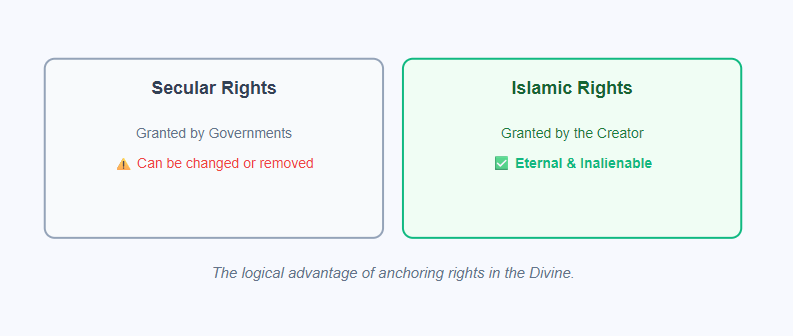
The primary logical distinction in the study of Islam and Human Rights is the origin of these rights. In secular philosophy, rights are often seen as a “social contract” between individuals and the state. The inherent weakness of this model is that what the state gives, the state can legally take away.
In contrast, Islam and Human Rights are based on the concept of Maqasid al-Sharia (The Objectives of the Law), which are designed to protect five fundamental necessities: Religion, Life, Intellect, Lineage, and Property. Because these rights are viewed as “Divine Trusts” (Amanat) given by Allah, the Most High, they are inalienable and eternal. This provides a much more stable logical foundation for human dignity than fluctuating political ideologies. This theological anchor is what we explored in the Concept of God in Islam, where Divine Justice is an absolute attribute.
2. Racial Equality: Dismantling the Logic of Tribalism
While the Western world struggled with systemic slavery and racial hierarchies well into the 19th and 20th centuries, the framework of Islam and Human Rights addressed racial equality in the 7th century. During his final sermon, Prophet Muhammad (peace be upon him) delivered a statement that remains a pinnacle of human rights history.
He declared that no Arab has superiority over a non-Arab, nor a white person over a black person, except by piety and good action. This was not merely a spiritual suggestion; it was a legal declaration that dismantled the tribal and racial hierarchies of the time. This radical equality is a core component of the Sincerity of Prophet Muhammad and his mission to unify humanity under one Creator who is distinct from His creation.
3. The Right to Life: A Universal Sanctity
The most fundamental of all Islam and Human Rights is the right to life. The Quran uses a powerful logical analogy to emphasize the gravity of taking a single human life: “Whoever kills a soul… it is as if he had slain mankind entirely. And whoever saves one – it is as if he had saved mankind entirely” (Quran 5:32).
This verse establishes that human life is a single, interconnected fabric. To violate the life of one person is a crime against the very concept of humanity. This level of sanctity was revolutionary in an era where tribal blood feuds were the norm. This right to life is extended to all, as seen in the Islamic view on Jesus and all prophets who came to preserve the sanctity of the soul.
4. Religious Freedom: The Logic of Non-Coercion
A frequent point of skepticism regarding Islam and Human Rights is the question of religious freedom. However, the Quranic mandate is clear and logically consistent with the nature of belief: “There shall be no compulsion in religion” (Quran 2:256).
Logic dictates that faith, by definition, must be a product of free will; a forced “belief” is an ontological contradiction. Allah, who is established over the Throne, has granted humans Free Will to choose their path. Historically, this led to the protection of religious minorities within Islamic lands, providing them with autonomy in their religious affairs—a practice often absent in medieval Europe.
5. The Protection of Private Property and Honor
In the framework of Islam and Human Rights, an individual’s dignity (Ird) and property are sacred. During his mission, the Prophet declared that a person’s blood, property, and honor are as sacred as the holiest sites of Islam. This was a direct application of Sharia Law in Islam, which seeks to build a society of mutual respect.
This legal protection ensured that individuals were safe from arbitrary seizure of property by rulers and from defamation. This establishment of personal privacy and due process is a testament to the Authenticity of the Quran as a guide for a just and orderly society.
6. Rights of the Vulnerable: The Social Safety Net
A unique aspect of Islam and Human Rights is the focus on those who cannot protect themselves. Rights in Islam are not just “freedoms from” interference, but “rights to” basic needs. The institution of Zakat, as explored in the 5 Pillars of Islamic Faith, is the prime example.
Zakat is not a voluntary charity but a “right” of the poor over the wealth of the rich. By framing social welfare as a human right rather than a favor, Islam preserved the dignity of the recipient. Logically, a system that focuses on the redistribution of wealth to the vulnerable—as further detailed in Islamic Environmental Ethics regarding resource sharing—is a system that understands the long-term stability of civilization.
7. Absolute Accountability: Justice Above Kinship
Finally, the Islam and Human Rights framework is sustained by an uncompromising standard of justice. In many systems, the law is bent to favor the powerful. The Quran, however, commands: “Be persistently standing firm in justice… even if it be against yourselves or parents and relatives” (Quran 4:135).
This principle established the “Rule of Law” where every leader and citizen is equal before the Divine Court. This ensures that the rights of an individual are protected even against the most powerful members of society. This ethical rigor is the logical conclusion of believing in Life After Death and Divine Justice, where every deed is accounted for by the All-Hearing, All-Seeing Creator.
Conclusion: A Universal Blueprint for Dignity
The study of Islam and Human Rights reveals that the perceived tension between Islamic values and universal dignity is largely a result of historical misunderstanding. When we return to the logic of the Quran and the authentic Sunnah, we find a robust system of rights that was centuries ahead of its time.
By embracing the divine mandate of stewardship and justice, Islam offers a worldview where human rights are not a human invention, but a divine gift. For the skeptical seeker, the revolutionary rights granted by Islam 1,400 years ago stand as an enduring proof of a divine plan for universal justice. Just as the Scientific Miracles of the Quran point to a Wise Creator, the Islamic framework of human rights points to a Merciful Lord who desires dignity for all His creation.













Leave a Reply