
This research paper is part of Truth Clearly’s commitment to providing an authentic Islamic perspective on theology and history. We adhere to rigorous academic standards, relying exclusively on the Quran, authentic Prophetic traditions, and verified historical sources to provide clarity for the rational seeker.
The miracle of human life, from a single microscopic cell to a fully functioning sentient being, remains one of the most breathtaking phenomena in the natural world. For the skeptical Western reader, the medical professional, or the student of anatomy, the study of human development is often confined to modern textbooks and high-resolution imaging. However, a rigorous logical and scientific inquiry into Embryology in the Quran reveals a series of descriptive realities that were unknown to the world until the invention of the microscope and advanced ultrasound.
In the Sunni Athari worldview, we recognize that the Quran is the literal and uncreated Speech of Allah. Allah, the Most High, who is established over His Throne and is distinct from His creation, is the One who “fashions you in the wombs as He wills” (Quran 3:6). Because the Creator of the human body is the same Being who spoke the Quran, the linguistic descriptions of the embryo are staggeringly precise. This article explores five profound realities of Embryology in the Quran, demonstrating how the literal Speech of Allah provided a biological roadmap fourteen centuries before modern anatomy could verify it.
Table of Contents
1. The Mixed Drop: The Logic of “Nutfah Amshaj”
The primary logical pillar of Embryology in the Quran begins with the identification of the very first stage of life. Ancient Greek theories, which prevailed during the 7th century, often suggested that the child was formed either from the menstrual blood or entirely from the father’s “seed.” The Quran, however, introduced the concept of the Nutfah Amshaj.
“Indeed, We created man from a sperm-drop mixture (Nutfah Amshaj) that We may try him; and We made him hearing and seeing.” (Quran 76:2).
Logically, the term Amshaj (mixture) identifies the biological truth that the zygote is a combination of fluids and genetic material from both the male and female parents. Modern genetics, as documented by Nature regarding the human genome, confirms that the fusion of the sperm and the ovum creates the foundational cell of human life. For a text to identify the “mixed” nature of the earliest stage of life—at a time when microscopic cells were unknown—is a profound sign of a source that transcends Islam and Human Logic. This reflects the perfect Knowledge of Allah, who initiated the Origins of the Universe and every biological law within it.
2. The Clinging Entity: The Logic of “Alaqah”
Perhaps the most famous stage in the study of Embryology in the Quran is the Alaqah stage. The Quran describes the development of the embryo immediately after the Nutfah as becoming an Alaqah. Linguistically, this Arabic term carries three specific meanings: a leech, a suspended thing, and a blood clot.
When Dr. Keith Moore, one of the world’s most prominent embryologists, analyzed this term, he found that all three meanings are anatomically accurate for the embryo at 7 to 24 days.
- The Leech: At this stage, the embryo physically resembles a leech in shape.
- Suspended: The embryo literally “clings” to the uterine wall and is suspended in the mother’s womb for nourishment.
- Blood Clot: Because the early cardiovascular system is forming and the blood is “trapped” in closed vessels, the embryo appears like a solid clot of blood.
Logically, this descriptive precision is a hallmark of the Authenticity of the Quran. No 7th-century observer could have seen the “leech-like” appearance of a microscopic embryo. This reality aligns with the Concept of God in Islam as the All-Seeing Creator who observes the hidden depths of the womb.
3. The Chewed Substance: The Reality of “Mudghah”
The third reality of Embryology in the Quran is the Mudghah stage. After the Alaqah, the Quran states that the embryo becomes a Mudghah, which means “a chewed-like substance.”
“…then We made the Alaqah into a Mudghah…” (Quran 23:14).
From a logical anatomical perspective, this is a staggering description. During the fourth week of development, the embryo develops “somites” (segmented blocks of tissue) along its back. These somites give the embryo a jagged, indented appearance that looks exactly like a piece of clay or gum that has been bitten and shows “tooth marks.”
Modern embryology textbooks—as reviewed by Britannica’s analysis of prenatal development—show that these somites are the precursors to the skeletal and muscular systems. The choice of the word Mudghah is not a poetic flourish; it is a technical anatomical observation. For a desert-dweller to use such a precise term is a sign of the Sincerity of Prophet Muhammad in delivering the message exactly as it was revealed by the All-Knowing Creator.
4. The Sequence of Growth: Bone and Muscle Formation
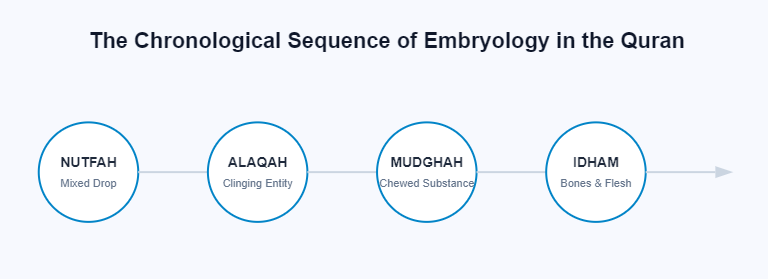
A critical reality in Embryology in the Quran is the specific chronological order of development. The Quran describes the transition from the “chewed substance” to the formation of the skeleton and then the clothing of those bones with flesh.
“…and We made the Mudghah into bones (Idham), and We clothed the bones with flesh (Lahm); then We developed him into another creation.” (Quran 23:14).
Logically, for centuries, it was assumed that bones and muscles formed simultaneously. However, modern anatomy has verified that the “primordium” of the bones (mesenchymal condensations) occurs first, followed shortly by the migration and differentiation of the myogenic (muscle) cells that wrap around the developing skeleton. This sequential precision is a primary evidence for the Scientific Miracles of the Quran. It demonstrates that the Quranic text is in perfect harmony with the actual biological process, reinforcing the Why Islam answer as the final and perfected guidance.
5. The Three Veils of Darkness: The Protective Environment
The final profound reality of Embryology in the Quran is the description of the environment in which the fetus grows. The Quran mentions:
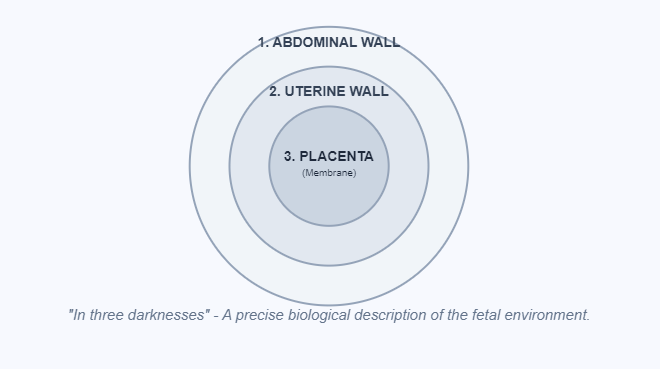
“He creates you in the wombs of your mothers, creation after creation, within three darknesses.” (Quran 39:6).
Modern anatomy confirms that the fetus is protected by three distinct layers:
- The abdominal wall of the mother.
- The uterine wall.
- The amnio-chorionic membrane (the placenta).
Logically, these “three darknesses” provide the necessary isolation for the complex genetic and biological transitions to occur safely. This protective design is a manifestation of Allah’s mercy (Rahmah). By identifying the specific number of protective layers, the Quran provides a “sign” for the rational mind to recognize that the One who is High above His Throne is the same One who manages the microscopic safety of the unborn. This connects to the Logic of Supplication, where we recognize our total dependence on the Sustainer from the very beginning of our existence.
The Infusion of the Soul: The Logical Transition to a Person
While the Quran describes the biological hardware, the authentic Sunnah provides information about the spiritual software. In a Sahih (authentic) Hadith, the Prophet Muhammad (peace be upon him) explained that after 120 days of development, Allah sends an angel to breathe the soul (Ruh) into the body.
Logically, this transition—from a “biological creation” to “another creation” (a sentient human)—explains the Reality of the Soul. Modern medicine acknowledges that at around 20 weeks (roughly 120-140 days), the fetus begins to show significant brain activity and response to stimuli. The alignment between the Prophetic timeline and neurological development is another logical credential. This soul is what possesses Free Will and will eventually be held accountable for its choices, fulfilling the Purpose of Life.
Conclusion: The Signature of the All-Knowing Creator
The investigation into Embryology in the Quran leads to a clear and inescapable rational verdict: the descriptions of human development found in the text are not the product of 7th-century human observation. They are the literal, uncreated Speech of the One who designed the human body in the first place.
For the skeptical researcher, these five realities are invitations to reflect. If the Quran is accurate about the hidden stages of your own creation, it is only logical to trust its message regarding your ultimate destination in the Life After Death. By recognizing the harmony between modern anatomy and divine revelation, one finds the “Truth Clearly”—that we are the honored trustees of a Creator who is the Most High, the Most Wise, and the Most Merciful.











Leave a Reply