

This research paper is part of Truth Clearly’s commitment to providing an authentic Islamic perspective on theology and history. We adhere to rigorous academic standards, relying exclusively on the Quran, authentic Prophetic traditions, and verified historical sources to provide clarity for the rational seeker.
In the modern secular world, a persistent narrative suggests that the advancement of scientific knowledge inevitably leads to the decline of religious belief. For the skeptical Western reader, the university student, or the agnostic researcher, the inquiry into whether Does Science Require Atheism is often presented as an absolute necessity. The common argument posits that as we uncover the mechanical “how” of the universe, the “Who” becomes redundant. However, a rigorous logical and philosophical inquiry into this topic reveals that science and atheism are not natural allies; in fact, the very foundations of the scientific method rely on a worldview that is only consistent with a purposeful, designed creation.
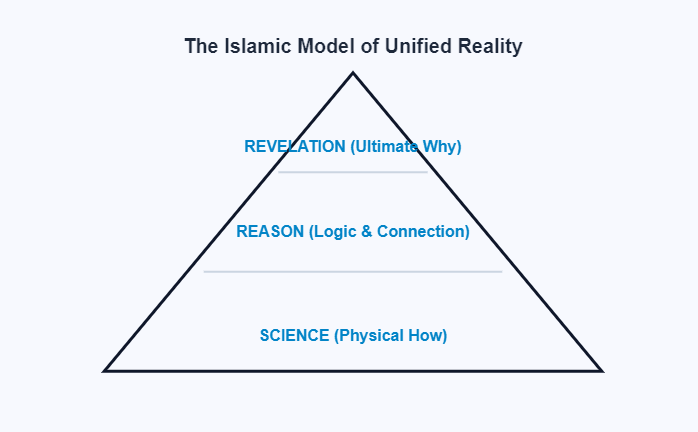
In the Islamic worldview, specifically through the lens of pure monotheism, we recognize that Allah is the unique Creator who is distinct from His creation. Allah, the All-Knowing, possesses absolute Knowledge and Wisdom, and He is the one who established the mathematical laws that govern every particle in existence. In our Sunni Athari creed, we affirm that Allah is High above His Heavens and established over His Throne (Istawa), and His signs are manifest in the horizons and within ourselves. From this perspective, science is not a rival to faith, but a tool to observe the “habits” of the Creator.
This article explores seven profound logical realities regarding the question, Does Science Require Atheism, demonstrating why the study of the physical world points directly to a Magnificent Designer.
Table of Contents
1. The Methodological Fallacy: Why Does Science Require Atheism is a Logic Error
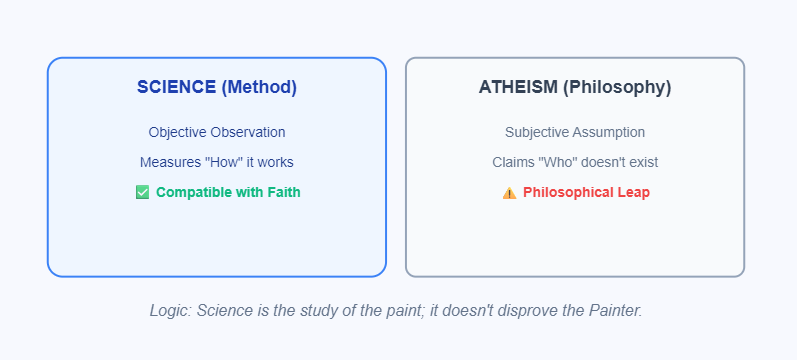
The primary logical error in the Does Science Require Atheism discourse is the conflation of “Methodological Naturalism” with “Philosophical Naturalism.” Science, by its very nature, is a limited tool designed to study the behavior of matter and energy within the physical world. It asks “how” things work, but it lacks the categorical capacity to answer “why” they exist or what initiated their existence.
Logically, choosing to use a metal detector to find gold does not mean that anything that cannot be detected by the metal detector (like a person’s emotions or a philosophical truth) does not exist. Similarly, using science to study the Origins of the Universe does not preclude the existence of a Creator who is outside the material system. Islam asserts that Allah is the Author of the laws of science. Therefore, the Authenticity of the Quran and the study of the natural world are two consistent ways of approaching the same Truth. Atheism, when it claims that “science proves there is no God,” is making a philosophical leap that science itself cannot sustain.
2. The Intelligibility of the Cosmos: The Logic of the Legislator
One of the most staggering realities that challenges the link between Science and Atheism is the mathematical intelligibility of the universe. As noted by Britannica regarding the philosophy of science, it is an “unreasonable effectiveness” that the human mind can use abstract mathematics to predict the behavior of galaxies and subatomic particles.
Logically, if the universe were a random, chaotic accident—as atheistic naturalism suggests—there would be no reason for it to follow consistent, elegant, and predictable laws. A law, by definition, requires a Legislator. In Islamic logic, the universal laws of gravity, thermodynamics, and electromagnetism are the “Habits of Allah” (Sunan Allah). Just as we discussed in the Fine-Tuning of the Universe, the mathematical precision of the cosmos is the “Signature” of a Creator who possesses absolute Knowledge. Science does not replace the Creator; it uncovers the brilliance of His design, proving that the question Does Science Require Atheism is fundamentally flawed.
3. The Information Problem: The Author of the Biological Code
Modern biology has moved from studying “matter” to studying “information.” The discovery of the digital code within DNA has presented a formidable challenge to the Does Science Require Atheism narrative. Every living cell contains a complex language of instructions more sophisticated than any software ever developed by human engineers.
Logically, information is never the product of blind, undirected material processes. While matter can produce patterns (like a snowflake), it cannot produce a “code” (like a set of instructions for building a beating heart). The Scientific Miracles of the Quran consistently point to this biological design. In the framework of Islam and Evolution, we recognize that while biological change may occur, the “Information” that drives that change must have an Intellectual Source. The presence of a code in our cells is an empirical credential for the One who spoke the final revelation from His position High above His creation.
4. The Logic of Causality: First Cause and the Cosmic Beginning
Science is the search for causes. Every scientific discovery is based on the logic that for every effect, there must be a cause. However, atheism reaches a logical dead-end when it approaches the beginning of time. If the universe had a starting point—a fact confirmed by modern cosmology—then the universe itself is an effect.
Logically, an effect cannot be its own cause. To suggest that the universe “popped” into existence from “nothing” is a violation of the very scientific logic that atheists claim to uphold. Islamic theology provides the only rational resolution: the universe was initiated by a Necessary Being who is not part of the material system. As we analyzed in The Big Bang in the Quran, the separation of the heavens and the earth was a purposeful act of the Creator. Does Science Require Atheism fails as a proposition because atheism requires a suspension of the law of causality at the most critical moment of history.
5. The Reliability of the Mind: Evolution vs. Rationality
A profound reality often ignored in the Does Science Require Atheism debate is the reliability of the human mind. If atheistic evolution is true, then our minds were designed solely for biological survival—to find food and avoid predators—not to discover absolute truths about quantum mechanics or the distant stars.
Charles Darwin himself expressed a “horrid doubt” about whether the human mind, developed from lower animals, could be trusted in its philosophical conclusions. Logically, if your brain is just a “survival machine,” you have no reason to trust that your “atheism” is true; it could just be a biological adaptation for social signaling. Islam, however, asserts that the human mind was created by Allah to recognize the truth. The Neurobiology of Faith shows that we are “wired” for God. Because our intellect (Aql) is a divine gift, we have a logical basis for trusting our scientific conclusions. This reality shatters the claim that Does Science Require Atheism.
6. The Limits of Empiricism: The Logic of the Unseen
Skeptics often claim that “I will only believe in what I can see and measure.” This is the logic of narrow empiricism, yet science itself relies on many things that are “unseen,” such as the laws of logic, the existence of other minds, and the uniformity of nature.
The Does Science Require Atheism inquiry is enriched when we acknowledge The Concept of the Unseen in Islam. Logically, just because a reality is beyond our current sensory horizon does not mean it is irrational. A Creator who designed the Deep Sea Description in the Quran long before we could see it is a Creator who knows what remains hidden from us. Science explores the “Seen,” but logic forces us to admit the necessity of the “Unseen” Source. To deny the Creator because He cannot be placed under a microscope is a logical category error.
7. The Fitrah: The Ethical Signature in the Laboratory
Finally, the relationship between Science and Atheism is resolved within the human soul—the Fitrah. Every scientist, regardless of their belief, operates on the assumption that the truth is worth seeking and that honesty in data is a moral imperative. But where does this “value” come from?
Materialistic science can explain the “firing of neurons,” but it cannot explain “why” we feel the weight of Objective Morality. If we were merely biological accidents, our search for the Purpose of Life would be a cruel biological glitch. Islam teaches that these non-material longings are the evidence of our soul’s origin. The Sincerity of Prophet Muhammad was based on this alignment between the heart’s intuition and the mind’s reason. For the rational seeker, the most logical conclusion is that the “Lawgiver of the Stars” is the same “Lawgiver of the Heart.”
Conclusion: Reclaiming the Rational Universe
The scholarly investigation into whether Does Science Require Atheism leads to a profound rational verdict: science does not require atheism; it requires a Designer. The mathematical order, the biological information, and the reliability of our own minds are all evidence that we live in a purposeful cosmos governed by Allah, the Most High.
For the skeptical researcher, the Islamic message is an invitation to consistency. It offers a worldview where you don’t have to choose between your laboratory and your soul. By recognizing Why Islam remains the final and perfected guidance, the seeker finds the “Truth Clearly”—that science is simply the study of the magnificent “habits” of Allah. The journey from science to faith is not a leap into the dark, but a walk into the brilliant light of the One who created the heavens and the earth in perfect proportion.














Leave a Reply