

This research paper is part of Truth Clearly’s commitment to providing an authentic Islamic perspective on theology and history. We adhere to rigorous academic standards, relying exclusively on the Quran, authentic Prophetic traditions, and verified historical sources to provide clarity for the rational seeker.
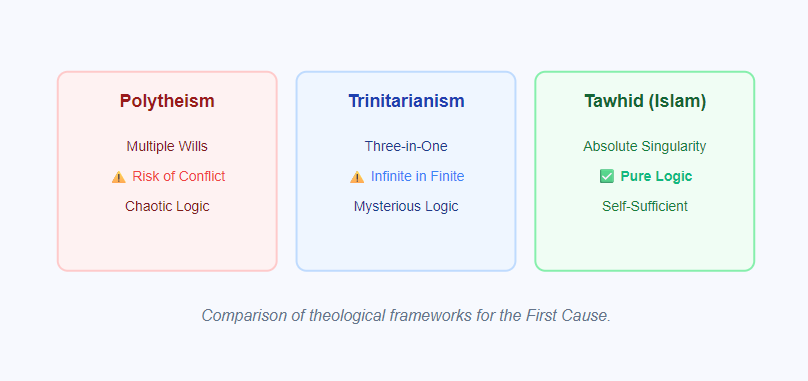
For the skeptical seeker, the agnostic philosopher, or the student of comparative religion, the most fundamental question in theology is the nature of the First Cause. Every civilization has grappled with the idea of the Divine, resulting in a spectrum of beliefs from polytheism and pantheism to Trinitarianism. However, the Concept of God in Islam, defined by the term Tawhid (Absolute Monotheism), presents a unique and rigorously logical paradigm that has remained unchanged for 1,400 years.
In Islamic theology, Allah is the unique Creator who has no equal, partner, or likeness. He is not a tribal deity, nor is He a complex of persons; rather, He is the One and Only. The Concept of God in Islam posits a singular, All-Powerful, and Self-Sufficient Essence (Dhat) who is High above His Heavens and established over His Throne (Istawa), distinct from His creation. As the Quran states: “Nothing is like unto Him.” This article explores five logical reasons why this absolute monotheism (Tawhid) is not only the core of the Five Pillars of Faith but also the most rational conclusion for the human mind.
Table of Contents
1. The Logic of Unified Command (The Argument of Mutual Hindrance)
The first logical pillar of the Concept of God in Islam is known in classical Islamic philosophy (Kalam) as Burhan al-Tamanu’ (The Argument of Mutual Hindrance). This argument posits that if there were more than one Supreme Being, the order of the universe would inevitably collapse.
Logically, if there were two Gods, each possessing absolute will and power, a conflict would arise. If one God willed a planet to move and the other willed it to stay still, either both wills would be frustrated (meaning neither is God), or one would prevail over the other (meaning the defeated one is not God).
The Quran articulates this logic perfectly:
“Had there been within the heavens and earth gods besides Allah, they both would have been ruined.” (Quran 21:22).
The remarkable stability and harmony of the physical laws we discussed in the Quran and Modern Science suggest a single, unified source of command. A plurality of creators would lead to a plurality of conflicting laws. The Concept of God in Islam solves this by asserting a single Will that sustains the entire cosmos.
2. Occam’s Razor: The Intellectual Clarity of Absolute Monotheism
In scientific and philosophical inquiry, “Occam’s Razor” is a principle stating that the simplest explanation—the one that makes the fewest unnecessary assumptions—is usually the correct one. When applied to the history of religions, the Concept of God in Islam stands out as the most intellectually clear and consistent model of the Divine.
While polytheism requires an entire hierarchy of competing deities with human-like limitations, and Trinitarianism introduces complex doctrines that often require a suspension of logic, Islam offers a direct and unclouded answer. The Concept of God in Islam is built on the absolute Oneness (Tawhid) of an Eternal, Uncreated, and Self-Sufficient Creator who is High above His Throne.
This clarity is not about a philosophical “lack of attributes,” but about the purity of worship directed to One Sovereign Lord. By removing intermediaries and partners, Islam returns humanity to the original monotheism rooted in the Fitrah (innate nature). This intellectual clarity is a primary reason for the Authenticity of the Quran, as it delivers a message that resonates with the sound intellect without the need for convoluted philosophical mysteries.
3. The Impossibility of Divine Incarnation
A core divergence between the Concept of God in Islam and other traditions—particularly the Islamic view on Jesus versus Christianity—is the rejection of incarnation. Logic dictates that the attributes of the Creator (The Infinite) and the attributes of the creation (The Finite) are mutually exclusive.
If God were to become a human, He would necessarily be limited by space, time, hunger, and mortality. However, the very definition of God in Islam is As-Samad (The Self-Sufficient), upon whom all depend but who depends on nothing.
Logically, the Creator is distinct from His creation; He is not contained within it, nor is any part of His creation within Him. Therefore, the Concept of God in Islam maintains an absolute distinction between the Creator and the created. This preserves the Majesty of Allah, who is High above His Throne, and protects the human mind from Tamthil (likening Allah to His creation) or attributing human deficiencies to the Divine. As the Quran establishes, Allah is the Self-Sufficient (As-Samad) and “Nothing is like unto Him.”
4. Universal Unity: Scientific Reflection of One Creator
Modern science is increasingly revealing that the universe is governed by a “Unified Theory.” From the furthest galaxies to the smallest subatomic particles, the same mathematical laws apply. This “Universal Unity” is a powerful physical reflection of the Concept of God in Islam.
If the universe were the product of different creators, we would expect to see different “signatures” in the laws of physics across different regions of space. Instead, we see a singular, consistent blueprint. This scientific observation aligns with the Islamic concept of Tawhid al-Rububiyyah (The Oneness of Lordship).
Scholars often reference the work of organizations like the Discovery Institute regarding “Intelligent Design,” noting that the fine-tuning of the universe points toward a single, coherent Mind rather than a committee of competing forces.

5. Personal Accountability: The Logic of a Direct Connection
Finally, the Concept of God in Islam has profound implications for human psychology and justice. Because there is only one God and He has no “favorites” based on lineage, the relationship between the individual and the Creator is direct. There is no need for a priestly caste, saints, or intermediaries.
This direct connection is logically consistent with the concept of Afterlife and Divine Justice. If God is One, then every human is equally a servant to Him. This destroys the logic of tribalism and racism, as emphasized in the Prophet’s Farewell Sermon.
In Islamic logic, because God is Al-Basir (The All-Seeing), a person’s morality is not based on who is watching them on earth, but on the absolute reality of the One who knows “the secrets of the hearts.” This provides the most robust foundation for objective ethics.
Conclusion: The Intellectual Clarity of Tawhid
The Concept of God in Islam offers a theological framework that satisfies both the spiritual heart and the rational mind. By stripping away the layers of mythology and philosophical contradictions, Tawhid provides a clear, unshakeable foundation for understanding our place in the universe.
For the skeptical reader, the logic of Islam is consistent: One Creator, one unified message, and one direct path to truth. Just as the physical world seeks a unified theory, the spiritual world finds its unity in the Concept of God in Islam. It is a worldview that invites humanity to look at the stars and find not a chaos of gods, but the undeniable signature of the One.











Leave a Reply