

This research paper is part of Truth Clearly’s commitment to providing an authentic Islamic perspective on theology and history. We adhere to rigorous academic standards, relying exclusively on the Quran, authentic Prophetic traditions, and verified historical sources to provide clarity for the rational seeker.
For the skeptical Western reader, the agnostic researcher, or the student of ancient history, the Quran is often recognized as a remarkably preserved text.
However, a significant intellectual challenge arises when we discuss the second source of Islamic authority: the Sunnah (Prophetic traditions). Many outsiders view Hadith as mere “oral hearsay” compiled centuries after the fact, prone to the typical corruptions of human memory.
Yet, a rigorous logical and historical inquiry into the Authenticity of Hadith in Islam reveals a transmission system that is unparalleled in human history—a system so precise that it functions as a spiritual and historical “peer-review” mechanism far ahead of its time.
In the Sunni Athari worldview, the Sunnah is not a collection of cultural anecdotes; it is a secondary form of revelation (Wahy). While the Quran is the literal and uncreated Speech of Allah, which He spoke with Letter and Voice and revealed to Muhammad, the Sunnah provides the divinely guided application of that Speech. Allah, the Most High, who is established over His Throne and distinct from His creation, promised to protect the “Reminder” (Dhikr), a term that encompasses both the Quranic text and the Prophetic explanation required to implement it. This article explores seven profound logical proofs for the Authenticity of Hadith in Islam, demonstrating the intellectual rigor used to safeguard the legacy of the final Messenger.
Table of Contents
1. The Logical Necessity of Preservation: The “What” vs. The “How”
The primary logical argument for the Authenticity of Hadith in Islam begins with the necessity of an explanation. The Quran provides the “Macro” principles of faith—such as the command to establish prayer, give charity, and perform pilgrimage. However, the Quran often leaves the “Micro” details of implementation to the Prophet. Logically, if Allah, the All-Wise (Al-Hakim), mandated the 5 Pillars of Islamic Faith but provided no authentic way to know how to perform them, the divine command would be impossible to fulfill.
Therefore, Divine Wisdom dictates that the Prophet’s application of the Law must also be preserved. If the explanation (the Hadith) were lost or corrupted, the original message (the Quran) would become functionally inaccessible. The Authenticity of Hadith in Islam is thus a logical extension of the preservation of Islam itself. Allah, who possesses absolute Knowledge and is established over the Throne, ensured that the path remains clear. A God who creates a complex, fine-tuned universe—as seen in the Scientific Miracles of the Quran—would not leave the final moral guide for humanity to be lost to the whims of time.
2. The Science of Isnad: The “Chain of Custody” for Truth
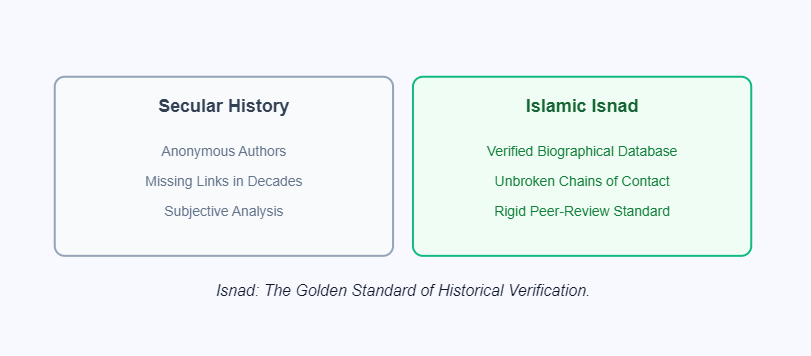
The most unique contribution of Islamic civilization to historical science is the Isnad (the chain of transmission). Long before modern academia required citations, bibliographies, and cross-references, Hadith scholars developed a system where no statement was accepted unless it was accompanied by a verified list of narrators leading directly back to the source.
Logically, the Isnad acts as a “Chain of Custody” for information. Scholars would not just record a saying; they would demand to know: “Who told you? Who told them? And where did they meet?” This transformed the study of the Authenticity of Hadith in Islam into a rigorous forensic investigation.
This method is documented by Britannica’s analysis of Hadith methodology. If a single link in the chain was missing, or if two narrators lived in different centuries and could not have met, the report was labeled as “Weak” or “Disconnected.” This level of scrutiny is far more advanced than the methods used to verify the works of Plato or Aristotle, whose earliest surviving manuscripts are often separated from the authors by over a thousand years.
3. Ilm al-Rijal: Biographical Forensic Evaluation
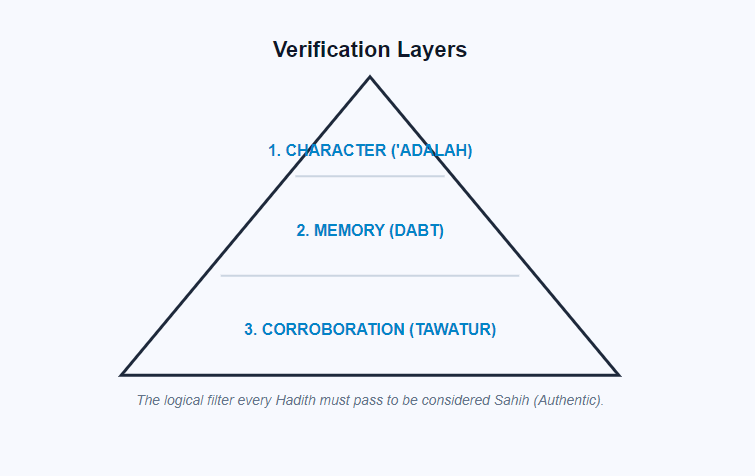
The Authenticity of Hadith in Islam is further supported by Ilm al-Rijal (Biographical Evaluation), a science that produced massive biographical encyclopedias detailing the lives of over 500,000 narrators. Scholars did not just look at the chain; they performed a psychological and moral profile on every individual in that chain.
A narrator’s report was only accepted if they met two rigid logical criteria:
- ‘Adalah (Moral Integrity): The narrator must be known for absolute honesty, piety, and a lack of public sin. If a narrator was ever caught telling a single lie in worldly matters—even a white lie—their Hadith reports were permanently rejected.
- Dabt (Mental Precision): A good person with a poor memory is a historical liability. scholars tested narrators by comparing their reports with others. If a narrator’s version frequently deviated from the consensus of other reliable students, they were flagged for “poor memory,” and their reports were treated with extreme caution.
This logical scrutiny proves that the Authenticity of Hadith in Islam was not built on blind faith, but on a critical analysis of human reliability. It reflects the Sincerity of Prophet Muhammad’s companions, who were so cautious of misquoting him that they established this uncompromising system of verification.
4. The Logic of Multiplicity (Tawatur)
In modern statistics and law, the probability of an error or a conspiracy decreases as the number of independent witnesses increases. The Authenticity of Hadith in Islam utilizes this through the concept of Mutawatir (Massively Attested) traditions. These are reports transmitted by such a large number of people at every level of the chain that it is logically and statistically impossible for them to have conspired in a lie.
For example, the core practices of Islam are not known through a single isolated report, but through thousands of independent observations transmitted through generations. This “Massive Transmission” provides a level of historical certainty that satisfies the most rigorous skeptical mind. When we combine this with the Authenticity of the Quran, we see a consistent framework of truth that has remained stable across vast geographical distances—from Spain to Indonesia—without a single deviation in the core teachings.
5. Early Written Documentation: Refuting the “200-Year Gap” Myth
A common misconception in Western scholarship is that Hadith remained purely oral for two centuries before being written down. However, historical and logical research proves that written documentation began during the lifetime of the Prophet himself.
Narrators like Abdullah ibn Amr kept a written scroll called Al-Sahifa al-Sadiqa, and the Prophet himself sent numerous written letters and legal treaties to various tribes and rulers. The transition from the era of the companions to the formal collections like Sahih Bukhari was not a leap from nothing; it was the final organization of pre-existing written and memorized records. This early documentation is a powerful evidence for the Authenticity of Hadith in Islam, proving that the “memory” was anchored by the “pen” since the very beginning.
6. Textual Logic and Contextual Consistency (Matn Analysis)
Beyond the chain of narrators, scholars analyzed the Matn (the actual text) of the Hadith. An authentic Hadith must not contradict the Quran, nor can it contradict established historical facts or the Scientific Realities mentioned in the Quran.
Logically, if an impostor were to invent a Hadith, they would likely include anachronisms—concepts or objects that did not exist in 7th-century Arabia. However, the authentic Hadith collections remain flawlessly consistent with the linguistic style, cultural context, and psychological profile of the Prophet Muhammad. This internal harmony provides another layer of proof for the Authenticity of Hadith in Islam. A fabrication would eventually clash with the established “Macro” truth of the religion, but the Sunnah acts as a perfectly fitted puzzle piece to the Quranic message.
7. The Logical Failure of “Quranism”
In recent times, some have suggested “Quranism”—the idea of following the Quran while rejecting all Hadith.
However, from a logical and historical perspective, this position is self-defeating. The same historical process that brought us the Quran (mass transmission through the companions) is the same process that brought us the Hadith.
If one rejects the Prophecies of Muhammad in the Bible or the historical details preserved by his companions, they lose the context required to even understand the Quranic verses. To accept the Quran as a preserved book while rejecting the preservation of the Prophet’s life is a logical inconsistency. The Authenticity of Hadith in Islam is the only way to maintain a coherent, functioning religion that connects the 21st-century believer with the 7th-century revelation.
Conclusion: The Unbroken Bridge to Truth
The Authenticity of Hadith in Islam is not a matter of medieval legends; it is a masterpiece of historical preservation and logical inquiry. By using the Isnad system, biographical evaluation, and the laws of mass transmission, Islamic scholars created a barrier against corruption that remains unparalleled in world literature.
For the skeptical mind, the Hadith system offers an invitation to respect the intellectual rigor of the Islamic tradition. It proves that Islam is not based on “blind following,” but on a verifiable, documented, and logically consistent chain of truth. Just as the Five Pillars provide the structure for action, the Sunnah provides the structure for understanding, ensuring that the “Truth Clearly” remains available for all of humanity until the Day of Judgment. Allah, the Most High, promised to protect the message, and through the genius of the Hadith sciences, that promise has been fulfilled.















Leave a Reply