

At Truth Clearly, our editorial policy is rooted in absolute academic integrity. This research paper is part of our “Humanity and Revelation” series, exploring how 7th-century Islamic principles established a comprehensive framework for ethical conduct. We rely exclusively on authentic scriptural sources and historical data to provide a logical perspective on the universal values of mercy and justice for all living beings.
In the contemporary world, the “Animal Rights” movement is often perceived as a modern Western achievement, gaining legal traction only in the late 19th and 20th centuries. For the skeptical seeker, the ethical philosopher, or the student of history, the idea that a comprehensive system of animal welfare existed fourteen centuries ago in the heart of the Arabian desert may seem improbable. However, a rigorous logical and scriptural inquiry into Animal Rights in Islam reveals a revolutionary legal and moral framework that mandated the protection of non-human life long before the existence of modern conservation movements.
In the Islamic worldview, we recognize that the universe is a purposeful creation of Allah—the unique Creator who is High above His Heavens and established over His Throne. He is the All-Knowing (Al-Alim) who possesses absolute Wisdom (Hikmah). From this perspective, animals are not mere “resources” for human exploitation, but are sacred trusts (Amanat) and independent communities. Animal Rights in Islam are not based on human emotional whim, but on divine accountability. This article explores seven profound logical realities that demonstrate how Islam provided a blueprint for the ethical treatment of animals, aligning divine revelation with biological compassion.
Table of Contents
1. The Logic of Communities: Animals as Nations
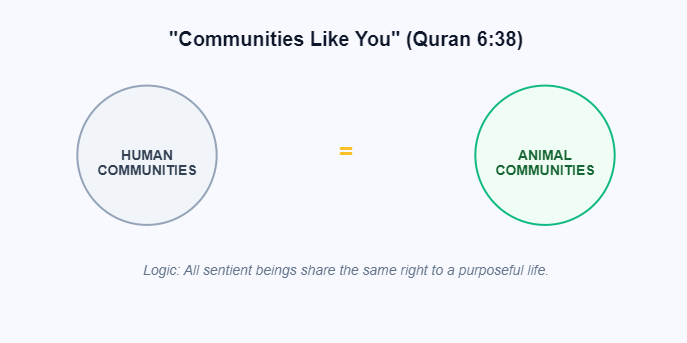
The primary logical pillar of Animal Rights in Islam is found in the Quranic recognition of animal sociology. Long before modern ethology studied the complex social structures of bees, ants, and migratory birds, the Quran made a definitive declaration:
“There is not an animal [that lives] on the earth, nor a being that flies on its wings, but [they are] communities (Umam) like you…” (Quran 6:38).
Logically, this verse shatters the “anthropocentric” view that humans are the only beings with social importance. By defining animals as “communities like you,” Islam establishes an ontological equality in the right to exist and function. This recognition dictates that human expansion must not come at the cost of destroying these non-human nations. This aligns with the Islamic Environmental Ethics that view the Earth as a balanced system (Mizan) created by the Most High.
2. Divine Accountability: The Logic of Judgment for Cruelty
In many secular philosophies, a crime against an animal is seen as a “victimless crime” because animals cannot testify in court. Animal Rights in Islam, however, are anchored in the Life After Death and Divine Justice framework. Islam teaches that Allah, who sees every atom’s weight of action, will settle the accounts between all creatures.
Prophet Muhammad (peace be upon him) taught in a highly authentic report that a person could enter the fire because of their cruelty to a cat, and conversely, a person’s sins were forgiven because they saved a thirsty dog by providing it with water. Logically, this provides the ultimate deterrent against animal abuse. It moves ethics from “public opinion” to “eternal responsibility.” If we acknowledge the Sincerity of Prophet Muhammad, we see that he prioritized the rights of the voiceless because he knew that the Creator of the Origins of the Universe is the ultimate Witness of all suffering.
3. The Logic of Prohibition: Banning “Useless” Cruelty
A profound reality in the study of Animal Rights in Islam is the specific list of prohibitions established in the 7th century. The Prophet strictly forbade “recreational killing” or using living animals as targets for archery. He cursed those who mutilated animals or caused them unnecessary pain for entertainment.
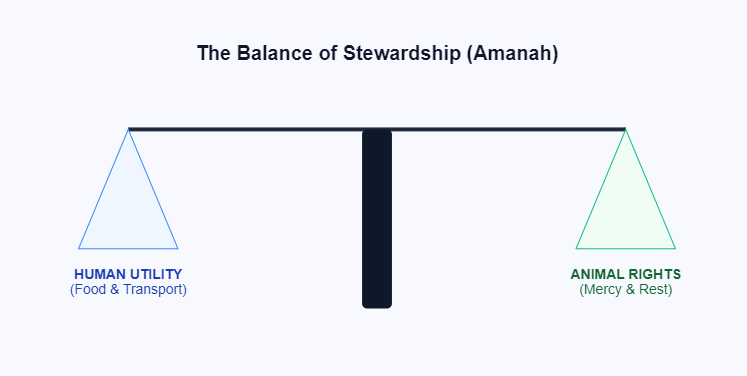
Logically, this was a strike against the “Logic of Dominance.” It established that human power over animals is “functional,” not “absolute.” While humans are allowed to use certain animals for food or transport—as we explored in the Logic of Prohibitions—this permission is strictly bounded by the requirement of necessity. This provides a robust ethical shield against modern industrial practices that treat living beings as inanimate commodities, ensuring that Islam and Human Rights principles of justice are applied to the entire biosphere.
4. The Logic of “Dhabihah”: Ethical Slaughter and Biological Integrity
Critics often question the Islamic method of slaughter (Dhabihah). However, when analyzed through Quran and Modern Science, this method is found to be a masterpiece of “Humane Logic.”
The Prophet (peace be upon him) commanded: “Verily Allah has prescribed excellence (Ihsan) in all things… so when you slaughter, slaughter well; let each of you sharpen his blade and let him give ease to the animal.” (Sahih Muslim). Logically, the focus is on the minimization of pain. By using a swift, sharp incision, the animal loses consciousness instantly, and the drainage of blood ensures the meat is healthy for human consumption. Furthermore, the Prophet forbade slaughtering one animal in the sight of another or sharpening the blade in front of the animal. This recognizes the psychological sentience of animals—a reality that Modern Anatomy is only now beginning to emphasize in animal welfare laws.
5. The Logic of Rest: Preventing Overloading and Exhaustion
Animal Rights in Islam introduced specific “labor laws” for working animals. Historically, the Prophet once entered a garden and saw a camel that was weeping from exhaustion and hunger. He reprimanded the owner, saying: “Do you not fear Allah regarding this beast that He has put in your possession?”
Logically, this established the principle of “Capacity.” An owner does not have the right to push an animal beyond its biological limits. This early regulation of the “beast of burden” is a precursor to modern labor laws. It reflects the Prophetic Medicine philosophy, where health is seen as a holistic state that must be preserved. By protecting the animal from burnout, Islam protected the very economy that relied on those animals, demonstrating a perfect harmony between ethics and utility.
6. The Logic of the “Fitrah”: Innate Compassion
The Animal Rights in Islam framework is an extension of the Fitrah (innate nature). Islam teaches that the human soul is naturally inclined toward mercy. When we see an animal in pain, our Human Logic and heart both react with empathy.
Islam does not suppress this empathy; it mandates it as a form of Worship in Islam. The Prophet said: “He who is not merciful to others, will not be shown mercy [by Allah].” Logically, mercy is a universal currency. By training the human heart to be kind to a cat or a bird, Islam cultivates a character that will eventually be kind to fellow humans. This spiritual “training ground” is essential for the Purpose of Life, which is to reflect the attributes of the Creator within our own capacity.
7. Global Preservation: Biodiversity as a Divine Sign
Finally, the study of Animal Rights in Islam concludes with the preservation of species. Islamic law prohibits the total extermination of any species, even those perceived as pests, unless they pose an immediate threat to human life.
Logically, every species is a unique “Word” from the Creator. To wipe out a species is to delete a chapter from the “Book of Signs.” This aligns with the Fine-Tuning of the Universe logic, where every organism has a niche and a function. By protecting biodiversity, Islam ensures the continuity of The Water Cycle and the ecological stability of the planet. It is a system designed by the One who is High above all, yet cares for the smallest sparrow.
Conclusion: Reclaiming the Universal Ethic of Mercy
The scholarly investigation into Animal Rights in Islam leads to an inescapable rational verdict: the Islamic tradition established a sophisticated and enforceable charter of rights for the non-human world over a millennium before the modern era. By anchoring these rights in divine accountability and the logic of stewardship, Islam offers a more stable and profound ethical foundation than purely secular models.
For the skeptical mind, the Prophetic concern for animals is an invitation to reflect on the Why Islam answer. A religion that provides such detailed care for the humble camel and the thirsty dog must surely have the ultimate guidance for the complex human soul. By recognizing the “Truth Clearly” in the Islamic treatment of animals, we find a worldview where all life is sacred, all pain is witnessed, and all creation points back to the One True God, the All-Wise, the All-Merciful.














Leave a Reply