
This research paper is part of Truth Clearly’s commitment to providing an authentic Islamic perspective on theology and history. We adhere to rigorous academic standards, relying exclusively on the Quran, authentic Prophetic traditions, and verified historical sources to provide clarity for the rational seeker.
In the modern geopolitical and cultural landscape, few subjects provoke as much intense debate and emotional rhetoric as the status of Women in Islam. For the skeptical Western reader, the prevailing narrative is often one of inherent oppression, lack of agency, and systemic inequality. However, when we apply a rigorous historical and logical analysis, a vastly different reality begins to emerge—one that positions the advent of Islam as a 7th-century civil rights revolution for the female gender.
To understand the true position of Women in Islam, one must strip away the cultural deviations of specific patriarchal societies and return to the foundational texts: the Quran and the authentic Prophetic traditions. By examining the legal, economic, and spiritual frameworks established 1,400 years ago, we find a system that was centuries ahead of its time in granting autonomy to women.
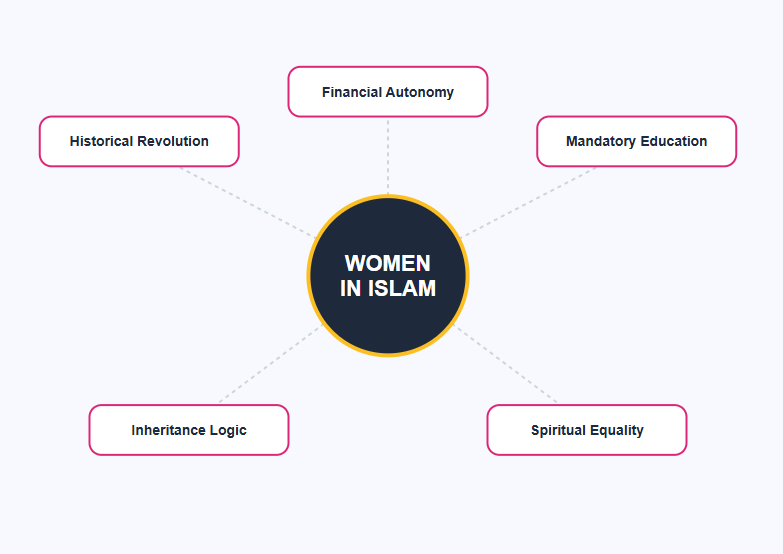
This article invites you to explore five logical facts about Women in Islam that challenge common stereotypes and invite a deeper, more nuanced understanding of the Islamic worldview.
Table of Contents
1. The Historical Context: A 7th-Century Revolution
To appreciate the status of Women in Islam, we must first look at the “Jahiliyyah” (Age of Ignorance) in pre-Islamic Arabia. Before the mission of Prophet Muhammad, women were often treated as mere property. Female infanticide was a common practice driven by the fear of economic burden or social shame. Women had no right to inherit, no say in their marriages, and were frequently traded or inherited like livestock.
The Islamic revelation did not just “improve” these conditions; it abolished them entirely. The Quran explicitly prohibited female infanticide (Quran 81:8-9) and established women as legal entities with their own rights and responsibilities. While the Western world was debating whether women had souls well into the Middle Ages, the Quran had already declared:
“And their Lord responded to them, ‘Never will I allow to be lost the work of [any] worker among you, whether male or female; you are of one another.’” (Quran 3:195).
This historical pivot is the first logical proof that the original intent of Islam was to elevate, not suppress, the female gender. It was a radical shift toward recognizing the humanity and agency of Women in Islam.
2. Financial Independence and Property Rights
One of the most significant, yet overlooked, facts regarding Women in Islam is their absolute right to financial independence. In the Islamic legal system, a woman’s wealth is her own. Whether she earns it through trade, receives it as a gift, or inherits it, her husband or father has zero legal claim to it.
A Comparative Perspective
To put this into a logical perspective for the Western reader:
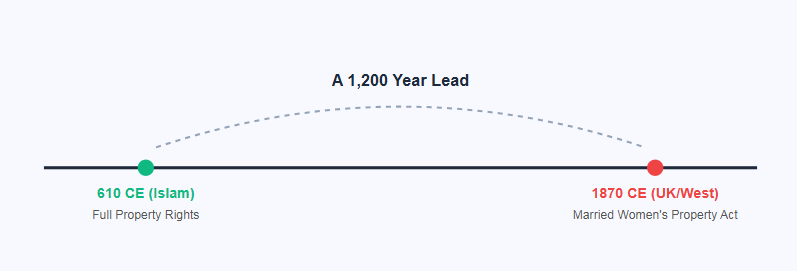
- In the United Kingdom, the Married Women’s Property Act was not passed until 1870, finally allowing women to keep their own earnings.
- In Islam, this right was established in the year 610 CE.
A Muslim woman is not required to spend a single penny of her wealth on the household; that responsibility falls entirely on the husband, even if the wife is wealthier than him. This unique economic autonomy is a cornerstone of the status of Women in Islam, providing them with a level of financial security that many Western women did not achieve until the late 19th or 20th century.
3. The Logic of Inheritance: A Financial Framework
A common point of skepticism regarding Women in Islam is the law of inheritance, where a daughter often receives half the share of a son. To the modern mind, this seems like a clear case of inequality. However, when we apply the logic of the entire Islamic financial system, it becomes a model of equity rather than mere equality.
The Burden of Responsibility (Nafaqah)
In Islam, financial rights are tied to financial responsibilities:
- The Man’s Role: Under Islamic law, a man is legally obligated to provide for his wife, children, parents, and even his unmarried sisters. His wealth is “taxed” by the needs of his dependents.
- The Woman’s Role: A woman has no legal obligation to spend on anyone but herself. Her share of inheritance is hers to keep, invest, or spend as she pleases.
When you look at the “net result,” the woman often ends up with more disposable wealth than the man, despite receiving a smaller share of the gross inheritance. This logical framework, rooted in the 5 Pillars of Islamic Faith regarding social justice, ensures that wealth is distributed based on the burden of care.
4. The Mandatory Pursuit of Knowledge
The narrative that Islam discourages the education of women is perhaps the most logically inconsistent with the religion’s history. The very first word of the Quran was “Read” (Iqra). This command was universal, applying to both men and women.
The Prophet Muhammad (peace be upon him) famously stated:
“Seeking knowledge is a mandate (fard) upon every Muslim (male and female).”
Historical Figures in Education
The status of Women in Islam is exemplified by historical giants such as:
- Aisha bint Abi Bakr: One of the greatest scholars of the 7th century. She was a primary source of law, medicine, and poetry, and taught thousands of men.
- Fatima al-Fihri: A Muslim woman who founded the world’s first degree-granting university, the University of al-Qarawiyyin in Morocco, in the year 859 CE.
The intellectual tradition of Women in Islam is deeply embedded in the Authenticity of the Quran and its call to reason. Any modern restriction on female education is a cultural deviation that contradicts the core tenets of the faith.
5. Spiritual Equality vs. Social Complementarity
Finally, we must address the ontological status of Women in Islam. In many ancient philosophies, women were seen as spiritually inferior to men. The Quran, however, is unambiguous in establishing spiritual equality.
The Quranic discourse often addresses “believing men and believing women” simultaneously, promising them identical rewards for their deeds:
“For men is a share of what they have earned, and for women is a share of what they have earned.” (Quran 4:32).
Complementarity vs. Sameness
Islam does not advocate for “sameness” (the idea that men and women are identical in every physical and psychological aspect) but rather for “complementarity.” It acknowledges that while they are spiritually equal, they may have different roles that harmonize to create a stable family unit—the building block of society.
This is best illustrated in the status of the mother. While the Western world often struggles to value domestic and maternal roles, Prophet Muhammad elevated them to the highest spiritual rank, stating: “Paradise lies at the feet of your mother.” This is not a demotion to the domestic sphere, but an elevation of the most critical role in human civilization.
Conclusion: Deconstructing the Myth of Oppression
The status of Women in Islam is far more complex and empowering than the simplistic “oppressor vs. oppressed” binary often presented in Western media. When we look at the facts—historical context, financial independence, inheritance logic, and educational mandates—we see a tradition that sought to protect and empower women in a world that offered them nothing.
By understanding the logical foundations of the Quran and the prophetic succession, we can see that Islam is not a religion that seeks to hide women, but one that seeks to honor them. For the skeptical mind, the challenge is to look beyond cultural headlines and recognize the revolutionary rights granted to Women in Islam over fourteen centuries ago.













Leave a Reply