
To understand Islam’s deep reverence for Jesus (peace be upon him), we must look at the linguistic and theological roots of “submission” to the Creator. This article is written by our research team to highlight the shared spiritual heritage of all prophets.
In the modern world, the identities of “Christian” and “Muslim” are often viewed as mutually exclusive categories, separated by centuries of geopolitical conflict and theological debate. For the skeptical Western reader, the agnostic academic, or the student of history, the question “Was Jesus a Muslim?” might initially seem like a provocative anachronism. After all, the institutionalized religion known today as Islam was revealed to Prophet Muhammad in the 7th century, while Jesus of Nazareth lived six hundred years prior. However, when we apply a rigorous logical, etymological, and scriptural inquiry, the answer reveals a profound continuity that transcends modern labels.
In the Islamic worldview, specifically the Sunni Athari perspective, we recognize that the religion of all prophets—from Adam to Muhammad—was fundamentally one: the absolute submission to the Will of Allah. Allah, the unique Creator who is High above His Heavens, has never changed His core message. He spoke the Quran as His literal and uncreated Speech to clarify that Jesus in Islam (Prophet Isa) was not the founder of a new ethnic religion, but a vital link in the chain of submission. This article explores seven profound logical realities that answer the question: “Was Jesus a Muslim?“
Table of Contents
1. The Etymological Logic: Defining the Identity
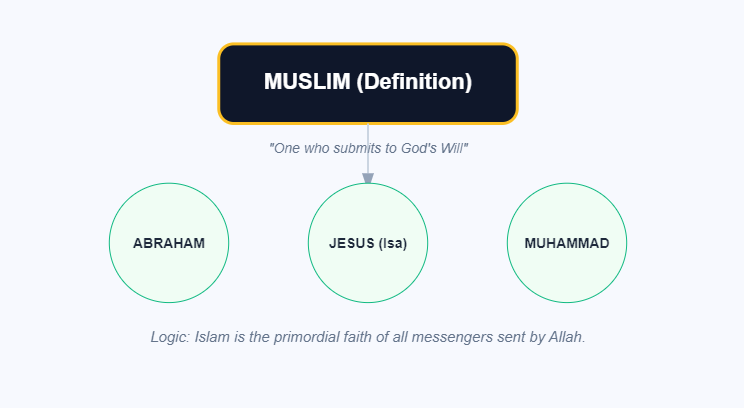
The primary logical pillar in answering the inquiry, “Was Jesus a Muslim?” is the definition of the word itself. Linguistically, the Arabic word “Muslim” is a present participle meaning “one who submits his will to God (Allah).” It is derived from the root S-L-M, implying peace through surrender to the Divine Command.
Logically, if a “Muslim” is defined by their ontological state of submission to the Creator, then every prophet in history fits this description perfectly. Jesus of Nazareth explicitly stated his mission in terms that mirror this exact definition: “I seek not mine own will, but the will of the Father which hath sent me” (John 5:30). In Islamic theology, this is the very essence of Worship in Islam. By his own admission, Jesus lived in a state of total Islam (submission). Therefore, when we ask, “Was Jesus a Muslim?“, we are simply recognizing his self-declared spiritual orientation.
2. The Continuity of Faith: Why the Quran Affirms Him
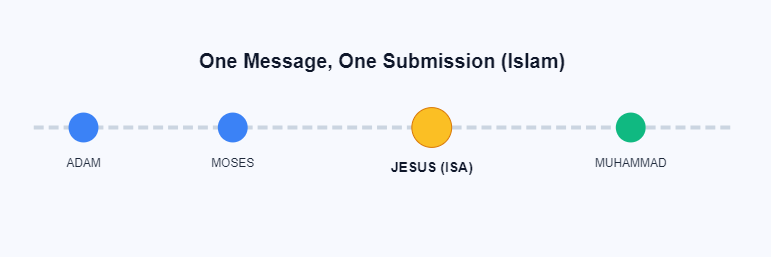
To understand the context of “Was Jesus a Muslim?“, one must position Jesus within the broader narrative of the Quran. The Quran does not present Islam as a “new” faith, but as the “Primordial Religion” (Deen al-Fitrah). The Quran explicitly identifies previous prophets as Muslims: Abraham was a Muslim (Quran 3:67), and the disciples of Jesus declared, “Bear witness that we are Muslims” (Quran 5:111).
Logically, the Authenticity of the Quran relies on this continuity. If Allah is the Most Wise and Unchanging, His guidance for humanity must be consistent. The Quran identifies Prophet Isa as a “Word” and a “Spirit” from Allah, sent to restore the pure monotheistic submission that had been obscured by time. When we analyze the question, “Was Jesus a Muslim?“, we see that he shared the same mission as all messengers: to establish absolute monotheism and remove the idols of the human ego.
3. Miraculous Birth: The Logic of a Created Servant
The virgin birth is a shared reality in the study of “Was Jesus a Muslim?“. While Christianity often uses this miracle to argue for the divinity of Jesus, Islamic logic applies a different conclusion. We believe that Allah created Jesus without a father through the command “Be” (Kun), just as He created Adam without a father or a mother.
Logically, the miracle of the birth is a proof of the Creator’s power, not the creature’s divinity. As we explored in the Origins of the Universe, Allah is the absolute Originator. By accepting the miraculous birth within the framework of submission, Jesus exemplified the status of a perfect “servant” (Abd). He was a miracle, but he was not the source of the miracle. This distinction is vital for Islam and Human Logic, which answers “Was Jesus a Muslim?” by pointing to his created and dependent nature.
4. The Ontological Gap: Why Jesus Could Not Be God
The most significant theological knot in the question of “Was Jesus a Muslim?” is his nature. Traditional Church dogmas claim he is the “Son of God” or part of a Trinity. However, a rigorous analysis of Is Jesus God in the Bible? reveals a lack of explicit claims to divinity by Jesus himself.
Islam resolves this identity crisis by affirming his pure human status. Allah is the Self-Sufficient Creator, and He is distinct from His creation. Logically, the Infinite cannot become finite without ceasing to be infinite. Therefore, Jesus could not be God; he had to be a submitter to God. He was a “Muslim” because he stood in the same row as all other humans, facing the Creator in Prayer and Supplication. His humanity was his greatest strength, allowing him to be a perfect Practical Exemplar for his people. This reinforces the affirmative answer to: “Was Jesus a Muslim?“
5. Prophecies and Handover: The Herald of the Final Path
A profound logical reality supporting the claim that Was Jesus a Muslim is a valid inquiry is his role as a herald. Every Muslim prophet was part of a “handover” process. Jesus was sent to confirm the Torah of Moses and to announce the coming of the “Paraclete” or the “Spirit of Truth.”
As analyzed in the study of Muhammad in the Bible prophecies, the logical evidence suggests that Jesus was pointing his followers toward the finality of the Quranic message. Logically, if Jesus was part of a unified divine plan, he must have belonged to the same spiritual community as the one who was to follow him. His mission was to prepare the world for the Why Islam answer—the final, perfected guidance. This prophetic synergy is a key reason why we conclude that, in essence, Was Jesus a Muslim is answered by the continuity of revelation.
6. The Practice of Islam: Alignment in Ritual and Law
When we look at the actual life and practices of Jesus as recorded in history, we see a striking resemblance to the 5 Pillars of Islamic Faith. This is a practical way to answer the question, “Was Jesus a Muslim?“
- Monotheism: He preached the absolute oneness of God.
- Prayer: He fell on his face in prostration to Allah (Matthew 26:39), exactly as Muslims do in Sujud.
- Fasting: He fasted extensively, emphasizing the Logic of Self-Restraint.
- Purity: He followed the Semitic laws of ritual purity and Prophetic Medicine.
Logically, if Jesus’s daily actions and spiritual discipline align perfectly with the Sharia Law in Islam, then he was a Muslim in practice. He did not eat swine, he was circumcised, and he greeted his followers with “Peace be unto you” (As-Salamu Alaykum). For the skeptical mind, these similarities prove that the answer to “Was Jesus a Muslim?” is a resounding yes.
7. The Eschatological Witness: Jesus on the Day of Judgment
The final reality in the inquiry of “Was Jesus a Muslim?” is his role at the end of time. In the Islamic worldview, Jesus did not die for the sins of the world—a concept we challenged in Salvation in Islam vs. Christianity. Instead, he was raised to Allah and will return to Earth before the Day of Judgment.
Logically, his return is the final proof of his identity. He will return not as a new god, but as a follower of the final revelation, establishing justice and breaking the idols of deification. On the Day of Judgment, he will stand as a witness before Allah, testifying that he only commanded his people to worship Allah, his Lord and their Lord. This aligns with the Life After Death and Divine Justice framework. Every aspect of his past, present, and future mission confirms the reality: Was Jesus a Muslim? Yes, he was the pinnacle of submission.
Conclusion: Reclaiming the Rational Messiah
The scholarly investigation into whether Was Jesus a Muslim leads to a profound rational verdict. If being a Muslim means submitting one’s heart, mind, and soul to the One True God, then Jesus was the quintessential Muslim. By stripping away the Hellenistic additions and the later theological inventions of the Church councils, we find the “Historical Jesus”—a majestic prophet who was the brother of Abraham and the herald of Muhammad.
For the skeptical reader, the Islamic portrayal of Prophet Isa is an invitation to logical consistency. It offers a Jesus who is relatable in his humanity and inspiring in his devotion. By recognizing that the answer to “Was Jesus a Muslim?” is found in his total submission to the Creator, the seeker finds the “Truth Clearly”—that the message of God has always been one, and its final destination is the worship of the Lord of the Heavens and the Earth.













Leave a Reply