

This research paper is part of Truth Clearly’s commitment to providing an authentic Islamic perspective on theology and history. We adhere to rigorous academic standards, relying exclusively on the Quran, authentic Prophetic traditions, and verified historical sources to provide clarity for the rational seeker.
In the contemporary era, characterized by unprecedented material wealth but a growing crisis of meaning, the question of existence has become more urgent than ever. For the skeptical Western seeker, the agnostic academic, or the individual struggling with existential dread, the inquiry into The Purpose of Life in Islam offers a unique intellectual and spiritual anchor. While secular philosophies often view life as a biological accident or a subjective narrative, Islam presents a worldview where life is an intentional, structured, and profoundly logical journey toward an ultimate destination.
The Sunni Athari perspective on this matter is rooted in the Recognition of Allah—the Most High, who is established over His Throne and is distinct from His creation. We believe that Allah did not create the universe for idle play or without a goal. He is the All-Wise (Al-Hakim) and the All-Knowing (Al-Alim), and His Speech, the Quran, provides a clear roadmap for human potential. This article explores seven profound logical realities of The Purpose of Life in Islam, demonstrating that worship is not a burden imposed by a needy deity, but a spiritual necessity designed for the flourishing and completion of the human soul.
Table of Contents
1. The Rejection of Absurdity: The Logic of Divine Wisdom
The first logical reality of The Purpose of Life in Islam is the rejection of “Abath” (pointlessness). In any human endeavor, we recognize that an intelligent agent acts with a purpose. A builder does not lay bricks for no reason; an engineer does not design a complex engine without an intent. Logically, it is impossible for the Creator of the most complex system imaginable—the universe—to have created it without a grand objective.
The Quran challenges this notion of accidental existence directly: “Then did you think that We created you uselessly and that to Us you would not be returned?” (Quran 23:115). Islamic theology asserts that because Allah is the Most Wise, every atom has a function and every soul has a destination.
Understanding the Origins of the Universe as a purposeful act leads us to conclude that the human experience is the climax of this cosmic design. Life is not a series of random events but a calculated stage for the manifestation of divine wisdom. For a skeptical mind, the existence of laws in physics—as explored by Britannica’s analysis of the laws of nature—is a powerful indicator that the moral world must also have an underlying law of purpose.
2. Divine Self-Sufficiency (Al-Ghina) and Human Need
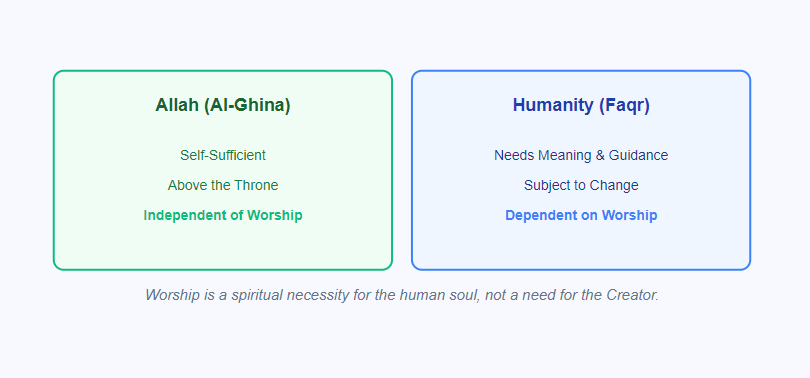
A frequent point of skepticism is the question: “Why does God want us to worship Him? Is He in need of our praise?” The Purpose of Life in Islam is built on the absolute self-sufficiency (Al-Ghina) of Allah. Allah is High above His Throne, and the worship of all mankind adds nothing to His Majesty, nor does the disbelief of all mankind diminish it.
Logically, worship (Ibadah) in Islam is for the benefit of the servant, not the Creator. Just as a plant “needs” to turn toward the sun to live and grow, the human soul “needs” to turn toward its Creator to find its true center and peace. Worship is the act of aligning one’s life with the Truth. By recognizing Absolute Monotheism (Tawhid), the human mind is freed from the slavery of worldly desires, superstitions, and the ego. In this framework, the “command” to worship is actually an act of supreme mercy—a guide for the creation to achieve its highest possible state of being and intellectual clarity.
3. The Fitrah: The Pre-Programmed Quest for Meaning
The Purpose of Life in Islam is internally verified by the Fitrah—the innate nature of the human soul. Every person is born with a “spiritual hunger,” an internal drive to find a source of ultimate justice, beauty, and truth. Secular materialism often fails to satisfy this drive, leading to what psychologists call an “existential vacuum.”
Islam posits that this hunger is an intentional feature of our design. We are “coded” to seek Allah. When a person discovers the Authenticity of the Quran, they often experience a sense of “homecoming” because the external revelation matches their internal Fitrah. Logically, a universe that produces a being with an innate need for meaning must also provide the source of that meaning. The Purpose of Life in Islam is to fulfill this natural inclination, bringing the soul into harmony with its original state. This concept of innate recognition is a cornerstone of Islam and Objective Morality.
4. The World as a Developmental Laboratory: The Logic of Trial
To understand The Purpose of Life in Islam, we must view the Earth not as a final destination, but as a transitional stage—a developmental laboratory. Islamic logic suggests that the human soul requires a specific environment of choice and trial to develop moral and spiritual virtues.
As we analyzed in the Logic of Suffering and Trial, virtues like patience, courage, and true sincerity cannot be “given”; they must be “earned” through the exercise of free will in the face of obstacles. If we were created in a state of perpetual ease, our moral potential would remain dormant. The challenges of life are the “stress tests” that refine the human character. Therefore, the purpose of our journey on Earth is to “grow” a soul that is fit for the eternal company of the Creator in the hereafter. This refinement process is supported by the Logic of Free Will, where our choices define our ultimate worth.
5. Holistic Worship: The Logic of Integrated Existence
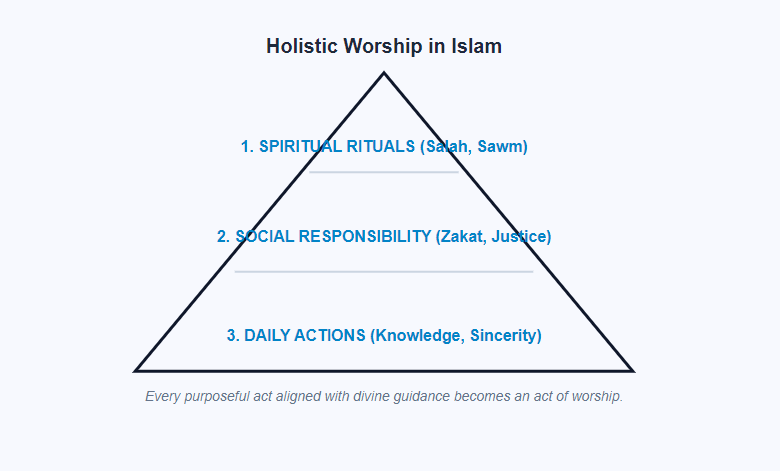
A common misconception is that the Purpose of Life in Islam is restricted to rituals like prayer and fasting. However, the Islamic concept of Ibadah (worship) is holistic and comprehensive. It encompasses every action done with the intention of pleasing Allah and following His guidance.
Logically, this transforms all of life into a sacred act. Seeking knowledge, as seen in the Islamic Contributions to Science, is an act of worship. Working to provide for one’s family, practicing justice, and advocating for Human Rights are all forms of worship. This ensures that a Muslim’s life is not fragmented between the “secular” and the “religious.” Every moment is an opportunity to fulfill the purpose of existence, creating a unified, highly motivated, and psychologically stable state of being.
6. The Logic of Accountability: The Weight of Human Agency
The Purpose of Life in Islam is fundamentally tied to the reality of accountability. Because we have been granted the gifts of intellect (Aql) and choice, we are responsible for the direction we navigate. This is what distinguishes humanity from the rest of the biological world.
Logically, if there were no consequence for our actions, then life would be an exercise in futility. The hero and the tyrant would meet the same end, which contradicts the attribute of Divine Justice. Islam asserts that Allah, who sees and hears all from His position High above the Heavens, will settle every account. This accountability gives every choice we make “infinite weight.” It ensures that our struggle for truth and our Sincerity are never in vain. The purpose of life is to prepare a “good record” for a meeting that is inevitable and logically necessary.
7. The Final Destination: Returning to the Source
Finally, the Purpose of Life in Islam is defined by its end point: the Akhirah (Afterlife). We are beings in a state of return. The human soul is a “stranger” in the material world, longing for its transcendent origin. Islamic theology provides a bridge across the grave, viewing death not as an end, but as a “birth” into a higher reality.
Logically, the transition from the womb to the world is a template for the transition from the world to the next. By following the 5 Pillars of Islamic Faith, a believer is essentially “preparing” for a long journey. The purpose of life is to recognize the signs of Allah in the universe and in our own souls, so that when we return to Him, we return in a state of peace and satisfaction. For the skeptical reader, the Preservation of the Bible and Quran serves as a historical reminder that God has never left humanity without a guide toward this final destination.
Conclusion: A World of Clarity and Meaning
The study of The Purpose of Life in Islam reveals a worldview that is deeply respectful of human intelligence. It offers a framework where nothing is wasted, nothing is accidental, and every individual has a unique and vital role in the divine plan. Islam does not ask you to hide from reality or abandon your logic; it asks you to see the world clearly—to recognize the signature of Allah in every breath and every star.
By embracing this purpose, the individual moves from the chaos of doubt into the clarity of truth, discovering that the journey toward Allah is the only journey that truly satisfies both the heart and the mind. Ultimately, the Purpose of Life in Islam is an invitation to live with dignity, to act with justice, and to die with hope, knowing that we belong to a Creator who is the Most Wise and the Most Merciful.














Leave a Reply