

This research paper is part of Truth Clearly’s commitment to providing an authentic Islamic perspective on theology and history. We adhere to rigorous academic standards, relying exclusively on the Quran, authentic Prophetic traditions, and verified historical sources to provide clarity for the rational seeker.
In the study of world history and religious phenomena, few figures have been as intensely scrutinized as Muhammad of Arabia. To the skeptical Western reader, the academic, or the student of psychology, the emergence of a man claiming divine revelation in the 7th century presents an interesting dilemma. Was he an ambitious politician, a self-deluded mystic, or a sincere messenger?
When we move beyond the polemics of “believer vs. non-believer” and apply a cold, logical analysis to the historical record, the Sincerity of Prophet Muhammad stands out as an undeniable constant. History shows that fraudsters or power-seekers follow a specific psychological pattern—one that is fundamentally absent in the life of Muhammad.
This article explores five profound logical evidences for the Sincerity of Prophet Muhammad, inviting the rational mind to consider the consistency between his claims, his actions, and the extreme circumstances of his 23-year mission.
Table of Contents
1. The Pre-Mission Record: A Lifetime of Absolute Integrity
Before exploring the Sincerity of Prophet Muhammad during his mission, one must analyze the forty years that preceded it. In any forensic or psychological investigation, past behavior is the strongest predictor of future honesty.
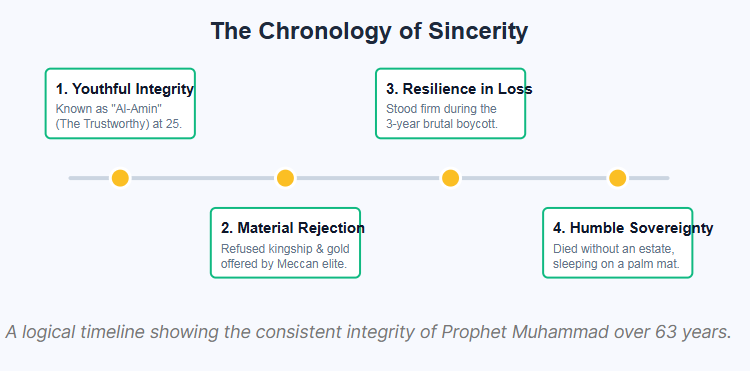
Muhammad lived his entire youth and early adulthood in a tribal society where reputation was everything. Long before he spoke of the Quran, he was universally nicknamed Al-Amin (The Trustworthy) and As-Sadiq (The Truthful). Even his most bitter enemies, when challenged by him years later, could not point to a single instance where he had lied or cheated in trade or social interaction.
From a logical standpoint, it is highly improbable for a man to maintain a flawless record of integrity for forty years, only to suddenly begin a complex, multi-decade lie. A person who has never lied for worldly gain is unlikely to suddenly invent a “cosmic lie” that would place his life and the lives of his family in immediate danger. This historical consistency is the first pillar of the Sincerity of Prophet Muhammad.
2. The Rejection of Material Wealth and Political Power
The most common motive for a fraudulent prophet is the pursuit of worldly gain: wealth, status, or kingship. If the Sincerity of Prophet Muhammad were a facade, he would have accepted the “ultimate bargain” offered to him by the leaders of Mecca.
The Meccan Offer
Early in his mission, the leaders of the Quraysh, seeing that his message was disrupting their socio-economic power, sent an envoy (Utbah ibn Rabi’ah) with a formal proposal:
“If you want money, we will collect for you so much that you will be the richest of us. If you want status, we will make you our leader. If you want kingship, we will crown you king.”
For a power-seeker, this was the goal achieved without a single drop of blood. However, Muhammad rejected it without hesitation, insisting on the message of Tawhid (the absolute oneness of God). Logically, why would an impostor reject the very things for which people usually commit fraud? His refusal to trade his message for absolute sovereignty in Mecca provides heavy logical weight to the Sincerity of Prophet Muhammad.
3. The Psychology of Self-Correction in the Quran
A profound internal evidence for the Sincerity of Prophet Muhammad is found within the Quran itself. In traditional literature, an author writing a book to glorify himself or his mission will edit out his mistakes, his doubts, or his moments of weakness.
The Quran, however, contains several instances where God openly admonishes or corrects Muhammad.
- The Incident of the Blind Man: In Surah ‘Abasa (He Frowned), the Quran reprimands the Prophet for turning away from a poor blind man (Ibn Umm Maktum) while trying to preach to wealthy tribal leaders.
- The Captives of Badr: The Quran corrected his decision regarding the treatment of war captives.
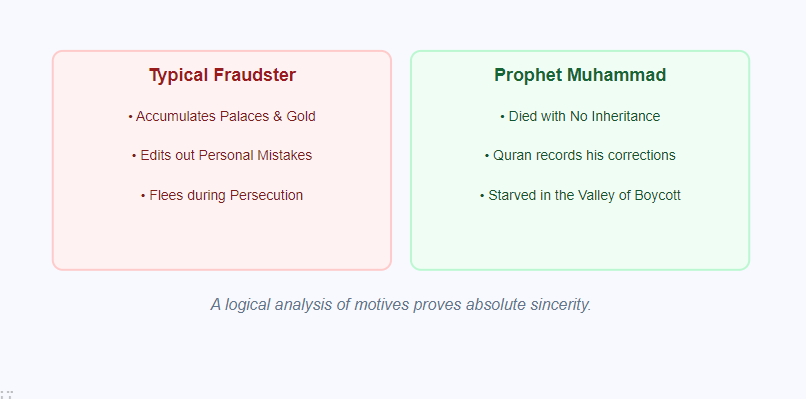
If Muhammad were the author of the Quran (an idea we challenged in our analysis of the Authenticity of the Quran), why would he include verses that criticize his own behavior? A fraudster seeks to appear perfect to his followers. The inclusion of these divine corrections is a powerful psychological proof that he was a faithful transmitter of a message that was not his own—a hallmark of the Sincerity of Prophet Muhammad.
4. Consistency Under Severe Persecution and Loss
False prophets typically abandon their claims when the “cost of belief” exceeds the “profit of the lie.” The thirteen years Muhammad spent in Mecca were a period of relentless suffering. He was boycotted, his followers were tortured, and he lost his beloved wife Khadija and his protector Abu Talib.
The Logic of the Boycott
For three years, the Prophet and his tribe were forced into a desolate valley (Shi’b Abi Talib), where they faced starvation. History records that they ate leaves to survive.
If there were any element of doubt or fraud, this would have been the moment to recant. People do not die of starvation for a lie they invented themselves. The fact that he remained unshakeable through the most traumatic losses of his life is a testament to the absolute Sincerity of Prophet Muhammad. This period of hardship mirrors the suffering of Jesus in Islam, who also faced rejection and trials while maintaining a singular divine focus.
5. The Lifestyle of Simplicity at the Peak of Sovereignty
Perhaps the most startling proof of the Sincerity of Prophet Muhammad is his lifestyle at the end of his life. By the 10th year of the Hijra, he was the undisputed ruler of the entire Arabian Peninsula. Riches and tributes were flowing into Medina from every corner.
Yet, his lifestyle remained identical to the day he started.
- His Bed: He slept on a simple mat made of palm fibers that left marks on his skin. When his companions suggested he get a softer bed, he compared his life to a traveler resting under a tree for a brief moment.
- His Wealth: At the time of his death, he did not leave behind dinars or dirhams. He had only a white mule, some weapons, and a piece of land left for charity.
- His Final Moments: His last instructions were not about a political dynasty, but about the 5 Pillars of Faith, especially prayer and the fair treatment of women and servants.
Contrast this with secular emperors or religious frauds who inevitably amass palaces, harems, and treasures. The stark poverty in which Muhammad lived and died, while having the power to live in extreme luxury, is the final logical proof of the Sincerity of Prophet Muhammad. He truly believed he was a servant-messenger, not a king.
Conclusion: The Logical Verdict on the Sincerity of Prophet Muhammad
When we assemble the data—the 40-year pre-mission integrity, the rejection of wealth and kingship, the psychological transparency of the Quranic text, the resilience under torture, and the humble death of a sovereign—a clear logical pattern emerge.
The Sincerity of Prophet Muhammad is the only explanation that harmonizes these historical facts. To claim he was a fraud is to ignore the basic laws of human motivation and psychology. To claim he was deluded is to ignore the sophisticated, historically accurate, and logically consistent message he delivered, as explored in Muhammad in the Bible prophecies.
For the skeptical mind, the life of Muhammad presents a profound invitation: to look past the cultural noise and recognize a man whose every action for 23 years screamed the truth of his conviction. The Sincerity of Prophet Muhammad remains one of the most compelling reasons why Islam continues to resonate with rational seekers 1,400 years later.















Leave a Reply