

This article provides an academic overview of Islamic jurisprudence (Fiqh and Maqasid). At Truth Clearly, we aim to present the foundational ethics of the Islamic legal system, highlighting its historical emphasis on justice, social welfare, and human dignity for all readers.
In the contemporary global discourse, few terms are as surrounded by fear, misconceptions, and intense debate as “Sharia.” For the skeptical Western reader, the mention of Sharia Law in Islam often invokes images of harsh punishments and restrictive social codes. However, from an academic and logical perspective, the term “Sharia”—which linguistically means “the path to the watering hole”—represents a comprehensive ethical and legal framework designed to sustain human life, protect dignity, and ensure social justice.
To understand the true nature of Sharia Law in Islam, one must move beyond the headlines and engage with its foundational logic. It is not a static, man-made legal code, but a divinely inspired system rooted in the Wisdom (Hikmah) of Allah. In the Sunni Athari worldview, we recognize Allah as the All-Wise Legislator (Al-Muqarnin) who is High above His Heavens and established over His Throne. He created humanity and, in His mercy, provided a “User Manual” for existence. This article explores seven profound realities of Sharia Law in Islam, revealing why it is a rational and necessary framework for a balanced society.
Table of Contents
1. The Five Objectives: The Maqasid Framework
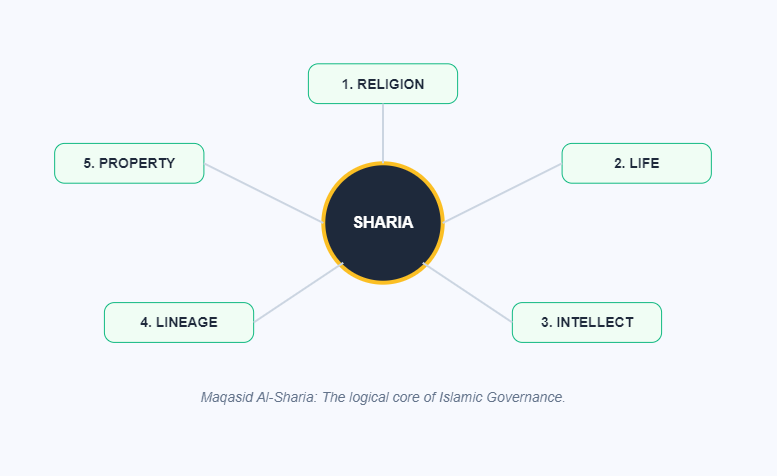
The primary logical pillar of Sharia Law in Islam is the concept of Maqasid al-Sharia (The Objectives of the Law). Islamic scholars have identified five fundamental necessities that every law in Islam is designed to protect:
- Religion: The freedom to recognize and worship the Creator.
- Life: The absolute sanctity and protection of the human body.
- Intellect: The preservation of the mind from harm (such as intoxicants).
- Lineage: The protection of the family unit and future generations.
- Property: The right to own and trade wealth without exploitation.
Logically, any legal system that prioritizes these five elements is a system designed for human flourishing. When we analyze Islam and Human Rights, we find that Sharia provides a robust defense for these rights, anchoring them in divine decree rather than fluctuating political whims. By focusing on these core values, Sharia Law in Islam acts as a holistic safeguard for civilization.
2. The Distinction Between Sharia and Fiqh
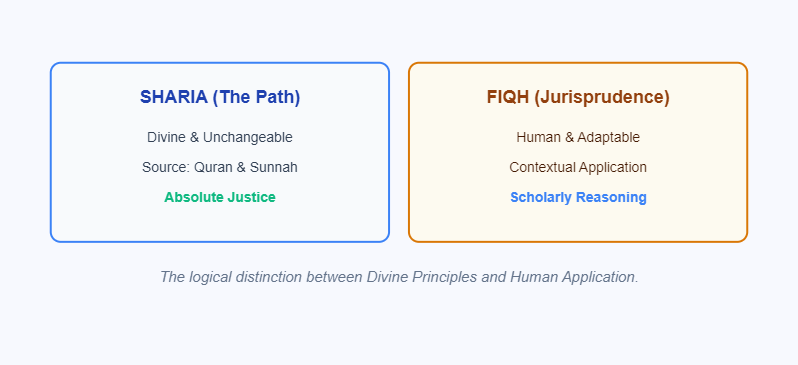
A common logical error made by skeptics is the failure to distinguish between Sharia and Fiqh (Jurisprudence). Sharia is the broad, divine path derived from the Authenticity of the Quran and the Sunnah. It represents the eternal and unchangeable principles of justice and morality spoken by Allah, the Creator of the Heavens and the Earth.
Fiqh, however, is the human understanding and application of those principles to specific times and places. While Sharia is divine and perfect, Fiqh is a scholarly effort that allows for flexibility (Ijtihad). This distinction is vital for the Sharia Law in Islam dialogue because it proves that the system is not a rigid, medieval relic, but a dynamic framework that can address modern challenges while remaining true to its unshakeable core. This logical adaptability allowed the Islamic Civilization to Contribute to Science and law for over a thousand years.
3. Economic Stability: The Logic of No-Interest Finance
One of the most revolutionary aspects of Sharia Law in Islam is its economic system. Sharia prohibits Riba (usury or interest) and promotes profit-sharing and asset-backed transactions. From a modern economic perspective, this logic is incredibly sound; it prevents the creation of “debt bubbles” and ensures that wealth is tied to real economic activity rather than speculative manipulation.
By institutionalizing Zakat (obligatory charity), as explored in the 5 Pillars of Islamic Faith, Sharia creates a mandatory social safety net. Logically, a society that prevents the hoarding of stagnant wealth and encourages investment in the community is a society that reduces the gap between the ultra-rich and the poor. The economic laws of Sharia Law in Islam are not merely “religious rules” but a sophisticated blueprint for a stable and equitable global economy.
4. The Logic of Deterrence: Rethinking the Penal Code
The most criticized part of Sharia Law in Islam is its penal code (Hudud). However, when viewed through the lens of social psychology and logic, these laws are based on the principle of maximum deterrence. The goal of the Sharia is to prevent the crime from happening in the first place by creating a high psychological barrier.
Furthermore, the requirements for evidence in Sharia are so strict that the most severe punishments are rarely, if ever, carried out in a just Islamic state. For example, to convict someone of a crime against public morality, four independent and upright witnesses must testify to seeing the act itself—a near impossibility in private life. Logically, the Sharia prioritizes the privacy and honor of the individual, and the penal system acts more as a “moral deterrent” than a “punitive machine.” This reflects the Logic of Objective Morality, where the sanctity of the society is balanced against the rights of the individual.
5. Justice Above Kinship: The Rule of Divine Law
In many historical and modern systems, the law is often bent to favor the powerful or those with the right connections. Sharia Law in Islam introduced a radical concept of “Universal Justice” where the ruler and the ruled are equal before the Divine Court.
Logically, if the law comes from the Creator—who is High above His Throne and has no favorites based on race or status—then no human has the authority to be “above the law.” This was exemplified by Muhammad as a Leader, who famously declared that even if his own daughter committed a crime, the law would be applied. This uncompromising standard of justice is what allowed Islamic society to flourish across different continents and ethnicities, providing a “Rule of Law” that was far superior to the feudal systems of medieval Europe, as documented by Britannica’s historical review of Islamic Law.
6. The Protection of Marginalized Voices
Contrary to popular misconceptions regarding Women in Islam, Sharia was the first legal system to grant women specific, unalienable rights to property, inheritance, and legal identity. Sharia provides a framework of “Equity” rather than a superficial “Equality,” acknowledging the different social and biological roles of men and women to create a balanced family unit.
Similarly, Sharia Law in Islam established the rights of minorities, orphans, and even animals. It created the “Waqf” (endowment) system, which provided free education and healthcare for centuries. Logically, a system that focuses on the protection of the weak is a system that understands the long-term stability of a civilization. By anchoring these rights in the command of Allah, the Most Merciful, Sharia ensures that the rights of the vulnerable are not subject to the majority’s vote.
7. The Logic of Divine Wisdom: Why We Need a Lawgiver
The final reality of Sharia Law in Islam is the acknowledgment of human limitation. Humans are often swayed by emotions, greed, and short-term thinking. If we were to design our own moral and legal codes entirely from scratch, they would inevitably reflect our biases and self-interests.
Islamic logic asserts that we need a “Transcendent Reference Point.” Allah, the All-Knowing (Al-Alim), knows the past, the present, and the long-term consequences of every action. Following Sharia Law in Islam is a rational choice to trust Divine Wisdom over human guesswork. Just as we follow the Logic of Free Will to make responsible choices, we follow Sharia to ensure those choices lead to a prosperous and just society. It is a system designed by the One who created the complex laws of physics—as seen in the Origins of the Universe—to govern the moral and social life of mankind.
Conclusion: The Path to Water and Life
The study of Sharia Law in Islam leads to a clear rational verdict: it is not a system of oppression, but a system of preservation. By protecting religion, life, intellect, lineage, and property, Sharia provides the necessary boundaries within which human potential can be maximized.
For the skeptical mind, Sharia offers an invitation to look at the results of a divinely mandated order. It is a worldview where justice is not an accident, but a requirement from the Creator. By embracing the logical framework of Sharia Law in Islam, humanity can move away from the chaos of moral relativism and toward a future where everyone is a servant of the One True God, the Most High, who commands only what is good and forbids only what is harmful.














Leave a Reply