
This research paper is part of Truth Clearly’s commitment to providing an authentic Islamic perspective on theology and history. We adhere to rigorous academic standards, relying exclusively on the Quran, authentic Prophetic traditions, and verified historical sources to provide clarity for the rational seeker.
In an era dominated by advanced pharmacology and complex medical technology, there is a growing global interest in traditional and preventative health systems. For the skeptical Western reader or the medical professional, the term Prophetic Medicine in Islam (known as Tibb al-Nabawi) might initially sound like a collection of 7th-century folk remedies. However, a rigorous logical and biological inquiry into these teachings reveals a sophisticated framework of preventative medicine that predates modern germ theory, nutritional science, and public health protocols by over a millennium.
From the Sunni Athari perspective, these health directives are not mere human guesswork. They are rooted in the revelation given to Muhammad (peace be upon him) by Allah—the Most High, who is established over His Throne and possesses absolute Knowledge (Ilm) of the human body He created. The Prophetic Medicine in Islam is a manifestation of Divine Wisdom (Hikmah), providing a blueprint for physical and psychological well-being. This article explores seven profound logical truths of Prophetic Medicine in Islam, demonstrating its remarkable harmony with modern scientific principles.
Table of Contents
1. The Logic of Preventative Purity: Ritual Ablution (Wudu)
The first logical pillar of Prophetic Medicine in Islam is the institutionalization of hygiene through Wudu (ablution). In the 7th century, when hygiene was often ignored in many global civilizations, Islam made the washing of the face, hands, arms, and feet a mandatory requirement five times a day before prayer.
Logically, this acts as a continuous “sanitization protocol.” Modern microbiology confirms that the most common vectors for infection are the hands and the orifices of the face (mouth and nose). By mandating the washing of these specific areas multiple times daily, Prophetic Medicine in Islam established a barrier against pathogenic transmission. This focus on “Purity as half of Faith” aligns with the 5 Pillars of Islamic Faith, where physical cleanliness is the prerequisite for spiritual communion with Allah, the Creator of the Heavens and the Earth.
2. The First Social Distancing: The Logic of Quarantine
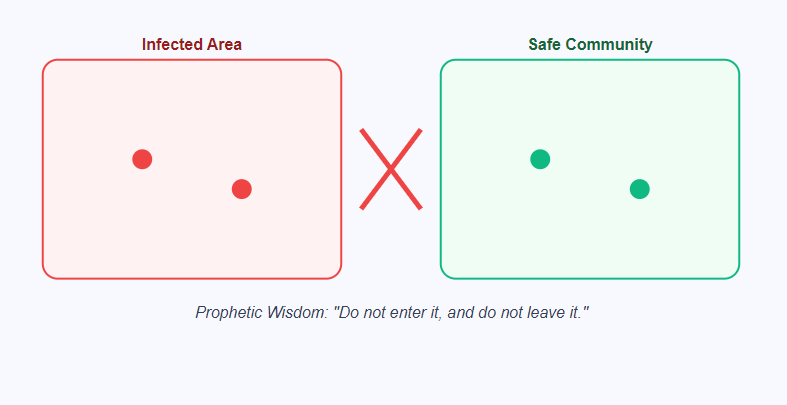
Perhaps the most staggering proof for the Prophetic Medicine in Islam is its early formalization of quarantine protocols. Long before the discovery of viruses and bacteria, Prophet Muhammad provided a clear logical directive for managing contagious diseases.
He stated: “If you hear of an outbreak of plague in a land, do not enter it; but if the plague breaks out in a place while you are in it, do not leave that place.” (Sahih Bukhari).
From a modern public health perspective, this is the exact definition of a “Lockdown” and “Containment Strategy.” By preventing the movement of people from an infected area, Prophetic Medicine in Islam sought to minimize the “R-naught” (reproduction rate) of the disease. This wisdom is documented in Britannica’s history of quarantine, highlighting that such logical foresight was revolutionary in an era that attributed plagues to “evil spirits” or “bad air.”
3. Nutritional Science: The Logic of Moderation
Modern medicine recognizes that the majority of chronic diseases—diabetes, obesity, and heart disease—are results of overconsumption. Prophetic Medicine in Islam addressed this through the logical principle of “The One-Third Rule.”
The Prophet taught: “The son of Adam does not fill any vessel worse than his stomach. It is enough for him to eat a few morsels… but if he must, then one-third for food, one-third for drink, and one-third for breath.”
Logically, this prevents the metabolic stress caused by overeating and allows the digestive system to function optimally. This early nutritional advice aligns with modern research on caloric restriction and “Mindful Eating.” By treating the body as an Amanah (Divine Trust) from Allah, the Most High, the Prophetic Medicine in Islam positions health as a moral responsibility, which we further explore in Islam and Human Rights.
4. Black Seed and Honey: Bioactive Compounds in the Sunnah
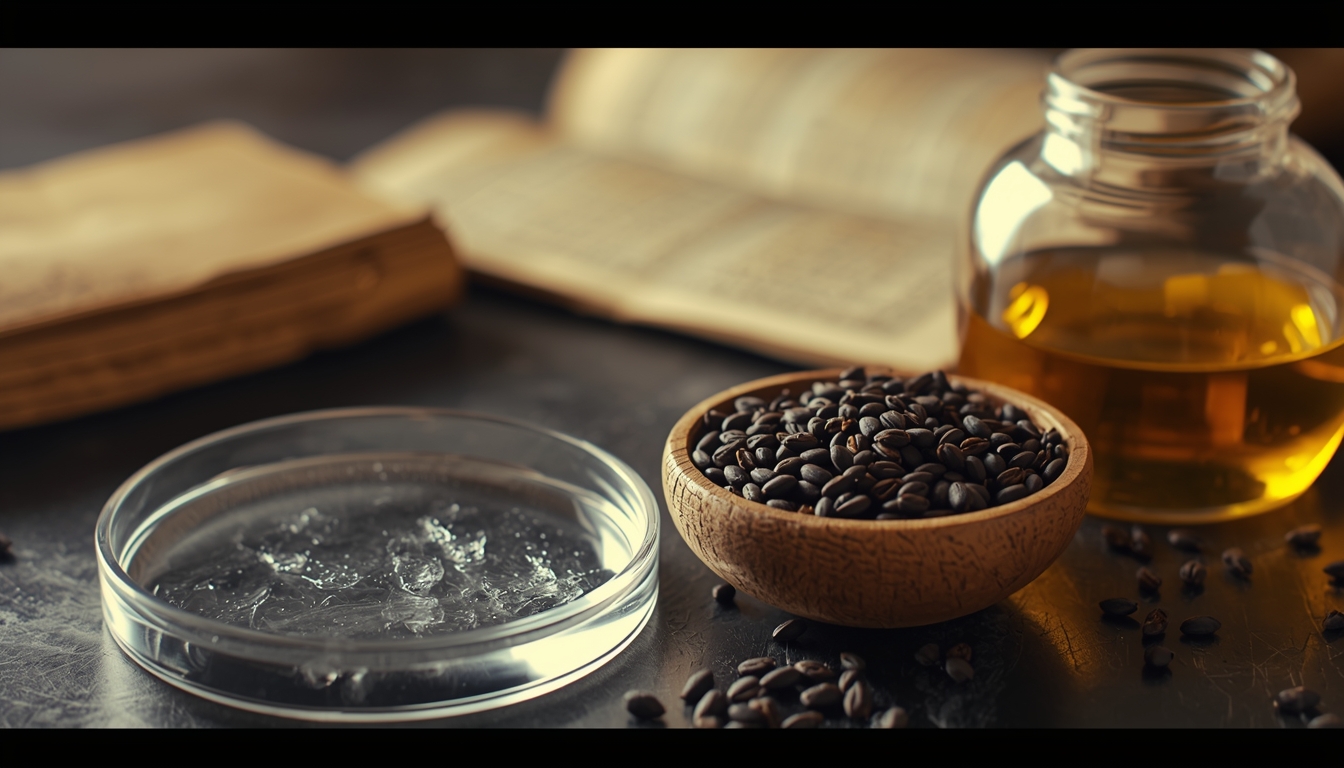
The Prophetic Medicine in Islam frequently mentions specific natural substances, most notably Nigella sativa (Black Seed) and honey. The Prophet described the black seed as a “cure for every disease except death.” While skeptics might see this as hyperbole, modern pharmacological research is beginning to uncover the staggering breadth of this plant’s utility.
Chemical analysis reveals that Black Seed contains Thymoquinone, a compound with potent anti-inflammatory, antioxidant, and anti-cancer properties, as reviewed in Nature’s scientific reports on Nigella sativa. Similarly, the Quran describes honey as having “healing for mankind.” Modern wound care often utilizes “medical-grade honey” for its antibacterial properties. This is a primary example of how the Scientific Miracles of the Quran and the Sunnah provide a natural pharmacy that is only now being fully understood by 21st-century science.
5. The Psychosomatic Connection: Prayer and Mental Health
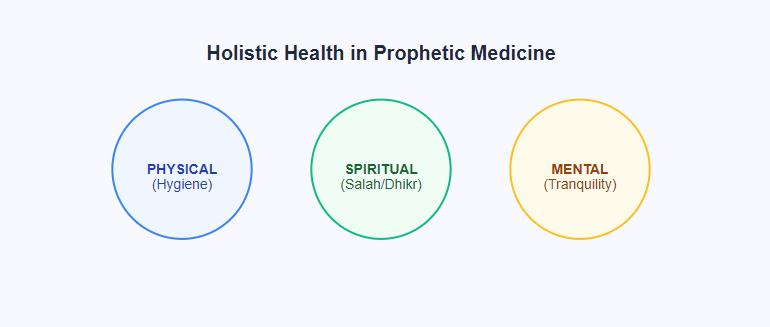
Prophetic Medicine does not separate the mind from the body. It recognizes that spiritual distress often manifests as physical illness. One of the most profound realities of Prophetic Medicine in Islam is the use of Dhikr (remembrance of Allah) and Salah (prayer) as therapeutic tools.
Logically, the rhythmic movements of prayer combined with focused meditation (Khushu’) act as a powerful stress-reduction mechanism. In modern psychology, this is known as “Mindfulness-Based Stress Reduction” (MBSR). By connecting the human soul to its Creator, who is established over His Throne, the believer achieves a state of “Sakinah” (tranquility). This psychological resilience is a recurring theme in the Sincerity of Prophet Muhammad, whose character remained unshakeable despite extreme external stressors.
6. Oral Hygiene: The Logic of the Miswak
Centuries before the mass production of toothbrushes and fluoride paste, Prophetic Medicine in Islam mandated the use of the Miswak (a twig from the Salvadora persica tree). The Prophet stated that if it were not for making things difficult for his followers, he would have commanded them to use the Miswak before every prayer.
Logically, this emphasized oral hygiene as a continuous daily habit. Modern dentistry has analyzed the Miswak and found that it contains natural silica, tannins, and resins that inhibit plaque formation and act as a natural antibiotic. This early dental care system is a testament to the Authenticity of the Quran and the wisdom of the messenger who conveyed it, ensuring that his community remained healthy and productive.
7. The Ethical Treatment of the Sick and the “Right to Cure”
Finally, Prophetic Medicine in Islam introduced a revolutionary ethical concept: the obligation to seek medical treatment. He taught: “Allah has not sent down a disease except that He has also sent down its cure.”
This logical statement removed the fatalistic notion that being sick was a “punishment” one must simply endure. It encouraged the pursuit of medical research, leading to the Islamic Golden Age of Science, where the first public hospitals were built. By framing health as a gift from Allah that must be preserved, Prophetic Medicine in Islam created a culture where the doctor is a servant of the Divine plan and the patient has a right to dignified care.
Conclusion: A Holistic Vision of Humanity
The study of Prophetic Medicine in Islam reveals a worldview where there is no conflict between faith and biological reality. It is a system that respects the laws of nature—created by Allah, the Most High—while acknowledging that ultimate healing comes from Him. Whether it is the logic of quarantine, the chemistry of natural cures, or the psychology of prayer, the Tibb al-Nabawi offers a timeless guide for human flourishing.
For the skeptical mind, these scientific and logical intersections are “Signs” of the divine origin of Muhammad’s message. Islam provides a comprehensive map for life, ensuring that the body is maintained, the mind is centered, and the soul is connected to its Source. By embracing the principles of Prophetic Medicine in Islam, we find a path to health that is as logically sound today as it was fourteen centuries ago.














Leave a Reply