

This research paper is part of Truth Clearly’s commitment to providing an authentic Islamic perspective on theology and history. We adhere to rigorous academic standards, relying exclusively on the Quran, authentic Prophetic traditions, and verified historical sources to provide clarity for the rational seeker.
For the skeptical Western reader, the academic researcher, or the sincere seeker of truth, the continuity of the Abrahamic prophetic chain is a subject of immense fascination. A central question often arises: “If God sends messengers in a sequence to guide humanity, did the previous scriptures—the Torah and the Gospel—foretell the coming of the final Messenger?”
The search for Prophet Muhammad in the Bible is not an attempt to force a new narrative onto ancient texts; rather, it is a rigorous logical and linguistic inquiry into the specific descriptions, geographical markers, and linguistic roots preserved within the biblical record for millennia.
In the Islamic worldview, we recognize Allah as the unique Creator who is High above His Heavens and established over His Throne. He spoke the Quran as His literal and uncreated Speech, and in this revelation, He affirms that the coming of Muhammad was mentioned in the previous scriptures: “Those who follow the Messenger, the unlettered prophet, whom they find written in what they have of the Torah and the Gospel” (Quran 7:157).
Finding Prophet Muhammad in the Bible is the act of recognizing a “Divine Handover” from one prophet to the next. This article explores seven profound logical proofs that demonstrate the biblical anticipation of the final Prophet.
Table of Contents
1. The Prophet Like Unto Moses: Deuteronomy 18:18
The primary logical pillar in the study of Prophet Muhammad in the Bible is found in the Book of Deuteronomy. In this passage, God speaks to Moses regarding a future messenger:
“I will raise up for them a Prophet like you from among their brethren, and will put My words in his mouth; and he shall speak unto them all that I shall command him.” (View Deuteronomy 18:18 on BibleHub).
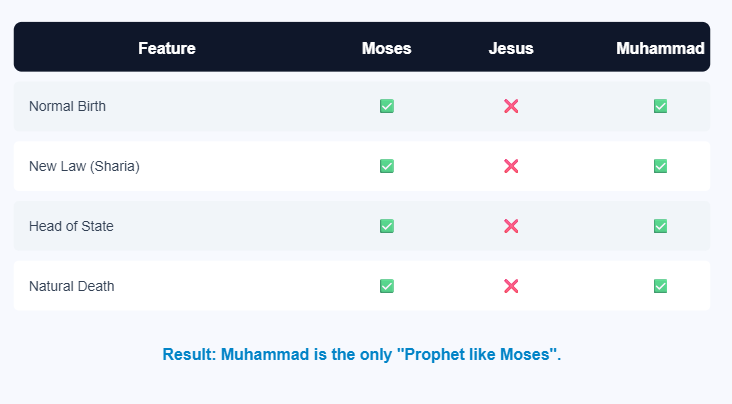
Traditional Christian exegesis often interprets this figure as Jesus. However, a rigorous comparative analysis reveals that Muhammad fits this specific profile far more accurately than any other figure.
- Birth: Moses and Muhammad were born naturally to a father and mother. Jesus was born miraculously without a father.
- Family Life: Moses and Muhammad married and had children. Jesus remained unmarried.
- Governance: Moses and Muhammad were both prophets and political leaders who brought a comprehensive Law. As we explored in Muhammad as a Leader, he established a state based on justice. Jesus famously stated, “My kingdom is not of this world.”
- Brethren: The text specifies “from among their brethren.” In the context of the descendants of Abraham, the brethren of the Israelites (descendants of Isaac) are the Ishmaelites (descendants of Ishmael). Muhammad arose from the lineage of Ishmael, fulfilling this requirement.
2. The Linguistic Mystery: Song of Solomon 5:16
A profound reality for researchers investigating Prophet Muhammad in the Bible is found in the original Hebrew text of the Song of Solomon. In the English translation, the verse describes a beloved figure: “His mouth is most sweet: yea, he is altogether lovely.”
However, in the original Hebrew, the word translated as “altogether lovely” is “Mahammadim” (מַחֲמַדִּים).
- The root word is Mahammad (M-H-M-D).
- The suffix -im in Hebrew is the pluralis majestatis (plural of respect), used for high-ranking names such as Elohim.
Logically, when this verse is recited in Hebrew, the name of the Prophet of Islam is heard clearly. While translators have historically treated this as a common adjective, the presence of the exact root name in a prophetic song about a “beloved” messenger provides a staggering linguistic link. This linguistic precision is a hallmark of the Authenticity of the Quran which claims that the previous people of the book recognized him as they recognized their own sons.
3. The Servant in Kedar: Isaiah 42
The Book of Isaiah contains a detailed prophecy regarding a “Servant of the Lord” who will bring justice to the nations. The geographical markers in this chapter are essential for identifying Prophet Muhammad in the Bible.
The text states: “Let the wilderness and its towns raise their voices; let the settlements where Kedar lives rejoice. Let the people of Sela sing for joy…” (Isaiah 42:11).
- Kedar: According to the Bible (Genesis 25:13), Kedar was the second son of Ishmael. Historically, the “land of Kedar” refers to the Arabian Peninsula.
- Sela: This is the name of a famous mountain in the city of Medina (the destination of Muhammad’s migration).
Logically, why would a biblical prophecy specify the descendants of Ishmael (Kedar) and a mountain in Medina (Sela) unless it was predicting a messenger arising from that specific location? This geographical accuracy matches the Hagar’s Journey narrative, proving that Makkah and Medina were the destined centers of the final prophecy.
4. The Paraclete of the Gospel of John
In the New Testament, the most prominent evidence for Prophet Muhammad in the Bible comes from the lips of Jesus in Islam. In the Gospel of John, Jesus promises the arrival of a figure called the Parakletos (Advocate or Comforter).
Jesus stated: “But when he, the Spirit of Truth, is come, he will guide you into all truth: for he shall not speak of himself; but whatsoever he shall hear, that shall he speak…” (John 16:13).
Logically, the description “he shall not speak of himself; but whatsoever he shall hear, that shall he speak” perfectly describes the mechanism of the Quranic revelation. Muhammad did not author the text; he recited the literal and uncreated Speech of Allah exactly as he heard it from the Angel Gabriel.
Unlike the “Holy Spirit,” which is described as a non-material entity, the Paraclete is described as a human-like messenger who “guides into all truth”—referring to the completion of the divine law in Sharia Law in Islam.
5. The Glory from Mount Paran: Habakkuk 3:3
Another fascinating geographical marker of Prophet Muhammad in the Bible appears in the Book of Habakkuk: “God came from Teman, the Holy One from Mount Paran. His glory covered the heavens and his praise filled the earth.” (Habakkuk 3:3).
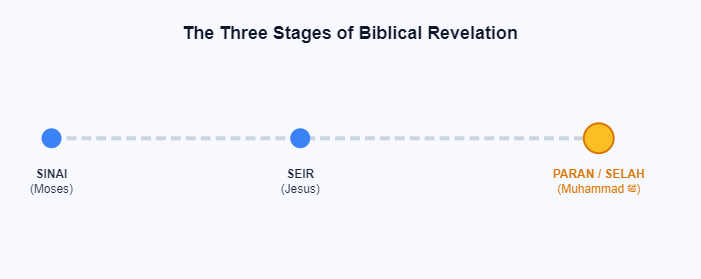
In the Bible, Mount Paran is the location where Ishmael and Hagar settled (Genesis 21:21). Islamic and historical geography identify Paran as the mountainous region around Makkah. Logically, the three major revelations of the Abrahamic tradition are often linked to three mountains: Sinai (Moses), Seir (Jesus), and Paran (Muhammad).
The name Muhammad itself means “The Praised One,” directly echoing the prophecy that “his praise filled the earth.” This consistency across multiple books of the Bible reinforces the Concept of Prophethood as a unified and planned divine effort.
6. The 10,000 Holy Ones: Deuteronomy 33:2
Deuteronomy 33:2 provides a majestic timeline of revelation: “The Lord came from Sinai and dawned over them from Seir; he shone forth from Mount Paran. He came with myriads of holy ones (10,000)…”
Logically, this verse tracks the progression of divine law. “Sinai” represents the Torah given to Moses. “Seir” represents the message of Jesus. “Paran” represents the final message given in Makkah. The specific mention of “10,000 holy ones” is a historical miracle; when Prophet Muhammad liberated Makkah, he was accompanied by exactly 10,000 companions.
This precise numerical and geographical alignment is a primary proof for the Sincerity of Prophet Muhammad and his mission to restore the Worship in Islam.
7. Historical Proof: The Jewish Tribes in Medina
To the skeptical researcher, the most objective “external” evidence for Prophet Muhammad in the Bible is the presence of influential Jewish tribes (such as Banu Nadir and Banu Qurayza) in the city of Medina in the 7th century.
Logically, why would learned Jewish scholars leave the fertile lands of Palestine to live in a harsh Arabian desert? Historical records indicate that they migrated to the “Land of Kedar” specifically because they were waiting for a prophet predicted in their scriptures. When Muhammad arrived, many rabbis recognized him by the physical and textual signs mentioned in the Torah.
This historical “wait” proves that the anticipation of a final prophet in Arabia was a well-established theological reality before the birth of Islam. It answers the Why Islam question by showing it was the only possible fulfillment of ancient promises.
Conclusion: A Unified Divine Narrative
The scholarly inquiry into Prophet Muhammad in the Bible leads to a profound rational verdict: Islam is not a “new” or isolated religion, but the final, logical, and predicted chapter of a single divine message. By analyzing the “Prophet like Moses,” the Hebrew name “Mahammadim,” and the geographical precision of “Paran and Kedar,” the rational mind finds an unshakeable consistency.
For the skeptical mind, these prophecies are invitations to reflect on the Concept of God in Islam as the Sovereign Director of history.
The “Truth Clearly” is that the same God who spoke to the ancient patriarchs is the same God who preserved the final revelation. By recognizing the biblical anticipation of Muhammad, the seeker finds a bridge of light that connects the past, the present, and the ultimate destination of the human soul.









Leave a Reply