

This research paper explores the historical development of early Christian doctrines. Our goal is not to disparage, but to offer a respectful, evidence-based Islamic perspective on how theological concepts evolved, encouraging peaceful intellectual dialogue.
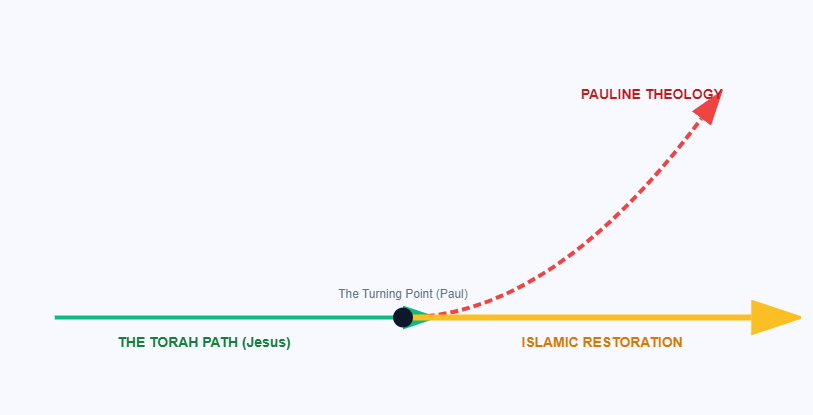
In the modern study of Christian origins and New Testament criticism, a striking historical tension has emerged that challenges the traditional foundations of Western theology. This tension is often summarized as Paul vs. Jesus. For the skeptical Western reader, the academic historian, or the seeker of religious clarity, the discrepancy between the simple, monotheistic message of Jesus of Nazareth and the complex, sacrificial theology of Paul of Tarsus is unavoidable. While the Church presents a unified narrative, many scholars argue that the religion about Jesus (Pauline Christianity) fundamentally replaced the religion of Jesus (Primitive Judeo-Christianity).
In the Islamic worldview, this historical divergence is not a surprise, but a confirmed reality. Islam positions itself as the final and perfected guardian of the prophetic legacy. We recognize Allah as the unique Creator who is High above His Heavens and distinct from His creation. He revealed the Injil (Gospel) to Prophet Isa (Jesus) as a direct, uncreated Speech to guide the Children of Israel. However, as the message traveled into the Greco-Roman world through Paul, it underwent an intellectual and ontological transformation. This article explores five profound logical reasons why Islam—through its unshakeable monotheism and preserved texts—is the only tradition that successfully preserves the true mission and message of the Messiah.
Table of Contents
1. Absolute Monotheism vs. The Deification of the Messenger
The primary logical pillar in the Paul vs. Jesus debate is the nature of the Creator. Jesus of Nazareth, as depicted even in the Synoptic Gospels, was a Jewish prophet who strictly adhered to the Shema: “Hear, O Israel, the Lord our God, the Lord is One.” His message was a call to return to the pure worship of Allah, the Most High, who has no partners or equals.
Logically, Jesus never claimed divinity; he identified himself as a “man who has told you the truth which I heard from God” (John 8:40). However, the theology of Paul introduced the concept of the “Pre-existent Christ” and the “Son of God” in a literal, ontological sense. This shift moved the focus from the Message to the Messenger. As we explored in the Concept of God in Islam, Islamic logic maintains an absolute distinction between the Creator and the created. By affirming that Jesus in Islam is a majestic but mortal servant (Abd), Islam preserves the unclouded monotheism that Jesus himself practiced and preached, rejecting the Hellenistic deification introduced by Paul.
2. The Law of Moses vs. The Doctrine of Grace
A central point of conflict in Paul vs. Jesus is the role of the Law (Torah). Jesus was a faithful follower of the Mosaic Law; he stated that he came “not to abolish the Law but to fulfill it” and that not a single “jot or tittle” would pass from the Law. He lived and died within the legal and ethical framework of his ancestors.
Paul, however, radically declared the Law to be a “curse” and argued that “Christ is the end of the law” (Romans 10:4). Logically, this creates a fundamental rupture in the Abrahamic chain. Why would a Creator send thousands of years of legal guidance only to declare it obsolete through a secondary follower? Islam restores the logical continuity of the prophetic office. While Islam acknowledges that some specific legalistic burdens were eased through Jesus, it maintains that the core Sharia Law in Islam is a necessary extension of the Mosaic tradition. By integrating Law and Spirit, Islam sides with the historical practice of Jesus over the anti-law theology of Paul.
3. Original Purity (Fitrah) vs. Inherited Original Sin
The logical framework of Paul vs. Jesus is most evident in the definition of the human condition. The entire Pauline system is built upon the doctrine of “Original Sin”—the belief that all humans are born “children of wrath” due to Adam’s fall. This necessitated a “Blood Sacrifice” to reconcile humanity with a frustrated deity.
Islam provides a more rational and compassionate alternative through the concept of the Fitrah. As we discussed in Salvation in Islam vs. Christianity, Islam teaches that every child is born pure and innocent. Allah, the All-Merciful, forgave Adam directly when he repented. Logically, a Just Creator does not hold an infant responsible for an ancestor’s error. By rejecting the Pauline notion of inherited guilt, Islam preserves the dignity of the human soul and the absolute Logic of Suffering and Trial. It aligns with Jesus’s own teachings of personal repentance and the Father’s direct forgiveness, rendering the Pauline “sacrifice” logically unnecessary.
4. The Direct Relationship: Rejection of Intermediaries
A profound reality in the Paul vs. Jesus discourse is the mechanism of prayer and connection. Jesus taught his disciples a direct form of communication: “Our Father… forgive us our debts as we forgive our debtors.” There was no requirement to pray through Jesus or to believe in his blood as a prerequisite for the Creator’s ear.
Pauline theology, however, positioned Jesus as the “Sole Mediator,” without whom no one can reach God. This eventually led to the development of a complex priestly hierarchy in the Church. The Islamic perspective—grounded in Worship in Islam—restores the unmediated “hotline” between the servant and the Creator. In Islam, every human has direct access to Allah, who is High above His Heavens and knows the secrets of the hearts. By removing the Pauline “Brokerage,” Islam honors the original spirit of Jesus’s ministry, which sought to bring the common person into a direct, loving relationship with the Lord of the Worlds.
5. Scriptural Integrity: The Corrective Nature of the Quran
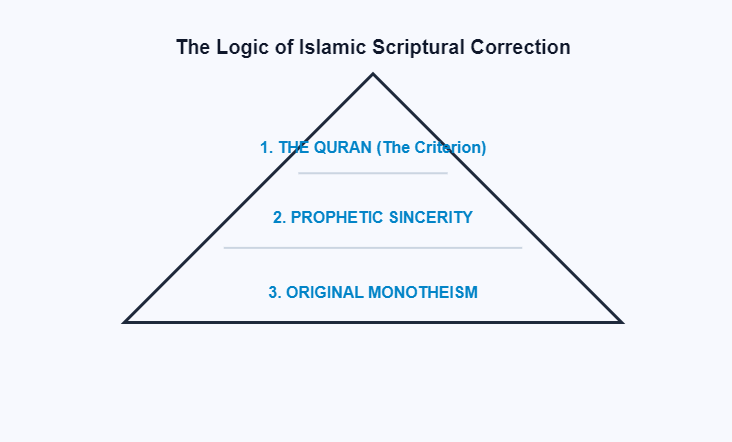
The final logical reason why Islam preserves the Messiah’s message in the Paul vs. Jesus debate is the presence of a “Criterion” (Furqan). For the skeptical researcher, the problem with Pauline Christianity is that Paul’s letters were written before the four Gospels, meaning his theology influenced the writing of the life of Jesus. As documented by Britannica’s analysis of St. Paul, he had a significant role in “shaping the Church’s understanding” of Jesus.
Logically, if the primary records are influenced by a secondary figure’s theological bias, we need an external, preserved reference point to identify the original truth. The Quran fulfills this role. As the literal and uncreated Speech of Allah, the Quran acts as a divine corrective to the “interpretative drift” of the centuries. The Preservation of the Bible and Quran dialogue proves that while previous scriptures were subject to human handling, the Quran remains the unchangeable standard. By correcting the Pauline deviations, the Quran allows the rational mind to rediscover the true Prophet Isa—the herald of Prophet Muhammad.
Conclusion: Reclaiming the Prophetic Path
The scholarly investigation into Paul vs. Jesus leads to an inescapable logical verdict: the theology of the modern Church is more a product of Paul’s Hellenistic vision than of Jesus’s Hebrew mission. By introducing the deification of man, the abolition of the Law, and the doctrine of inherited sin, Pauline Christianity moved humanity away from the pure, rational monotheism of the patriarchs.
Islam, through its unshakeable commitment to Tawhid and its preserved revelation, serves as the ultimate rescue mission for the message of Jesus. It restores him to his rightful place as a mighty messenger of Allah, a teacher of Objective Morality, and a sign of the Day of Judgment. For the skeptical mind searching for the “Historical Jesus,” the answer is found in the “Quranic Jesus.” By embracing the Why Islam answer, one finds that the truth has been clearly preserved—not in the complex mysteries of the councils, but in the brilliant, logical light of the Final Revelation.














Leave a Reply