
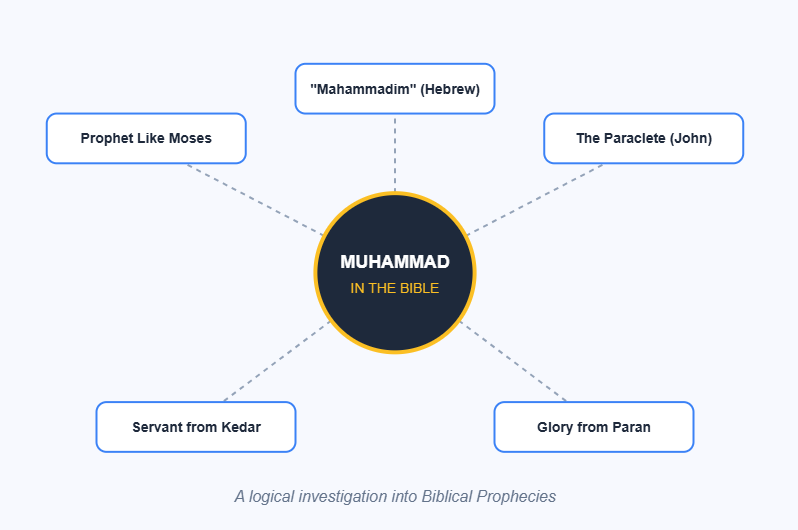
For centuries, theologians and historians have debated the continuity and evolution of the Abrahamic faiths. For the skeptical Western reader, seeing Islam not as a rival to Christianity and Judaism, but as their logical and final continuation, requires a significant shift in perspective. A central question arises in this theological journey: If God sends prophets in a continuous chain to guide humanity, did the previous scriptures—the Torah and the Gospel—foretell the coming of the final messenger?
The search for Muhammad in the Bible is often dismissed by mainstream modern apologetics as a forced interpretation. However, when we strip away centuries of translation choices and return to the original Hebrew and Greek linguistic roots, startling evidence begins to emerge. Exploring the claim of Muhammad in the Bible is not about forcing a narrative; it is about recognizing historical, geographical, and textual facts that have been preserved within the scriptures for millennia.
This article invites you to an academic and rational investigation. We will not rely on blind assertions or emotional appeals, but on rigorous linguistic analysis, historical geography, and comparative theology to explore the profound and logical proofs of Muhammad in the Bible.
Table of Contents
1. The Logic of Prophetic Succession: Why a Final Messenger?
Before diving into specific verses, we must establish the logical framework of prophetic succession. The biblical narrative is not a collection of isolated stories but a single, unfolding drama of progressive revelation. God sends messengers to guide humanity as society evolves and faces new moral and social challenges.
- Abraham established the foundation of absolute Monotheism.
- Moses brought the detailed Law (Torah) to structure a nation.
- Jesus brought the Spirit of the Law to reform the hardened hearts of the Children of Israel.
From an Islamic perspective, the chain did not end with Jesus. As humanity moved toward a more globalized era, there was a logical need for a final, universal law—one that combined the legal rigor of Moses with the spiritual depth of Jesus. Finding Muhammad in the Bible is simply the act of recognizing the “profile” of a prophet who fits the description of this final “Seal of the Prophets.”
If the Authenticity of the Quran (read more about the Quran’s authenticity) is accepted as a divine message, then it must logically be the fulfillment of the previous promises made to the patriarchs.
2. Deuteronomy 18:18: The Definitive Evidence for Muhammad in the Bible
One of the most foundational and frequently cited arguments for Muhammad in the Bible is found in the Old Testament, specifically in the Book of Deuteronomy. In this text, God speaks directly to Moses regarding a future messenger:
“I will raise up for them a prophet like you from among their fellow Israelites (brethren), and I will put my words in his mouth. He will tell them everything I command him.” (View Deuteronomy 18:18 on Bible Gateway).
Traditional Christian exegesis interprets this “Prophet like Moses” as Jesus. However, when we apply a rigid comparative and historical analysis, the case for Muhammad in the Bible becomes far more logically consistent.
A Comparative Profile: Moses, Jesus, and Muhammad
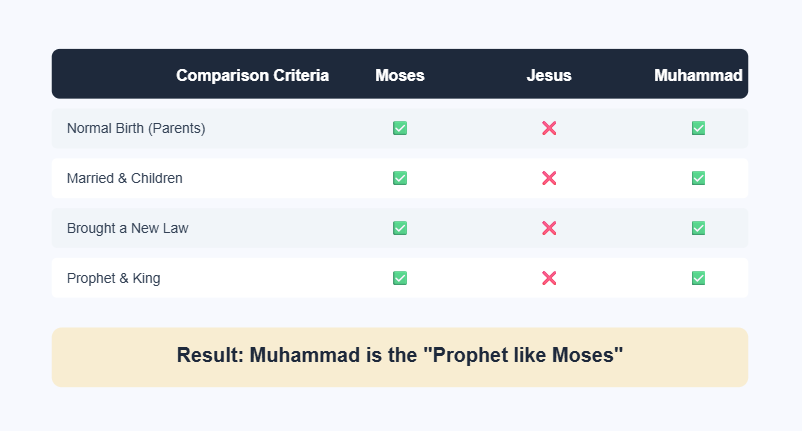
When God says “A Prophet like you (Moses),” we must look at the biographical and functional similarities.
- Birth: Moses and Muhammad were born through natural biological processes to a father and mother. Jesus, as we discussed in the Islamic view on Jesus, was born miraculously through a virgin birth without a human father.
- Marriage and Procreation: Moses and Muhammad married and had children. Jesus remained celibate and had no offspring.
- Nature of Prophethood: Moses and Muhammad were both prophets and political heads of state. They governed their people with a civil and criminal legal code. Jesus famously declared, “My kingdom is not of this world,” focusing primarily on spiritual reform rather than statecraft.
- The Law: Moses brought a new Law (The Torah). Muhammad brought a new Law (The Quran). Jesus explicitly stated he came to “fulfill the Law” of Moses, not to replace it with a new legal system.
- Death: Moses and Muhammad died natural deaths and were buried in the earth. Jesus (according to Christian belief) was crucified and ascended.
Furthermore, the phrase “from among their brethren” is critical. In the context of the descendants of Abraham, the brethren of the Israelites (descendants of Isaac) are the Ishmaelites (descendants of Ishmael). Since Muhammad arose from the lineage of Ishmael, he is the only figure who perfectly fits the criteria of being a “brother” to the Israelites and being “like Moses.” This remains a cornerstone proof for Muhammad in the Bible.
3. Song of Solomon 5:16: Muhammad in the Bible’s Linguistic Mystery
For scholars and linguists looking into the original manuscripts, one of the most startling discoveries of Muhammad in the Bible is hidden in the Hebrew text of the Song of Solomon.
In the English King James Version, the verse describes a beloved figure: “His mouth is most sweet: yea, he is altogether lovely.” While this sounds like a romantic or metaphorical description, the original Hebrew tells a different story. The Hebrew word translated as “altogether lovely” is “Mahammadim” (מַחֲמַדִּים).
- The root word is Mahammad (M-H-M-D).
- The suffix -im in Hebrew is the pluralis majestatis (plural of respect), used for high-ranking names like Elohim (God).
When you listen to the verse recited in its original Hebrew tongue, the name is unmistakably clear: “Hikko Mamittakim we kullo Mahammadim…”
Translators have historically treated this as a common noun (lovely/desirable) rather than a proper noun (Muhammad). However, in many ancient prophecies, names are often translated into meanings to obscure the identity of the person being prophesied. The presence of the exact root name is a powerful, albeit often overlooked, piece of evidence for Muhammad in the Bible.
4. Isaiah 42: The Servant from Kedar and Mount Sela
The Book of Isaiah is filled with messianic expectations, but Chapter 42 contains geographical markers that can only point to the Arabian Peninsula, making it a vital chapter for identifying Muhammad in the Bible.
The chapter describes a “Servant of the Lord” who will bring a law to the gentiles and “not fail or be discouraged” until he has established justice on earth. The specific location is given in verse 11:
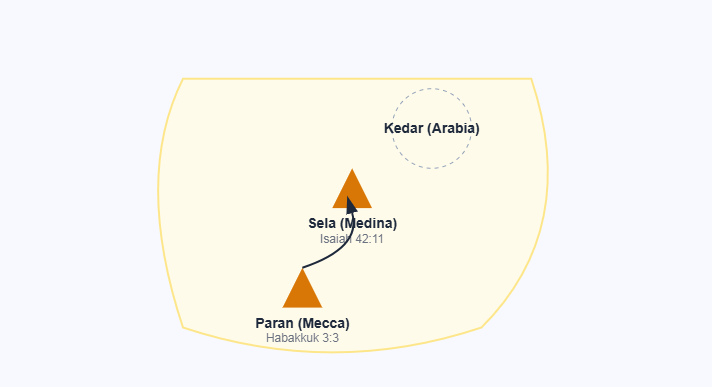
“Let the wilderness and its towns raise their voices; let the settlements where Kedar lives rejoice. Let the people of Sela sing for joy; let them shout from the mountaintops.” (Isaiah 42:11).
Decoding the Geography of Arabia
- Kedar: According to Genesis 25:13, Kedar was the second son of Ishmael. Historically and biblically, the “descendants of Kedar” refers to the nomadic tribes of North and Central Arabia. Muhammad is the most famous descendant of Kedar in history.
- Sela: This is not a generic term. Mount Sela is a famous mountain located in the city of Medina (formerly Yathrib). It was at the foot of Mount Sela that the Prophet Muhammad and his companions fought the Battle of the Trench.
Why would the Bible mention Kedar (Arabia) and Sela (Medina) in the context of a “New Song” (a new revelation) and a “Servant” who brings justice to the nations? The geographical precision here is an undeniable link to the life of the Prophet, solidifying the theme of Muhammad in the Bible.
5. Habakkuk 3:3: The Glory from Mount Paran
Another fascinating, yet often ignored, geographical prophecy of Muhammad in the Bible appears in the Book of Habakkuk. It describes the coming of a holy one from a specific location:
“God came from Teman, the Holy One from Mount Paran. His glory covered the heavens and his praise filled the earth.” (Habakkuk 3:3).
Where is Mount Paran?
In the Bible, Mount Paran is the place where Ishmael (the ancestor of Muhammad) settled after leaving his father Abraham. Genesis 21:21 states, “He dwelt in the Wilderness of Paran.”
Islamic and historical geography identify Paran as the mountainous region around Mecca. Moses came from Sinai, Jesus came from Seir (Bethlehem/Nazareth), but who came from Paran with a “praise that filled the earth”? The very name Muhammad means “the praised one.” This prophecy beautifully connects the three great Abrahamic revelations (Sinai, Seir, and Paran), confirming the role of Muhammad in the Bible as the final piece of the puzzle.
6. The Paraclete of John 14 & 16: Muhammad in the Bible as the Final Guide
In the New Testament, the most prominent evidence for Muhammad in the Bible comes from the lips of Jesus himself. In the Gospel of John, Jesus promises the arrival of a figure called the Paraclete (often translated as Comforter, Advocate, or Helper).
“And I will ask the Father, and he will give you another Advocate (Paraclete) to help you and be with you forever.” (John 14:16).
“But when he, the Spirit of Truth, comes, he will guide you into all the truth. He will not speak on his own; he will speak only what he hears…” (John 16:13).
Why the “Holy Spirit” Interpretation Faces Logical Hurdles
While mainstream Christianity identifies the Paraclete as the Holy Spirit, several logical inconsistencies arise from this view:
- The Condition of Departure: Jesus said, “Unless I go away, the Advocate will not come to you.” (John 16:7). The Holy Spirit was already present on earth—it was with John the Baptist in the womb and with Jesus at his baptism. Why would Jesus have to leave for the Holy Spirit to arrive?
- Auditory Revelation: The text says the Paraclete “will not speak on his own; he will speak only what he hears.” This describes an auditory reception of revelation and its subsequent oral delivery. This is the exact definition of how the Quran was revealed—Prophet Muhammad heard the words from the Angel Gabriel and recited exactly what he heard.
Furthermore, some scholars suggest that the original Greek word was not Parakletos (Advocate) but Periklytos (The Praised One). In Arabic, the name Ahmad (another name for Muhammad) literally means “The Praised One.” This linguistic connection provides an incredible bridge for understanding Muhammad in the Bible.
7. Historical Context: Why Were Jews Waiting in the Arabian Desert?
To the skeptical reader, perhaps the most objective “external” proof of Muhammad in the Bible is a historical fact: the presence of large, influential Jewish tribes in the city of Medina (Yathrib) in the 7th century.
Tribes like the Banu Qurayza and Banu Nadir were not indigenous to the Arabian desert. Why did these learned Jewish scholars leave the fertile lands of Palestine and Syria to live in a harsh, volcanic desert?
Historical records and Islamic traditions indicate that they migrated there specifically because their scriptures—the Torah—prophesied that a final prophet would arise in the “land of Kedar” near “Mount Sela.” They were waiting for him. When Muhammad arrived, many Jewish rabbis, such as Abdullah ibn Salam, recognized him immediately from the descriptions in their books and accepted his message.
8. Conclusion: The Unified Divine Plan of Muhammad in the Bible
The presence of Muhammad in the Bible is not a modern invention but a deeply rooted theological reality. It shows that Islam is not a “new” religion that appeared in a vacuum, but the final, logical chapter of the same divine plan that began with Abraham, Moses, and Jesus.
When we combine the “Prophet like Moses” in Deuteronomy, the Hebrew “Mahammadim” in Solomon, the “Kedar and Sela” geography in Isaiah, and the “Paraclete” in the Gospel of John, the image becomes undeniable. For the open-minded and skeptical seeker, the data points to a unified truth.
Understanding Muhammad in the Bible allows us to see the Abrahamic faiths not as warring factions, but as a single, beautiful staircase leading humanity toward the worship of the One Creator, as structured by the Five Pillars of Faith.
Leave a Reply