
This research paper is part of Truth Clearly’s commitment to providing an authentic Islamic perspective on theology and history. We adhere to rigorous academic standards, relying exclusively on the Quran, authentic Prophetic traditions, and verified historical sources to provide clarity for the rational seeker.
In the study of world history and political science, the rapid emergence of Islamic civilization in the 7th century remains one of the most remarkable phenomena ever recorded. Within just 23 years, a single man transformed the Arabian Peninsula—a fragmented, tribal, and war-torn desert—into a unified global power that would eventually lead the world in science, law, and ethics. Analyzing Muhammad as a Leader reveals a model of governance and social reform that was not only revolutionary for its time but remains a gold standard for leadership today.
From the Sunni Athari perspective, the success of Muhammad (peace be upon him) was not merely the result of a brilliant tactical mind; it was the direct outcome of divine guidance. As a mortal messenger carrying the literal Speech of Allah, who is established over His Throne, his leadership was an application of the Authenticity of the Quran. This article explores seven revolutionary realities of Muhammad as a Leader, demonstrating how his logical approach to justice and human dignity changed the course of history.
Table of Contents
1. The Dismantling of Tribalism: The Pact of Medina
Before Islam, Arabian society was ruled by “Asabiyyah” (blind tribalism). Justice was determined by one’s lineage, and blood feuds lasted for generations. The first revolutionary act of Muhammad as a Leader upon arriving in Medina was the drafting of the “Constitution of Medina.”
Logically, this was the world’s first inclusive legal framework for a multi-religious state. It unified disparate tribes—including Muslims, Jews, and pagans—into a single political entity (the Ummah). For the first time, the “Rule of Law” replaced the “Rule of the Tribe.” Justice was anchored in accountability to the Creator rather than kinship. This laid the foundation for Islam and Human Rights by recognizing the legal rights of individuals regardless of their tribe.

2. Economic Justice: The Institutionalization of Zakat
The pre-Islamic economy was dominated by usury (Riba) and the exploitation of the poor by the elite. As a leader, Muhammad understood that spiritual reform must be accompanied by economic reform. He prohibited usury and established Zakat (obligatory charity) as a state institution.
As explored in the 5 Pillars of Islamic Faith, Zakat was not a voluntary favor; it was a right of the poor over the wealth of the rich. Logically, by taxing stagnant wealth rather than productivity, Muhammad as a Leader encouraged investment and trade while providing a social safety net for widows and orphans. This economic model ensured that wealth circulated through all levels of society rather than being hoarded by a few.
3. The Meritocratic Revolution: Character over Nobility
In a world where power was a birthright, Muhammad introduced a radical meritocracy. He appointed leaders based on their competence and piety (Taqwa) rather than their social standing.
A famous example of his leadership was appointing Bilal ibn Rabah, a former Abyssinian slave, as the chief caller to prayer—a position of immense honor. He also appointed young, capable individuals like Usama ibn Zayd to lead armies over more senior tribal elders. Logically, this meritocratic shift empowered the common people and ensured that the most capable minds were leading the community. This reflects the absolute Sincerity of Prophet Muhammad, as he never sought to build a family dynasty.
4. Military Ethics: The Introduction of Just War
Critics often focus on the battles of early Islam, but a logical analysis of Muhammad as a Leader reveals a unique military ethics. Despite the constant threats he faced, the total number of casualties in all his military expeditions was incredibly low compared to the wars of Byzantium or Persia.
He established strict prohibitions that were centuries ahead of modern international law:
- Do not kill women, children, or the elderly.
- Do not destroy places of worship (churches or synagogues).
- Do not cut down trees or kill animals needlessly.
These rules transformed war from a tool of tribal vengeance into a disciplined struggle for justice. His ultimate military victory—the bloodless liberation of Mecca—remains a logical proof that his goal was the establishment of Tawhid (Monotheism) and peace, not personal power.
5. Educational Mandate: Literacy as a State Priority
In a mostly illiterate society, Muhammad as a Leader made education a mandatory pillar of social progress. After the Battle of Badr, he offered freedom to any prisoner of war who could teach ten Muslims to read and write.
This logical focus on literacy was the catalyst for the Islamic Civilization’s Contributions to Science. He understood that a nation cannot lead if it cannot read. He described the “ink of the scholar” as more sacred than the “blood of the martyr,” creating a culture of inquiry that would eventually give birth to the world’s first universities.
6. The Empowerment of the Marginalized: Women and Slaves
The status of Muhammad as a Leader is most visible in how he treated those with no voice. In a society where Women in Islam were treated as property, he granted them the right to inherit, own businesses, and choose their husbands.
Similarly, he created a legal pathway for the abolition of slavery by making manumission (freeing slaves) a primary form of expiation for sins. Logically, by giving rights to the oppressed, he built a society with an unshakeable ideological core that was far more resilient than the surrounding empires.
7. Leading by Example: The Ascetic Sovereign
The final reality of Muhammad as a Leader was his personal lifestyle. At the peak of his power, as the sovereign of the Arabian Peninsula, he continued to live in a simple mud-brick house and often slept on a palm-fiber mat.
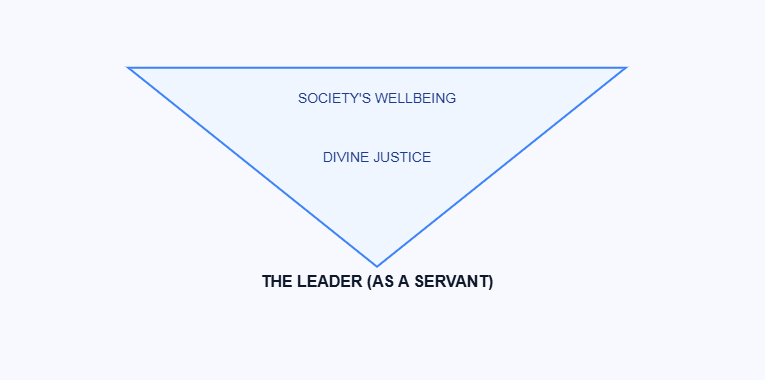
Logically, “Servant Leadership” is the most effective form of governance. His followers saw that he was the first to go hungry and the last to take his share. This lack of self-interest proved his Sincerity and made his people willing to sacrifice everything for the message of Allah. He died without leaving a single coin as inheritance, proving that he was a prophet of God, not a king of men.
Conclusion: A Model for All Ages
Analyzing Muhammad as a Leader leads to a clear rational verdict: he was a transformative force whose success was anchored in divine truth and ethical consistency. By prioritizing justice, education, and the rights of the weak, he created a civilization that would lead humanity for a thousand years.
For the skeptical mind, the Prophetic model offers a profound alternative to modern power politics. It is a model where the leader is the first servant of the One True God, the Most High, who is established over the Throne. His legacy, preserved in the Bible and Quran prophecies, remains a light for anyone seeking a just and logical world order.












Leave a Reply