

This research paper is part of Truth Clearly’s commitment to providing an authentic Islamic perspective on theology and history. We adhere to rigorous academic standards, relying exclusively on the Quran, authentic Prophetic traditions, and verified historical sources to provide clarity for the rational seeker.
In the vast and interconnected history of the Abrahamic traditions, no prophetic figure is as frequently mentioned or as deeply revered across scriptures as Moses (Musa, peace be upon him). For the skeptical Western reader, the historian, or the student of ancient texts, the study of Moses in the Quran and Bible is a journey into the very heart of the concepts of Law, Freedom, and Divine Communication. While the Bible provides a detailed historical narrative, the Quran presents Moses as a primary archetype of the struggle between Truth and Tyranny, and as the prophet who received the most direct interaction with the Creator.
In the Sunni Athari worldview, we recognize Moses as Kalimullah—the one to whom Allah spoke directly. We believe that Allah, the Most High, who is established over His Throne and is distinct from His creation, actually spoke to Moses with a literal Voice and Letters that Moses heard. This communication was not a “spiritual feeling” or a “metaphorical inspiration,” but a real event that suits the Majesty of Allah. The narrative of Moses in the Quran and Bible serves as a “Criterion” (Furqan) that confirms the previous truths and corrects the historical distortions. This article explores seven profound logical realities that define the status of Moses in Islamic theology and his relationship to the final revelation.
Table of Contents
1. The Logic of Divine Speech: Moses as Kalimullah
The primary logical and theological pillar of Moses in the Quran and Bible is the unique nature of his communication with the Divine. In Islam, Moses is uniquely honored with the title Kalimullah. The Quran is explicit: “And Allah spoke to Moses with [direct] speech” (Quran 4:164).
Logically, this establishes the Attribute of Speech (Kalam) for Allah as a reality. Unlike philosophical systems that attempt to distance God from “Action” or “Speech,” the Islamic framework asserts that the Creator who initiated the Origins of the Universe has the absolute power to speak to His chosen servants whenever He wills. This direct communication with Moses provided the legal foundation (the Torah) that governed the Children of Israel for centuries. By recognizing that Allah spoke to Moses حقيقة (literally), Islam maintains the Concept of God as an active, living Sovereign, rather than a silent, abstract force.
2. Infancy and Divine Providence: The Logic of Protection
The narrative of Moses in the Quran and Bible regarding his birth and infancy is a masterpiece of divine logic. At a time when the Pharaoh (the ultimate tyrant) was murdering newborn males, Allah inspired the mother of Moses to place her child in a basket and cast it into the Nile.
From a human perspective, this seems like certain death. However, Islamic theology uses this to demonstrate “Divine Providence.” The basket did not float toward a random citizen; it floated directly into the palace of the very man who wanted Moses dead. Logically, this shows that Allah’s decree (Qadar) is superior to human planning. It demonstrates that the Sincerity of Faith shown by Moses’s mother was the key that unlocked divine protection. This early miracle established Moses as a “Sign” before he even spoke a single word of guidance.
3. Confronting Tyranny: The Logic of Truth vs. Magic
A central theme in the study of Moses in the Quran and Bible is the confrontation with Pharaoh. The Pharaoh represented the peak of material power, claiming divinity for himself—the ultimate violation of Tawhid (Absolute Monotheism).
Moses was sent not only with a message but with “Credentials” (Miracles). The turning of his staff into a serpent and his hand glowing with white light were logical counters to the expertise of Egypt: magic. Logically, as we explored in the Miracles of Jesus in Islam, a miracle must challenge and surpass the highest human achievement of the time to be recognized as divine. When the greatest magicians of Egypt saw Moses’s staff swallow their illusions, they immediately recognized it was not magic but a “Divine Signature” from the Lord of the Worlds, the Most High. This event proved that the Authenticity of the Quran’s historical accounts is rooted in the triumph of rational truth over sophisticated deception.
4. The Burning Bush: The Logic of the Sacred Presence
When Moses approached the burning bush in the valley of Tuwa, he heard the voice of Allah. The Quran records: “O Moses, indeed I am Allah, Lord of the worlds” (Quran 28:30).
Logically, this encounter establishes the “Transcendence” and “Proximity” of Allah simultaneously. Allah is High above His Heavens, yet His Knowledge and Speech reach the created world. In the Athari perspective, we do not interpret this voice as a “hallucination” or a “metaphor.” It was a literal address from the Creator. This event provided Moses with the “Psychological Certainty” required to face the most powerful king on earth. It reminds us that Worship in Islam is based on a real relationship with a real Creator who guides His creation through the Logic of Revelation.
5. The Law and the Covenant: The Logic of Social Structure
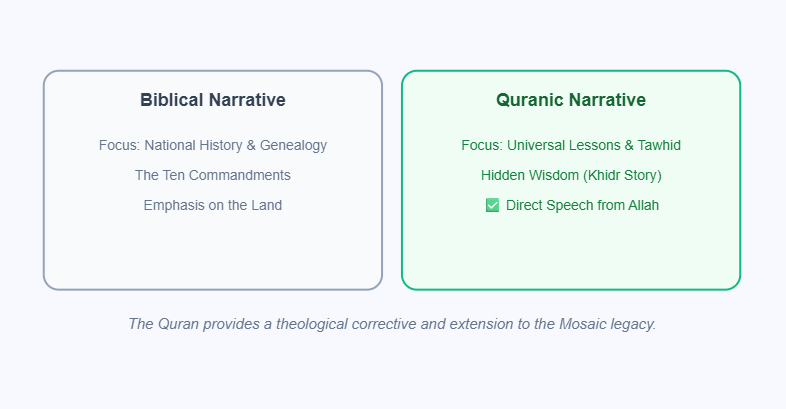
Both the Quran and Bible agree on the significance of the “Law” given to Moses. The Ten Commandments and the broader Mosaic code were designed to transform a group of liberated slaves into a disciplined nation.
Logically, freedom without law leads to chaos. The Moses in the Quran and Bible dialogue emphasizes that the “Rule of Allah” is what ensures Islam and Human Rights and social justice. The law of Moses focused on the Preservation of Life and Property, which are the core objectives of the Sharia. By anchoring the law in the command of the One who is Above the Throne, Moses ensured that justice was not a matter of human consensus but a divine mandate that applied equally to all.
6. The Odyssey of Wisdom: Moses and the Khidr (The Hidden Logic)
A unique reality found in the Quran, which is not present in the Bible, is the journey of Moses with a mysterious servant of Allah (known as Khidr). Moses, as the man of the “Law,” was challenged to understand the “Hidden Logic” of the Divine Decree.
This narrative is essential for understanding the Logic of Suffering and Trial. Khidr performed actions that seemed “evil” to Moses (scuttling a boat, killing a boy), but each act had a “macro” purpose of mercy that Moses could not see. Logically, this story teaches that human reason is limited and that Allah’s wisdom often operates beyond our immediate perception. It bridges the gap between Islam and Human Logic, reminding us that true certainty comes from trusting the Knowledge of the All-Wise Creator.
7. Moses as a Herald for the Final Prophet
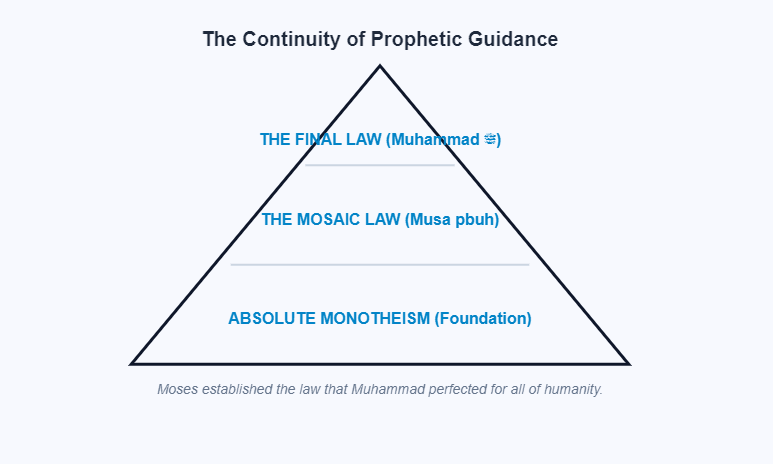
The final reality of Moses in the Quran and Bible is his role as a precursor to the “Final Revelation.” Both traditions mention a prophet like Moses arising in the future. In the Torah, God promises: “I will raise up for them a prophet like you from among their brethren” (Deuteronomy 18:18).
As we analyzed in Muhammad in the Bible Prophecies, the profile of the “Prophet like Moses” matches Muhammad more than any other historical figure. Both Moses and Muhammad were born naturally, married, brought a comprehensive law, led their people in battle, and died natural deaths. This logical continuity proves that the Preservation of the Bible and Quran was part of a unified divine plan to lead humanity toward the Why Islam answer—the final, perfected guidance.
Conclusion: The Endurance of the Mosaic Truth
The scholarly investigation into Moses in the Quran and Bible leads to a profound rational verdict: Moses was the monumental architect of the monotheistic legal tradition. By dismantling the divinity of man (Pharaoh) and establishing the divinity of the Creator (Allah), he prepared the world for the final message of Islam.
For the skeptical mind, the Islamic portrayal of Musa offers a logical clarity that respects his human vulnerability while celebrating his prophetic strength. He remains a bridge between nations and a constant reminder that the truth does not fear power—it overcomes it. In the story of Moses, we find the “Truth Clearly” revealed: that the path to freedom begins with submission to the One True God, the Most High, who is established over His Throne and hears the call of His servants in every age.











Leave a Reply