

This research paper is part of Truth Clearly’s commitment to providing an authentic Islamic perspective on theology and history. We adhere to rigorous academic standards, relying exclusively on the Quran, authentic Prophetic traditions, and verified historical sources to provide clarity for the rational seeker.
In the modern world, where the focus is primarily on material cause and effect, the religious act of supplication (Dua) is often misunderstood or dismissed as a primitive ritual. For the skeptical seeker, the agnostic researcher, or the rational observer, the question is frequently framed as a logical paradox: “If an All-Knowing Creator has already decreed the future, what is the purpose of asking Him for anything? Does prayer change the mind of the Divine?” The Logic of Supplication in Islam, however, offers a sophisticated and intellectually consistent answer that reconciles the absolute sovereignty of God with the genuine initiative of the human soul.
In the Sunni Athari worldview, we recognize Allah as the Most High, who is established over His Throne and possesses absolute Knowledge (Ilm) of all that was, is, and will be. He is the Creator of both the “End” and the “Means.” Supplication is not an attempt to inform the Creator of something He does not know, but a divine technology mandated for human spiritual, psychological, and even physical flourishing. This article explores seven profound keys to the Logic of Supplication in Islam, demonstrating how Dua is the ultimate manifestation of human reason aligning with divine mercy.
Table of Contents
1. Supplication as a Predestined Cause: The Logic of Qadar
The primary logical resolution to the paradox of prayer and predestination is the understanding that Dua is itself part of the decree (Qadar). In Islamic theology, Allah does not just decree the final outcome; He decrees the causes that lead to that outcome.
Logically, just as Allah has decreed that fire will be a cause for heat, or that eating will be a cause for satiety, He has decreed that certain blessings will reach a person only after they ask for them. The act of asking is a spiritual cause linked to a physical or metaphysical effect. Therefore, when we say “Dua changes the decree,” we mean that the decree of “No Blessing” (based on no asking) is replaced by the decree of “Blessing through Dua” (based on asking). This ensures that human initiative is a recognized force within the cosmic order, perfectly aligning with the Logic of Free Will in Islam.
2. The Logic of Ontological Recognition: Humanity’s Essential Need
From a rational standpoint, the Logic of Supplication in Islam is based on the ontological reality of the human condition. Humans are inherently dependent (Faqir), while Allah is the Self-Sufficient (As-Samad). As we explored in the Concept of God in Islam, Allah is the source of all existence.
Supplication is the highest intellectual act because it is the “Recognition of Reality.” When a human asks Allah for help, they are aligning their mind with the fundamental truth: that they are not the masters of their own fate. Logically, ignoring the Source of existence while benefiting from His creation is a form of intellectual delusion. Dua serves as a constant “reality check,” anchoring the human ego in humility and connecting it directly to the One who is High above His Heavens and distinct from His creation.
3. The Triple Response System: The Logic of Infinite Wisdom
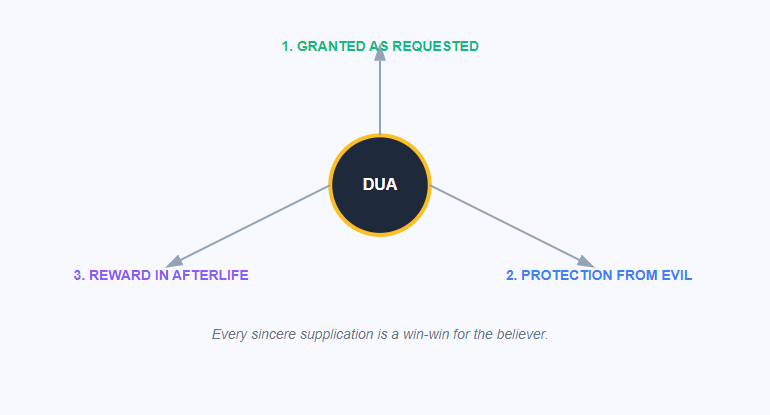
A common skeptical critique of prayer is the “unanswered request.” However, the Logic of Supplication in Islam defines “response” differently than a simple human transaction. Prophet Muhammad (peace be upon him) explained in a highly authentic tradition that Allah always responds to a sincere Dua in one of three ways:
- He grants exactly what was asked for.
- He averts a proportional evil or harm that was destined to happen to the person.
- He stores the reward and the benefit for the person in the hereafter.
Logically, if we assume that Allah is the All-Wise (Al-Hakim), then He knows what is beneficial for us better than we do. A child may ask for a sharp knife because it looks shiny; a wise parent refuses to give it out of mercy. By offering these three potential outcomes, Supplication in Islam provides a resilient psychological framework. It ensures that the believer never feels abandoned, recognizing that even a “No” from the Creator is a purposeful act of protection, consistent with the Logic of Suffering and Trial.
4. The Psychosomatic Synergy: Direct Connection and Mental Peace
Supplication is not merely a verbal exercise; it is a therapeutic event. In modern psychology, vocalizing needs and expressing hope is known to reduce cortisol levels and increase psychological resilience. The Logic of Supplication in Islam provides the most stable form of this therapy because the “Listener” is the Absolute Authority who is capable of changing reality.
When a believer speaks to Allah—who hears and sees all from His position Above the Throne—they experience Sakinah (Tranquility). Unlike speaking to another limited human, speaking to the Creator removes the fear of judgment, shame, or rejection. This direct connection is a cornerstone of Islam and Human Rights, as it establishes that every individual, regardless of status, has direct access to the highest power in existence.
5. The Logic of Persistence: Refining the Human Soul
Islam encourages “urgency” and “persistence” in Dua. Logically, why would a God who already knows our needs require us to ask repeatedly? The answer lies in the effect of persistence on the human character.
The Logic of Supplication in Islam views the time between the request and the response as a period of “spiritual training.” It teaches patience, consistency, and absolute trust (Tawakkul). If every request were granted instantly, humanity would become arrogant and demanding. By delaying the response, Allah invites the servant into a longer conversation, deepening the relationship and refining the soul’s Sincerity. The journey of asking becomes more valuable for the soul’s development than the object requested.
6. Theological Alignment: Calling Upon the Divine Names
A profound aspect of Dua is the requirement to call upon Allah by His specific Names (The Merciful, The Provider, The Healer). Logically, this requires the believer to study the Authenticity of the Quran and understand the attributes of the Creator.
When a person asks for healing using the name Ash-Shafi (The Healer), they are engaging in an act of “Theological Alignment.” They are acknowledging that while medicine is a physical cause, the “Heal” is a divine effect. This prevents the heart from becoming overly attached to material causes, maintaining a balanced worldview between the Science in the Quran and the spiritual reality of the Divine Will. It is a logical synthesis of observing the material world while acknowledging its Originator.
7. Supplication as the “Brain of Worship”
The Prophet Muhammad (peace be upon him) stated in an authentic report: “Supplication is the worship.” (Sahih Tirmidhi). Logically, why is Dua considered the essence of all religion? Because it contains every element of the 5 Pillars of Islamic Faith within a single act.
In one moment of Dua, there is Tawhid (directing the heart to One), there is humility (acknowledging weakness), and there is the recognition of God’s sovereignty. It is the most honest expression of the human-Creator relationship. The Logic of Supplication in Islam is that it fulfills the very Purpose of Life: to recognize the Creator and turn to Him in all states. This provides a sense of meaning that material pursuits can never replicate.

Conclusion: The Rational Power of Prayer
The study of the Logic of Supplication in Islam leads to a clear rational verdict: Dua is not a primitive superstition, but a sophisticated mechanism for human flourishing. It reconciles the unchangeable knowledge of Allah with the dynamic effort of the human soul, creating a life filled with purpose, resilience, and hope.
For the skeptical mind, the Islamic model of Dua offers an invitation to a direct, unmediated relationship with the One who is High above His Throne. It is a world-view where the smallest whisper of a servant is heard by the Lord of the Heavens and the Earth. By embracing this logic, the individual moves from a state of existential isolation to a state of divine companionship, discovering that the most powerful force in the universe is a heart that sincerely asks its Creator for guidance.











Leave a Reply