

This research paper is part of Truth Clearly’s commitment to providing an authentic Islamic perspective on theology and history. We adhere to rigorous academic standards, relying exclusively on the Quran, authentic Prophetic traditions, and verified historical sources to provide clarity for the rational seeker.
One of the oldest and most challenging philosophical dilemmas is the “Problem of Evil.” For the skeptical Western reader, the agnostic philosopher, or the individual experiencing personal tragedy, the question is often framed as a paradox: “If God is All-Powerful, All-Knowing, and All-Merciful, why does He allow suffering?” This inquiry, known in academic circles as the Epicurean Paradox, has led many toward atheism. However, when we apply the Logic of Suffering in Islam, we find a comprehensive and intellectually satisfying framework that reconciles divine attributes with the reality of human hardship.
In Islamic theology, suffering is not seen as a flaw in the creation or a sign of divine abandonment. Instead, the Wisdom of Suffering in Islam positions hardship as a meaningful part of a universe governed by the Decree (Qadar) of Allah. Islam does not offer a superficial “feel-good” answer; it provides a profound framework rooted in Divine Wisdom (Hikmah) and Justice (‘Adl), accounting for human refinement and ultimate accountability before the Creator, who is High above His Throne. This article explores seven profound realities that explain the purpose of suffering within the
Table of Contents
Human Limitation vs. Divine Wisdom: The Problem of Perspective
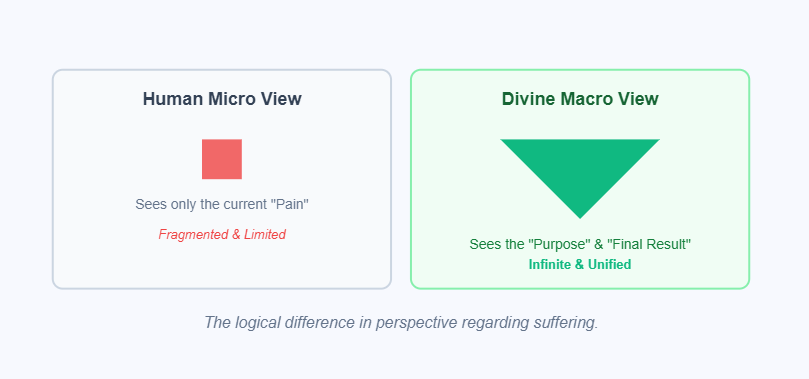
The primary logical hurdle in understanding suffering is the inherent limitation of human perception. We observe the universe through a narrow lens, seeing only a tiny fragment of time and space. In contrast, the Logic of Suffering in Islam is based on the absolute Knowledge (Ilm) and Wisdom (Hikmah) of the Creator, who is High above His Heavens and established over His Throne, encompassing all things in His sight and decree.
Imagine a person observing a surgeon cutting open a patient’s abdomen. Without the context of the surgery, this act appears as a brutal assault. However, with the knowledge that the surgeon is removing a life-threatening tumor, the act is recognized as one of supreme mercy and skill. Similarly, the Logic of Suffering in Islam suggests that many events we perceive as “evil” are necessary parts of a much larger plan decreed by the All-Wise (Al-Hakim). While our limited minds may not grasp the immediate reason, we trust in the perfection of Allah’s actions. This aligns with the Concept of God in Islam as the Sovereign Lord whose actions are always rooted in perfect knowledge and justice, and “He is not questioned about what He does” due to His absolute Wisdom.
The Purpose of Trial: Hardship as a Catalyst for Growth
If the purpose of human life were mere entertainment or comfort, then suffering would indeed be illogical. However, the Logic of Suffering in Islam asserts that Earth is not a resort, but a “testing ground” or a developmental laboratory. This world is a place where human potential is refined through challenge.
Logically, virtue cannot exist without the possibility of its opposite. Courage is impossible without fear; patience is impossible without annoyance; and charity is impossible without need. Suffering provides the “friction” necessary for the soul to develop these higher moral qualities. In Islamic logic, a life without hardship would result in a stagnant, unrefined humanity. By overcoming obstacles, the individual achieves a level of spiritual and psychological maturity that could never be reached in a state of perpetual ease. This refinement process is essential to the Sincerity of Prophet Muhammad, who faced extreme trials to prove the weight of his convictions.
Free Will: The Logical Necessity of Consequence
A significant portion of human suffering is a result of “moral evil”—crimes, wars, and injustices committed by humans. Skeptics often ask why God doesn’t intervene to stop every act of cruelty. The Logic of Suffering in Islam responds by pointing to the necessity of free will.
If God were to intervene every time a human intended to do harm, free will would become a mockery. For humans to be moral agents capable of choosing good, they must also have the capacity to choose evil. A world where God forced everyone to be “good” would be a world of robots, not humans. By granting us the dignity of choice, God logically allowed for the possibility of its misuse. The suffering caused by human hands is the price of human freedom. This freedom is what makes the Day of Judgment and Life After Death a logical necessity, as it is the only place where the misuse of free will is finally addressed.
The Contrast Principle: Light and Shadow
In philosophy and physics, many things are defined by their opposites. We only appreciate the value of health because we have experienced sickness; we understand the beauty of light because we have known darkness. The Logic of Suffering in Islam uses this contrast principle to deepen the human experience of grace.
Without the existence of pain, the concept of “relief” would be meaningless. Without the experience of loss, the value of “possession” would be diminished. This logical duality ensures that the human soul remains humble and appreciative. In Islamic thought, temporary suffering serves as a dark backdrop that allows the “Divine Signs” and blessings to shine more brilliantly. This is a recurring theme in the Authenticity of the Quran, which constantly invites humans to reflect on the alternating states of the day and night, life and death, and hardship and ease.
Expiation of Sins: The Logic of Spiritual Cleansing
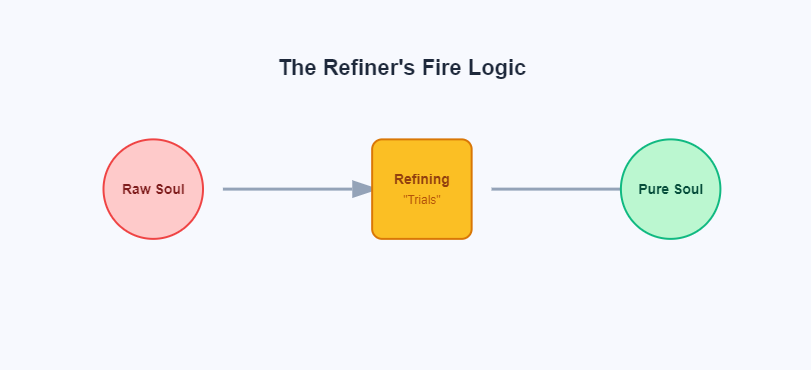
From an Islamic legal and spiritual perspective, suffering is often a form of “divine cleansing.” The Logic of Suffering in Islam suggests that hardships can act as a natural expiation for moral failures or sins. Just as heat is used to purify gold from its dross, life’s trials are used to purify the human character.
The Prophet Muhammad taught that even the prick of a thorn experienced by a believer serves as a means for God to remove some of their errors. This logic provides a powerful psychological coping mechanism: it transforms “meaningless pain” into “meaningful purification.” For a rational mind, this framework ensures that no suffering is wasted; every ounce of pain has a “utility” in balancing the individual’s moral account before they enter the next life. This perspective is vital for maintaining Islam and Human Rights, as it emphasizes that every individual’s struggle has inherent value.
The Relative Nature of Time: This Life vs. The Eternal
When a child receives a vaccination, they cry because they perceive the needle as a total catastrophe. To the child, the five seconds of pain feel like an eternity. To the parent, those five seconds are negligible compared to a lifetime of health. The Logic of Suffering in Islam applies this same logic to the human lifespan.
Islamic theology argues that the seventy or eighty years of human life are like a split second when compared to the infinite nature of the afterlife. Any amount of suffering in this world—no matter how severe—becomes infinitesimal when weighed against the eternal bliss promised to the patient. From the perspective of Theodicy (the defense of God’s goodness), the brevity of the trial makes the reward an act of extreme divine generosity. In the Logic of Suffering in Islam, the scales of justice are not meant to be balanced in this life alone, but across the continuum of existence.
The Call to Collective Responsibility
Finally, the Logic of Suffering in Islam serves a social and sociological purpose: it triggers collective human compassion. The suffering of one individual or nation is a “call to action” for others. It is the catalyst for medical advancement, humanitarian aid, and social reform.
If there were no poverty, the pillar of Zakat (obligatory charity) in the Five Pillars of Faith would have no function. Hardship creates a “moral economy” where the rich can earn spiritual merit by helping the poor, and the healthy can serve the sick. This interconnectedness creates a society based on empathy rather than narcissism. Logically, a perfect world with zero suffering would be a world with zero opportunity for altruism and self-sacrifice.
Conclusion: Reconciling Pain with Purpose
The Logic of Suffering in Islam offers a nuanced and sophisticated response to the problem of evil. By combining the necessity of free will, the contrast principle, the Catalan of growth, and the promise of eternal compensation, Islam provides a worldview where pain is not a mistake, but a purposeful sign.
For the skeptical mind, this framework satisfies the demand for intellectual consistency. It does not deny the harsh reality of pain, but it refuses to accept the idea that pain is meaningless. When we understand the Concept of God as the Ultimate Wise and Just, suffering becomes a difficult but necessary chapter in a glorious story. Ultimately, the Logic of Suffering in Islam invites us to look at our scars not as evidence of a cruel universe, but as a map of our growth toward a higher reality.














Leave a Reply